
CAPC scorecard places Connecticut among top states; council eyes Medicaid payment, pediatric supports
Get AI-powered insights, summaries, and transcripts
Subscribe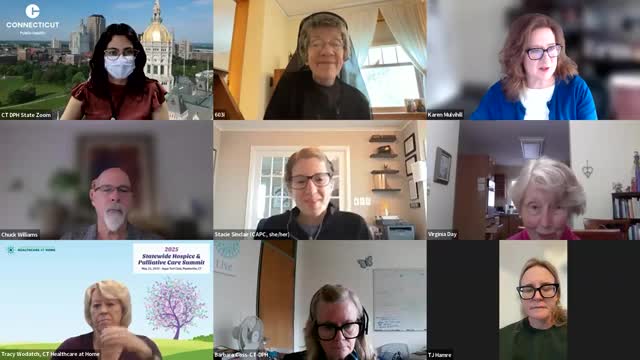
Summary
At a virtual meeting of the Connecticut Palliative Care Advisory Council, Stacy Sinclair of the Center to Advance Palliative Care (CAPC) reported that CAPC’s new Serious Illness Scorecard gave Connecticut a 7.5 out of 10 and identified Medicaid reimbursement and pediatric payment as leading areas for improvement.
Stacy Sinclair of the Center to Advance Palliative Care (CAPC) told the Connecticut Palliative Care Advisory Council in a virtual meeting that CAPC’s new Serious Illness Scorecard rates Connecticut 7.5 out of 10 — a score CAPC converts to 3.75 stars and then rounded up — placing the state among the top eight nationally for capacity to deliver or advance palliative care. "Connecticut got a 4 and I won't bury the lead," Sinclair said during her presentation, later adding, "your final score was 7 and a half out of 10."
The scorecard measures states across 10 indicators in five domains, including specialty palliative care availability, certified specialists per population, payment and insurance coverage, structured champions and advocacy, and education and community supports. Sinclair told the council CAPC preserved the prior metric on the proportion of hospitals with 50 or more beds that report a palliative care program, and added measures such as the number of certified hospice and palliative care professionals per 100,000 people, the presence of state legislation or regulation to expand specialty palliative care payment, whether the state's largest commercial insurer shows a unique serious-illness benefit, and training and continuing-education measures.
Sinclair highlighted specific Connecticut findings: the state scored above the median in specialty palliative care availability and in measures for building skills outside specialty palliative care, and it performed well on foundational supports including a Medicaid waiver beyond common waivers. CAPC's internal data showed 224.1 clinicians per 10,000 in Connecticut completed at least one CAPC course, a value the organization used in the training domain. Sinclair said CAPC could not find state legislation expanding payment for specialty palliative care in the most recent review and identified that gap as the biggest opportunity to raise Connecticut’s score in future editions.
Council members and stakeholders responded with program and policy follow-ups. Tracy Wodach, president and CEO of the Connecticut Association for Health Care at Home, introduced herself and asked how to compare state-by-state details on specific pillars such as Medicaid payment; Sinclair offered to provide targeted data and said she could pull a column showing which states have a Medicaid payment expansion. Toni Ann, a council member, reported progress on a workforce-related senate bill: she said the proposal "passed through the public health committee" and "passed there unanimously" in appropriations and is now on the consent calendar for the Senate.
Sinclair and council members discussed pediatric palliative work: council members reported an existing pediatric coalition and ongoing legislative work on pediatric reimbursement. Sinclair said CAPC will update its individual state report to reflect active coalitions and can revise the public deck; she also offered to share a sample questionnaire Kansas used to put palliative-care items into the CDC's Behavioral Risk Factor Surveillance System (BRFSS) and to provide the corrected slide deck.
Council staff from the Connecticut Department of Public Health (DPH) and others discussed using the BRFSS optional module to collect state-level data on palliative care and advanced care planning; a DPH representative agreed to follow up with the council offline about BRFSS contacts. Members also discussed community-based palliative care reporting: Sinclair said CAPC’s getpalliativecare.org directory currently provides the only reasonable source for community program locations but warned a sustainable national registry had proved expensive and the field would likely pursue smaller, lower-cost data collection efforts.
The meeting produced a mix of discussion, direction and small formal actions. Discussion items included detailed scorecard methodology, Connecticut's strengths and gaps, and program financing challenges for community palliative programs. Directions recorded in the meeting include CAPC agreeing to send an updated slide deck and the Kansas BRFSS module, CAPC offering a Medicaid-by-state table on payment expansion, and DPH staff following up on BRFSS contacts. A council member reported legislative progress on the workforce senate bill that has passed committees and sits on the Senate consent calendar. The meeting adjourned after a motion to adjourn was made and seconded.
The council scheduled its next meeting for June 6 at 9:30 a.m. and discussed using the scorecard results and CAPC materials to guide next steps on pediatric reimbursement, Medicaid payment advocacy, and outreach to DPH about BRFSS data collection. CAPC staff noted the scorecard will be updated periodically and invited members to send corrections or additional state information for future editions.