Get Full Government Meeting Transcripts, Videos, & Alerts Forever!
Get email alerts on the Land Use topic
No spam. Unsubscribe anytime.
Sayreville Planning Board continues Masjid Sadar review after traffic, parking and safety concerns; applicant to seek parking variance
Summary
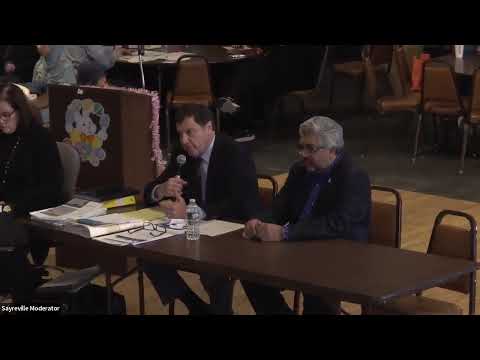
The Borough of Sayreville Planning Board continued its hearing on the Masjid Sadar Community Center site plan on April 16, 2025, after testimony about a reduced worship occupancy, new parking arrangements, traffic studies and residents99 safety concerns.
Sayreville94The Borough of Sayreville Planning Board continued its hearing on the Masjid Sadar Community Center preliminary and final major site plan for 2129216 Ernston Road on April 16, 2025, after hearing testimony on revised occupancy, parking and traffic controls and receiving extensive public comment about safety and neighborhood impacts.
The applicant told the board it reduced the planned worship occupancy and eliminated a mechanical stacked-parking system while offering an operations manual and off-site parking. Lauren Sachs, attorney for the applicant, said the plan now sets a combined occupancy of 321 worshipers and "we reduced it by approximately 30%, and now we have an occupancy of 321," with marked prayer mats and aisles to fix how people will be arranged inside the prayer halls. Sachs also said the applicant removed the stacked parking lifts and would provide 107 on-site spaces required under the borough99s parking calculation for the prayer mats.
The reduction in capacity and other conditions were offered as mitigation for what board professionals and residents called a tight site and a high-risk traffic location. Traffic engineer William Stimmel (testifying for the applicant) described multiple traffic-counts and driveway analyses and said those analyses showed driveway operations at the proposed site would be "level of service D or better" during the busiest periods, and that with police directing traffic Fridays the driveway LOS would improve further. Stimmel also testified that counts at the congregation's current location at Madison Park Volunteer Fire Company showed roughly 2639270 persons at both Friday services combined on the dates measured.
Why it matters: the project replaces a smaller, existing house of worship with a 43,000-square-foot community center that includes two prayer halls, a gym, classrooms and ancillary spaces. Board members, residents and reviewers focused on whether the site plan and the applicant99s operational limits will prevent off-site parking and unsafe crossing behavior at the nearby county road intersection.
What the applicant offered and agreed to - Occupancy: total prayer-hall capacity limited to 321 worshipers (men's and women's halls combined). Sachs told the board the plan shows specific prayer mats and aisles, which she said enforces the occupancy limit. - Parking and circulation: 107 on-site parking spaces to meet the borough99s calculation for the prayer mats; the applicant eliminated stacked parking lifts and valet operations from the plan. The team said they have a lease for additional off-site parking at 3 Johnson Place (described in testimony as 22 spaces) and the use of Samsel (Sam Sel) Upper Elementary School for overflow during Ramadan and Eid. - Police traffic control: the applicant agreed that Sayreville police will direct and monitor traffic on Friday afternoons, during Ramadan and for special events when needed. - Operating rules: an operations manual (entered as exhibits) that restricts use of the gym, exercise rooms, classrooms and multipurpose hall during prayer services; scheduled hours for recreational uses; limits on attendance for non-prayer activities; and a quarterly calendar of typical prayer start and end times. - Monitoring: the applicant agreed to provide updated studies and to return to the board for as-constructed evaluations and additional traffic analysis if problems occur after occupancy.
Professional reviews and unresolved technical issues - Applicant99s traffic expert, William Stimmel, summarized a sequence of counts and analyses (May 17, 2024 and January 17, 2025 counts at the firehouse and an April 1, 2025 driveway analysis). He said the Friday midday peak was analyzed as 107 vehicles entering and exiting in the peak hour and that driveway operations would be acceptable; with police traffic directors at the driveway the peak-hour driveway performance improved. - Joe Fischinger of BrightView Engineering, the borough99s traffic reviewer, questioned how the ordinance99s seat-based parking metric (1 space per 3 seats) applies to mosques that use prayer mats, and he noted real-world counts at the firehouse better reflect vehicle occupancy patterns. Fischinger told the board he expected about "270 persons at the site between the two services on a Friday" based on counts and that vehicle occupancy and turnover patterns matter for peak-hour demand. - CME and other engineering reviewers asked for standard site-plan corrections (grading, drainage, turning templates, stormwater, sanitary-service coordination, striping and signage), and the applicant99s engineer and architect agreed to comply or work with board professionals.
Public comment and safety concerns Residents were the most frequent speakers in public comment and raised multiple concerns: traffic backups on Ernston Road and Bordentown Avenue, pedestrian safety crossing the county road to reach off-site parking, the reliability and longevity of the off-site lease for 3 Johnson Place, construction vibration and dust effects on nearby homes, and whether the 107 on-site spaces plus any off-site spaces would be sufficient if attendance grew.
Several speakers said they had personally observed much higher parked-car counts at the firehouse site than the applicant's spreadsheet suggested. One resident asked whether a shuttle or crossing guards might be needed to move people safely from off-site lots. The board asked the applicant to consider those options; Sachs said the applicant would explore additional measures such as off-duty crossing guards or additional police detail if needed.
Board action and next steps The board did not vote on the Masjid Sadar application on April 16. Board counsel indicated privately during the hearing that, after review, a parking variance would be necessary; the applicant confirmed it will seek a variance. The board carried the application to its next hearing, set for May 7, 2025, and instructed the applicant to supply revised exhibits and to be prepared to respond to outstanding engineering and traffic comments.
What was not decided There was no final approval or vote on the site plan, and the board did not grant a parking variance on April 16. The applicant did not rest its full case; counsel reserved the right to present additional expert testimony and the applicant agreed to return with its planner and any supplemental materials.
Bottom line The applicant reduced the planned prayer-hall occupancy, removed mechanical stack parking, produced an operations manual and traffic analyses and agreed to police-directed Friday traffic control and other conditions. Residents and reviewers, however, pressed the board for stricter assurances about on- and off-site parking, pedestrian safety at the nearby county intersection and construction impacts. The application remains pending; the board scheduled continued hearings and the applicant will seek a parking variance at a future meeting.
Ending note The Planning Board scheduled the matter for continued public hearing on May 7, 2025; residents and the applicant were told to be prepared to present revised exhibits and additional testimony.