
Committee advances amended paid‑leave bill that lets Department set weeks by fund solvency, adds actuarial studies
Get AI-powered insights, summaries, and transcripts
Subscribe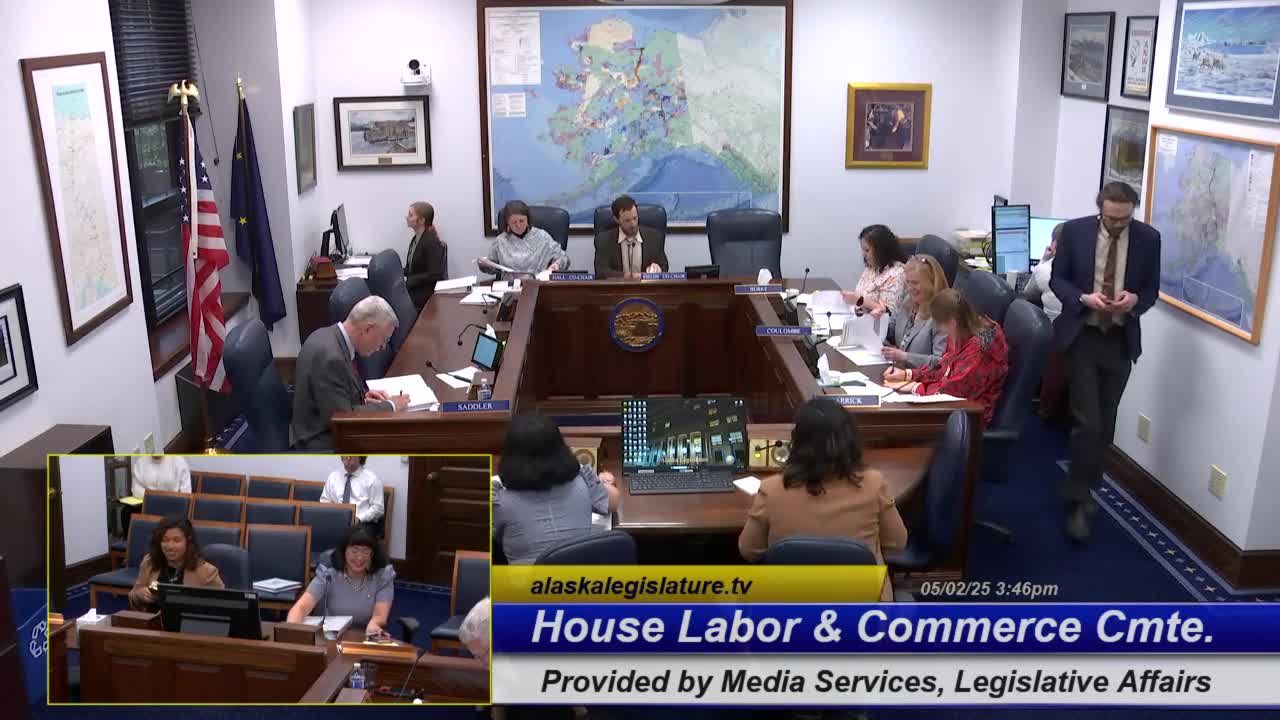
Summary
The House Labor and Commerce Committee advanced an amended paid‑leave bill that lets the Department of Labor set annual weeks between 8 and 26 based on fund solvency, requires actuarial studies, and includes funding and technical changes; the committee voted to report HB193 out as amended.
The House Labor and Commerce Committee on Thursday advanced House Bill 193 as amended, a wide-ranging bill to create a paid parental‑leave program funded through the state’s unemployment insurance architecture. The committee adopted a series of amendments that let the Alaska Department of Labor and Workforce Development set annual benefit duration based on the fund’s actuarial solvency, require actuarial studies, create an accelerated‑benefit option, and make several technical and funding changes. After amendment votes and discussion the committee voted to report HB193 out of committee as amended.
Representative Paul, the bill sponsor, and Department of Labor staff described the central change adopted in amendment 1: the department may set the number of weeks of parental leave a claimant may take each year within a statutory range (8 to 26 weeks) based on the fund’s solvency. The amendment also added an “accelerated benefit” option so a claimant can receive the full value of the benefit over half the duration (for example, full wage replacement for half the weeks instead of partial replacement over more weeks). The amendment directs the department to conduct actuarial studies on the new paid‑leave fund similar to those performed for the UI trust fund and allows the department, under actuarially sound conditions, to divert up to 0.1 (0.1 percentage point) from employer UI contributions into the paid‑leave fund and to reduce the employer contribution rate as low as 0.5 when consistent with UI fund soundness; sponsors said that mechanism could enable a 20% employer contribution reduction contingent on solvency.
Department economist-actuary Lennon Weller explained the actuarial framework the department would use to set rates and benefits. “We… look at costs as a percentage of wages covered,” Weller said, and noted the UI system’s statutory target reserve ratio is 33.3 percent of covered wages; the department’s analysis would consider costs, reserve ratio and solvency when setting rates. Weller and department staff said the bill’s timeline sets an effective program disbursement date of Jan. 1, 2027 to allow the fund to build before benefits are paid.
The committee approved other amendments that change program design and implementation. Amendment 3 required future inflation adjustments for specified figures (base period wages, dependent allowance, weekly benefit amounts and parental‑leave benefits). Amendment 4 adjusted the income cap for eligibility (raising it to $70,000 where the bill had a lower cap). Amendment 10 removed the option for self‑employed workers to elect coverage (the department estimated that change reduced the fiscal note by roughly $700,000). Amendment 11 updated the dependent allowance from $23 to $72 (not to exceed $216 per individual). Amendment 12 added qualifying language to allow leave when a person becomes a legal guardian or adoption is finalized, including tribal‑court proceedings, and clarified acceptable documentation.
Committee discussion repeatedly returned to solvency and administrative details. Weller said initial administration and IT costs to collect contributions and run the program were large but manageable: a one‑time benefit‑payment system implementation and ongoing administration estimated in the committee discussion at roughly $875,000–$900,000 per year, plus a tax‑collection cost estimated at about $675,000 in an initial year. The committee also heard a fiscal estimate that providing 26 weeks for all eligible workers would carry a substantially larger fiscal cost (the department’s fiscal-note estimate discussed in committee placed a 26‑week rollout cost near $175,000,000 in one cited estimate).
Committee members debated program scope. Representative Sadler and Cochair Hall both voiced caution about expanding benefits immediately; Hall opposed an amendment (amendment 7) that would have broadened the program to cover additional family‑medical leave uses, and that amendment failed on a 2–4 recorded vote. Supporters said the plan balances parental leave goals with the need to protect UI fund solvency.
On the procedural record, amendment votes included recorded roll calls for several items: amendment 3 passed 5 y‑es to 1 n‑ay; amendment 7 (which would have expanded coverage to broader family medical leave) failed 2 y‑es to 4 n‑ays; amendment 8 (a change raising the salary table) passed 5 y‑es to 1 n‑ay. Other amendments passed by voice or unanimous consent after discussion and technical fixes. The committee voted to report HB193 out of committee as amended with accompanying fiscal notes and recommendations.
What’s next: The committee sent HB193 out of committee as amended; the bill’s effective provisions for disbursement are set to start Jan. 1, 2027 and the department is required to do actuarial study and set initial benefit levels in advance. Members said legislative legal staff may make technical and conforming changes to match adopted amendments.