Get Full Government Meeting Transcripts, Videos, & Alerts Forever!
Get email alerts on the Critical Minerals topic
No spam. Unsubscribe anytime.
Senate adopts bill defining rare earths in coal, sets 2.5% minimum royalty amid heated debate
Summary
The North Dakota Senate passed House Bill 1459 to treat rare earth elements chemically bound to coal as part of the coal estate and to set a minimum 2.5% gross‑revenue royalty; the measure drew prolonged floor debate over retroactivity and interfering with existing leases.
The North Dakota Senate on a floor vote passed House Bill 1459, a measure that declares rare earth elements and critical minerals chemically bound to coal part of the coal estate, sets a minimum 2.5% gross‑revenue royalty for minerals extracted during mining, and provides retroactive application intended to protect mineral owners.
Supporters said the bill gives legal clarity needed for private investment and for the state to remain a leader in domestic rare‑earth production. "House Bill 14 59 deals with rare earth elements and critical minerals," Senate Bill carrier Senator Patton said, adding the measure "establishes that fly ash that is produced is a product of a coal conversion facility, belong to the operator of that facility" and that the bill "sets a minimum royalty of 2 and a half percent of gross revenue, if refined during the mining process." He urged senators to vote aye.
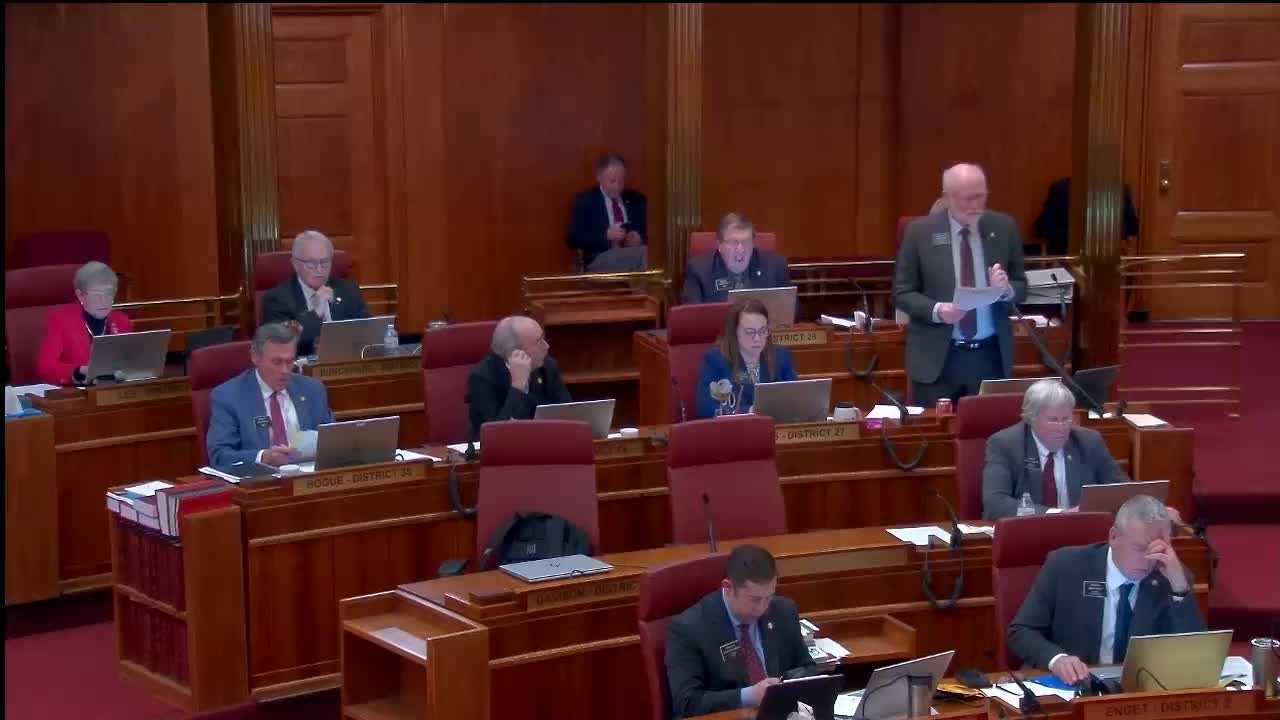
Opponents warned the measure reaches into private contracts and that retroactive application could be unconstitutional. "This is not the same bill that we I voted on this bill when it was over here, and this isn't the same bill," Senator Magram said on the floor, arguing the conference report rewrote prior language and lacked the hearings some senators expected. Senator Powers also criticized what he called retroactive changes to lease agreements.
Why it matters: Supporters and conferees said the bill addresses a legal gap about whether rare earths in coal belong to mineral owners or coal lessees and provides a statutory policy for courts to consider in inevitable litigation. Backers said establishing that the minerals are part of the coal lease at the time of mining gives mineral owners an opportunity to capture value; without it, they said, value could be consumed by downstream uses such as fly ash products.
Key provisions and details
- Definitions and property rules: The bill declares rare earth elements and critical minerals that are chemically bound, embedded, commingled, included, or contained within a coal seam or deposit to be part of the coal estate unless specifically excluded from a coal lease.
- Fly ash and facility product: The bill states that fly ash produced by a coal conversion facility is a product of that facility and belongs to the operator of the facility.
- Royalty floor: A minimum royalty of 2.5% of gross revenue is set if the rare earth elements are refined during the mining process; supporters described the figure as a midpoint among western states' hard‑rock rates and noted it was set on gross revenue to provide certainty for investment.
- Retroactivity: The measure includes retroactive language intended to enable mineral owners to receive value even where coal has already been mined and transferred to power plants, a point sponsors said is necessary to protect mineral owners and to make new processing investments financeable.
Floor debate and legal context
Senators pressed on whether the bill improperly interferes with existing leases. Several senators said prior positions had held the legislature should not rewrite existing lease contracts; conferees and supporters disagreed, saying mineral law and contract principles require consideration and that ownership does not transfer until consideration is given at the time of extraction. Senator Sickler noted the subject is "incredibly complex" and novel: "North Dakota right here, this debate we are having is on the cutting edge of this type of law on rare earth elements," and said the bill frames issues so courts will rule with legislative guidance.
Supporters said the legislature had consulted the attorney general's office, title attorneys, the governor's counsel and industry representatives. Opponents pressed concerns about retroactivity, contract interference, and the speed of conference committee changes.
Votes and procedural steps
- The Senate adopted the conference committee report on House Bill 1459 (tally reported on the floor: 48 yea, 6 nay, 1 absent).
- On final passage, the Senate approved the bill 27 yea, 19 nay; the emergency clause failed.
Distinct outcomes and follow‑ups
The bill sets state policy; conferees acknowledged litigation is likely and said the statute is designed to provide a legislative position for courts to interpret. Sponsors said additional statutory work and implementation details can follow once legal positions are clarified.
Speakers quoted and notable attributions in this article are drawn from the Senate floor transcript of the session that considered House Bill 1459.