Get Full Government Meeting Transcripts, Videos, & Alerts Forever!
Get email alerts on the Behavioral Health Funding topic
No spam. Unsubscribe anytime.
Task force: Oregon’s behavioral health funding fragmented; staff to map flows and report in July
Summary
Legislative task force heard an ElPro briefing showing Oregon mixes Medicaid, county agreements and one‑time grants to pay for behavioral health services, but lacks shared data and coordination. Members asked staff to prepare maps, best practices and a July update and noted no immediate policy votes.
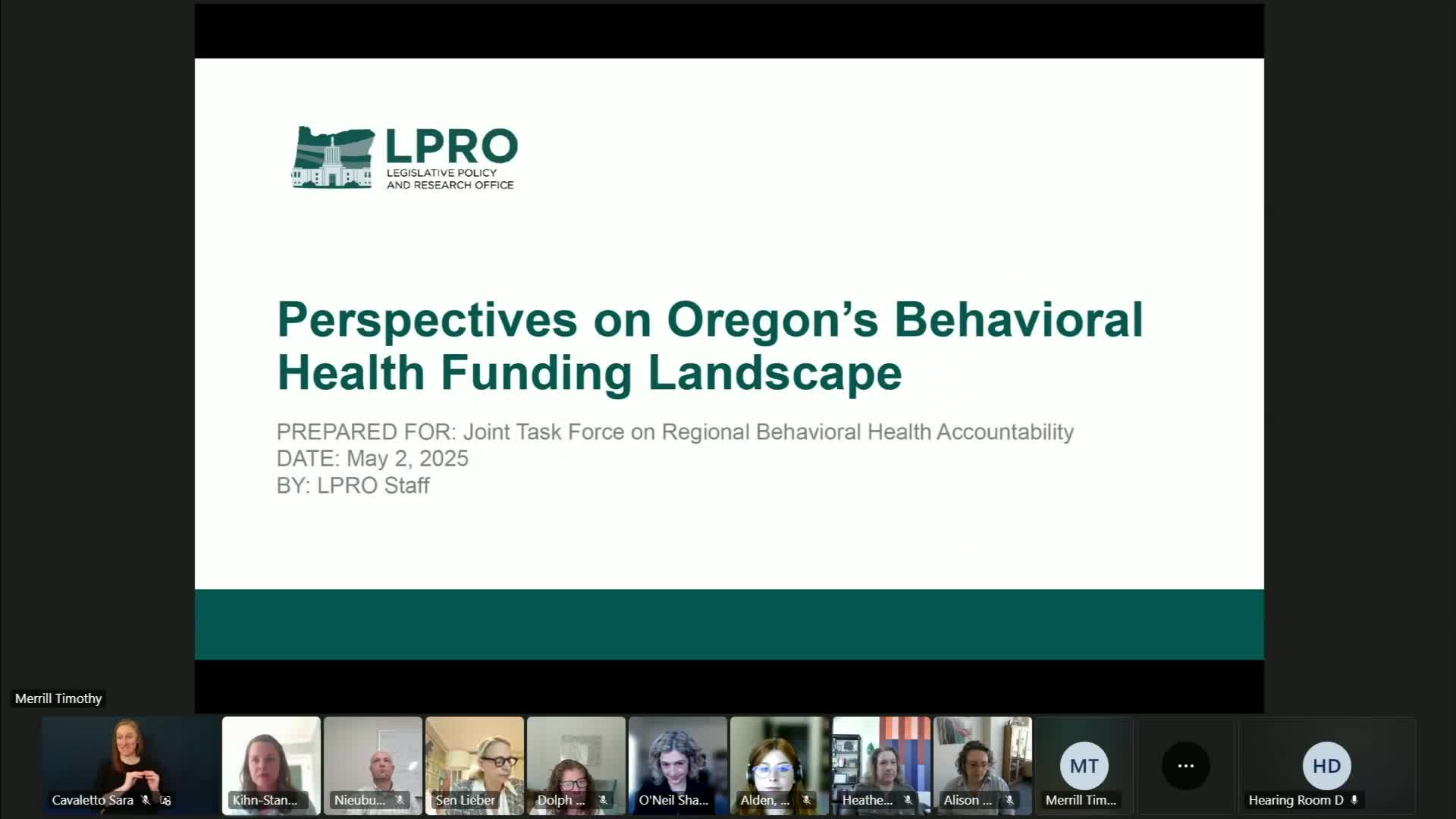
Senators, representatives and task force members heard a briefing June 15 that described Oregon’s behavioral health financing as a braided set of Medicaid reimbursements, county financial assistance agreements and a variety of one‑time or restricted grant funds that together pay for services — but that lack a shared data foundation for coordinated decision making.
"Oregon is braiding and blending together funds from a variety of different sources," said Shauna O'Neil, a senior research analyst with ElPro, summarizing interviews staff conducted in March. "Decision makers are frequently trying to target their funds toward filling gaps in the delivery system, but ... there really are key pieces of information missing that would be needed in order to truly employ that kind of a gap analysis approach to decision making."
Task force members said the finding matched their experiences: providers and county partners described unpredictable payment streams and administrative burdens that make it hard to sustain services, while governance boards and federal grant rules can restrict how one‑time funds are used.
O'Neil told the Joint Task Force on Regional Behavioral Health Accountability that ElPro organized its review around three aims: (1) identify primary funding conduits in Oregon's behavioral health system, (2) describe how decisions are made about those conduits, and (3) surface challenges and opportunities experienced by decision makers. Staff compiled a list of conduits that included CCO contracts, county financial assistance agreements (CFAAs), federal grants such as SAMHSA block grants, opioid settlement dollars, Measure 110 grants and other state or local revenues.
The briefing lifted several recurring themes from interviews with state and local leaders: wide variation in how coordinated care organizations (CCOs) and community mental health programs (CMHPs) approach behavioral health payment and integration, lengthening prior‑authorization or eligibility processes under Medicaid that can lead to client disengagement, and use of short‑term grant dollars to patch gaps that Medicaid or CFAA funding does not reliably sustain.
"Providers are struggling with a lack of predictability in the funding landscape," O'Neil said. "They would like OHA to be more directive to CCOs," she added, while also noting Oregon Health Authority staff must balance direction from the Centers for Medicare & Medicaid Services (CMS).
Several members stressed the difference between filling fiscal gaps (making up for inadequate reimbursement) and filling service or network gaps (creating services that do not yet exist). O'Neil noted some grant programs explicitly target services without other payment sources and therefore are not easily braided with Medicaid revenue.
"We are literally under coordinated," said Senator Lieber, co‑chair of the task force, describing how different regions and decision bodies manage funds in distinct ways. Lieber asked staff to return in July with more detail, including mappings of delivery regions and funding flows and a review of best practices.
Judicial concerns surfaced during discussion. Judge Nan Waller said her forensic population — people in the aid‑and‑assist and mental health court systems — regularly faces gaps not only of services but of clear responsibility. "Who has the responsibility?" Waller asked. "Who ultimately is the authority that's responsible?"
Task force members and staff also raised practical next steps. Staff agreed to compile additional information for the July 7 meeting, including: overlays of CCO regions, county boundaries and trauma regions; a summary of relevant statutory, contractual and regulatory alignments; and examples of best practices inside and outside Oregon. Brian (LPRO staff) said the team will also summarize what legislation affecting these topics passes in the current session.
Several participants recommended a centralized clearinghouse for fiscal information so decision makers could see which entities receive which funds and reduce duplicate reporting. The Public Consulting Group's earlier inventory of substance‑use funding was cited as aligning with that recommendation.
On specific funding details, members and staff repeatedly noted limits in the presentation: ElPro did not produce a fiscal tally of total dollars flowing through each conduit and deferred that analysis to the Legislative Fiscal Office. Members also flagged particular streams and constraints discussed in interviews: SAMHSA block grants are intended to cover services without another source; opioid settlement dollars are subject to Department of Justice agreements; Measure 110 grants and cannabis tax revenue are unstable or subject to programmatic restrictions; and some CFAA elements are tied to federal block grants and cannot be used to supplant Medicaid billable services, a restriction noted by task force member Ebony Clark.
No motions or votes were taken during the meeting. Staff framed the briefing as preliminary and sought input on what additional details would most help the task force meet its statutory deliverables: a draft report due Sept. 15 and a final report due Dec. 15.
The task force's next meeting is scheduled for July 7, when staff will return with requested mapping and statutory summaries. Members signaled support for incremental, legislatively feasible steps to improve coordination while acknowledging federal funding uncertainty could change options later this year.