Get Full Government Meeting Transcripts, Videos, & Alerts Forever!
Get email alerts on the Teachers Retirement System topic
No spam. Unsubscribe anytime.
Teachers Retirement System posts gains; Senate Bill 9 limits common‑leave credit costs and House bills shift health‑trust contributions and return‑to‑work rules
Summary
Beau Barnes, deputy executive secretary and general counsel for the Teachers Retirement System, reported multi‑year investment returns that exceed TRS assumptions and outlined enacted statutory changes to sick‑leave retirement credit, health trust funding reallocation, and return‑to‑work rules.
Beau Barnes, deputy executive secretary and general counsel for the Teachers Retirement System (TRS), told the Public Pension Oversight Board that TRS investment returns exceeded the fund’s assumed rate over most multi‑year horizons and that the system’s cash‑flow position and asset allocation remain the primary drivers of near‑term funding metrics.
Why it matters: TRS manages both retirement annuity and retiree health insurance trusts for Kentucky teachers; enacted statutory changes adjust how sick‑leave credit is funded and change when and how certain employer contributions move between the health insurance trust and the retirement annuity trust, which can alter long‑term funding dynamics.
Investment performance and funding: Barnes reported net returns (net of fees) for the retirement annuity trust as of March 31, 2025: quarter +0.22%, fiscal‑year‑to‑date +4.49%, one‑year +5.41%, five‑year +11.24%, 10‑year +7.67%, 20‑year +7.3%, and 30‑year +7.95%. He noted the retirement annuity trust and the health insurance trust have an assumed rate of return of 7.1%.
Cash flow and asset totals: For the July 1, 2024–Feb. 28, 2025 reporting period Barnes gave detailed cash flows. TRS reported total cash inflows for the retirement annuity trust of about $1.507 billion over that eight‑month period and total cash outflows of roughly $1.71 billion, producing a negative operating cash flow of $203.9 million; investment gains (realized and unrealized) offset that and led to an increase in market value from about $26.108 billion on July 1, 2024, to about $27.360 billion on Feb. 28, 2025. For the health insurance trust he reported inflows of about $461 million and outflows of about $278 million over the same period, leaving a positive net cash flow and an increase in trust assets from $3.3177 billion to $3.6736 billion.
Asset allocation: As of Feb. 28, 2025 TRS remained within each target asset‑class range approved by the investment committee; U.S. equity comprised about 39.8% of the retirement annuity trust versus a 38% target.
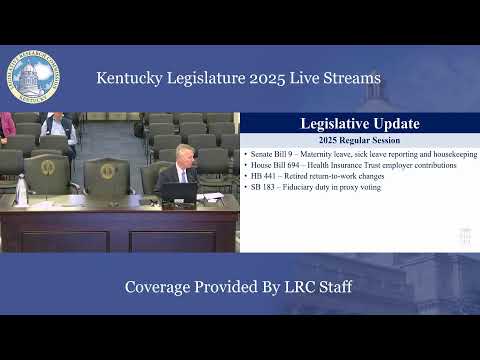
Legislative changes summarized by Barnes included: - Senate Bill 9: amended Department of Education sick‑leave rules and the statutory treatment of employer‑paid sick‑leave salary credit for retiring teachers. From July 1, 2024 forward, the commonwealth will pay actuarial costs only for up to 13 sick‑leave days per year awarded to teachers; any sick days above that limit or annual‑to‑sick leave rollovers will be the responsibility of the school district prospectively. The bill also requires school districts to report sick‑leave balances and provide TRS with their sick‑leave policies. - House Bill 694 (shared‑responsibility and reallocation): Barnes said the law provides that once the health insurance trust reaches at least 100% funded, certain employer contributions that previously flowed to the health trust (including a 0.75% statutory employer portion and certain university and district shared contributions) will be reallocated to the retirement annuity trust until funding triggers reverse reallocation (if the health trust falls below 95%). Employee contributions to the health trust will continue until both trusts reach specified funding levels. - House Bill 441 (return‑to‑work changes): the bill increases statewide caps on the number of retirees who may return to full‑time work from 3% to 10% (and raises several caps within the critical‑shortage program), removes a prior certification requirement that no other qualified applicant exists before hiring a retiree into a critical shortage role, and repeals the waiver program that allowed retirees to waive benefits to return to work under specific conditions.
Barnes also noted TRS investment policy and proxy‑voting approach are consistent with recently enacted Senate Bill 183; TRS says it invests for pecuniary reasons and does not pursue non‑pecuniary ESG objectives.
Questions from members touched on the funding mechanics: Representative Tipton asked about the percentage cost to maintain the health insurance trust once fully funded; Barnes replied it was substantially lower and estimated in the 2–3% range but said he did not have an updated precise number. Senator Funke Frohmeyer asked about year‑to‑year differences in the health trust’s investment gains; Barnes pointed to differing asset‑class mixes between the retirement and health trusts as a plausible driver. A member asked about PBM rebate collection for the health trust; Barnes said Express Scripts administers rebate collection and auditing as part of the contract and TRS cooperates with that vendor.
TRS did not present or adopt any new board motions during the session; legislative housekeeping and implementation planning will proceed with staff and the General Assembly’s enacted provisions.