Get Full Government Meeting Transcripts, Videos, & Alerts Forever!
Get email alerts on the Kpaa Legislation topic
No spam. Unsubscribe anytime.
KPPA reports modest gains; House Bill 30 and Senate Bill 10 change pension‑spiking and CERS retiree health subsidies
Summary
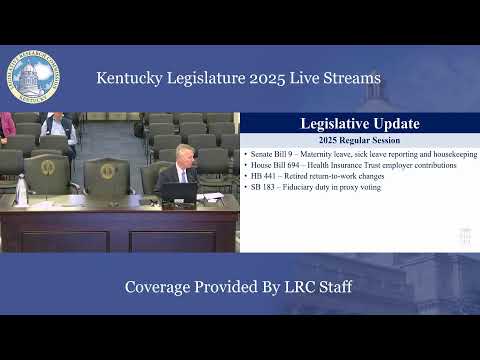
KPPA staff reported positive short‑term investment results and outlined two enacted bills: House Bill 30 (pension‑spiking definition) and Senate Bill 10 (increasing health insurance dollar subsidies for CERS career retirees and adjusting HIC contributions).
Ryan Barrow, of the Kentucky Public Pensions Authority (KPPA), and Erin Serrato, KPPA’s executive director of the Office of Benefits, gave the Public Pension Oversight Board a quarterly investment and legislative update, saying the funds produced modest positive returns but remained below some long‑term benchmarks in parts of the portfolio.
Why it matters: the two enacted bills discussed change how certain pay increases count toward retirement calculations and increase dollar health subsidies for members of the County Employees’ Retirement System (CERS). The provisions will affect eligibility thresholds, benefit dollar amounts and some employee contribution rules beginning in 2026.
House Bill 30: Serrato summarized the pension‑spiking change. The bill, enacted after a Court of Appeals ruling, amends the definition of a bona fide promotion or career advancement so that across‑the‑board pay increases given to a specified class of employees are excluded from the pension‑spiking calculation. Serrato said the change applies across systems administered by KPPA, including CERS, KERS and SPRS, and that an administrative regulation had already been implemented for retirement dates on or after July 1, 2024.
Senate Bill 10: KPPA described this measure as expanding the non‑Medicare monthly dollar health subsidy for CERS career retirees. KPPA said the bill sets effective dates and dollar amounts: effective Jan. 1, 2026, hazardous Tier 1 members who meet a 20‑year career threshold would receive $50 per month per year of service (up from a much lower statutory amount); hazardous Tiers 2 and 3 must reach 25 years for the higher subsidy; nonhazardous career thresholds are 27 years with a $40 monthly per‑year‑of‑service subsidy. KPPA also said that, effective July 1, 2026, certain CERS Tier 1 members who previously did not pay the HIC (health insurance contribution) will begin paying it, and hazardous HIC rates will increase from 1% to 2%; the nonhazardous HIC rate remains 1%.
KPPA staff said they are still evaluating implementation details, including how service accumulated in one system and later in another will count toward career thresholds; they confirmed shared reciprocity between systems means service generally can be added together for eligibility. On purpose, Barrow said the subsidy changes are intended to reduce out‑of‑pocket premium costs for eligible members by covering more of a single‑coverage premium once a member reaches the career threshold.
During Q&A, Representative Tipton asked about how service across systems would be treated; Barrow said reciprocity would be considered in implementation. Representative Johnson asked for clarification on the member benefit impacts; Barrow summarized the subsidy‑coverage intent. Representative Camille asked whether House Bill 30 was retroactive; Serrato said the administrative regulation has been applied to retirement dates July 1, 2024, and after.
KPPA also noted Senate Bill 183 (the proxy‑voting economic‑analysis measure discussed earlier) and said its staff will review existing voting policies to incorporate any new requirements. KPPA did not present any formal motions or votes at the meeting.