Get Full Government Meeting Transcripts, Videos, & Alerts Forever!
Get email alerts on the Public Pensions topic
No spam. Unsubscribe anytime.
Judicial Forum Retirement System reports strong short‑term gains; SB 183 would require economic analyses for proxy votes
Summary
Beau Craycraft told the Public Pension Oversight Board the Judicial Forum Retirement System showed fiscal‑year‑to‑date outperformance through March, warned of negative cash flow driven by lower employer contributions, and summarized Senate Bill 183, which would require an economic analysis when the plan’s provider votes against management.
Beau Craycraft, executive director of the Judicial Forum Retirement System, told the Public Pension Oversight Board that the system posted fiscal‑year‑to‑date gains through March and outperformed its benchmark, but cautioned the plans remain on a negative cash‑flow trajectory tied to lower employer contributions.
Craycraft said the plans were up “just over 11%” fiscal‑year‑to‑date versus an index return of about 4.5%, with most relative outperformance concentrated in the first quarter of 2025. He credited Baird Trust, the plans’ sole investment provider, with preserving capital during the recent market decline. “Our model is unique,” Craycraft said, noting long‑term compounded returns near the high single digits over 20‑ and 30‑year horizons for the partnership with Baird Trust.
Why it matters: the Judicial Forum plans pay benefits to retired judges and are smoothed on multi‑year actuarial schedules. Investment gains can mask an underlying operating deficit when employer contributions decline; trustees and legislators use these updates to judge funding risks ahead of budget decisions.
Craycraft said the portfolio targets roughly 70% U.S. equity and 30% fixed income and that Baird Trust has been underweight large information‑technology names nicknamed the “Magnificent 7,” which helped in the recent down market. He also said the plan currently holds about 26 individual equity names, a concentration that reduces the number of proxy votes it must manage compared with large indexed portfolios.
On cash flow, Craycraft said the Judicial Retirement Plan (JRP) saw a noticeable decline in inflows driven by a lower employer contribution rate in the current budget biennium; benefit payments were slightly lower year‑over‑year only because 2024 included several one‑time refunds. He summarized: after investment gains, plan assets rose in the reported period, but “if 2025 continues, you’re going to probably see that unrealized gain come down and then we would see the asset base drop as well.”
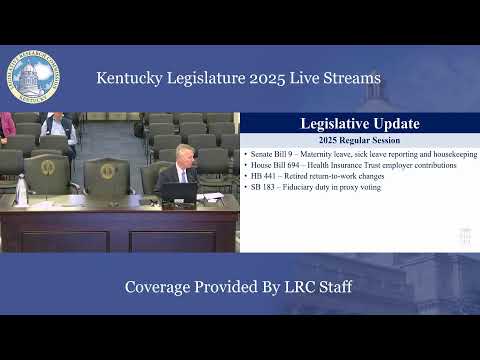
Craycraft reviewed Senate Bill 183, legislation that would add definitions such as “shareholder‑sponsored proposal” and require an economic analysis when an investment manager votes against company management. He said Baird Trust and the plan do not expect “a real significant or real material impact” from the bill because the plan’s concentrated portfolio limits the number of contested votes and because Baird Trust says it follows a long‑term, business‑owner investment philosophy.
During questions, Senator Funke Frohmeyer asked whether the cash‑balance plan returns represented a rate of return or a cash‑balance accounting pool; Craycraft explained the retirement system maintains two accounting pools—legacy defined‑benefit assets and a separate post‑2014 cash‑balance pool that initially used ETFs and later moved into the consolidated portfolio as assets grew. Senator Wilson asked for current funding and participant counts; Craycraft said the most recent full valuations were done in 2023 and that the plans exceeded 100% funding in those valuations. He estimated about 500 beneficiaries on the JRP side and roughly 300 on the LRP side drawing benefits.
The presentation closed with Craycraft noting board materials are available on the system website and that Baird Trust discussed the frequency and historical depth of market drawdowns at its most recent quarterly briefing.
The Public Pension Oversight Board did not take formal action on investments or the bill during this meeting.