
State education committee hears Johnstown officials and parents on rising cyber-charter costs
Get AI-powered insights, summaries, and transcripts
Subscribe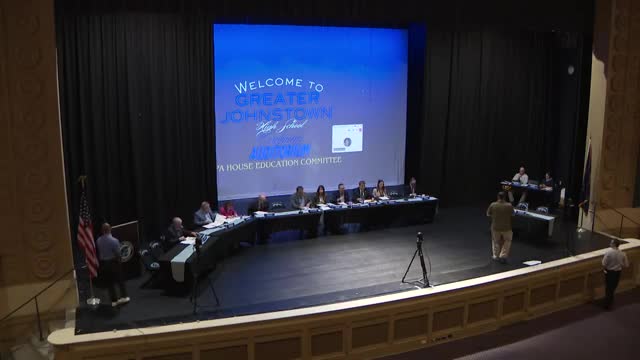
Summary
State lawmakers heard sharply different accounts Wednesday in Johnstown about the fiscal and educational impacts of cyber charter schools as testimony focused on rapidly rising tuition payments, special‑education costs and calls for funding reform.
State lawmakers heard sharply different accounts Wednesday in Johnstown about the fiscal and educational impacts of cyber charter schools as testimony focused on rapidly rising tuition payments, special‑education costs and calls for funding reform.
Rob Gleason, president of the Westmont Hilltop School Board of Education, told the House Education Committee that his rural district now pays roughly $1.2 million a year to third‑party cyber charters for 79 students and that the program’s outcomes and costs worry local leaders. “The practice of repeating students is a very expensive” burden, Gleason said, and he noted that Westmont Hilltop provides school counselors at a ratio of less than 300:1, a social worker, two school psychologists and a behavioral specialist—services he said many cyber charter students do not receive.
Michael Dady, assistant to the superintendent for the Greater Johnstown School District, said Johnstown’s cyber tuition has increased sharply in recent years and that the district struggles to plan because the payments are unpredictable. He told the committee that Johnstown paid $3,937,760.89 in cyber‑school tuition in 2023–24 and projects $6,931,917.85 for 2024–25. “Every dollar spent on gift cards and advertising came from Pennsylvania taxpayers, largely from local property taxes paid by families and businesses in our district,” Dady said, referencing expenditures described in testimony.
Hannah Barrick, executive director of the Pennsylvania Association of School Business Officials, told the committee that the state’s charter‑tuition calculation is based on school districts’ budgeted expenditures, not cyber charter operating costs. “The underlying tuition calculation is based entirely on school district costs,” Barrick said, describing how that method yields 500 separate tuition rates and drives year‑to‑year increases when districts’ budgets, special‑education expenditures or enrollment denominators change.
Barrick outlined policy options discussed by school finance officials, including a single or blended per‑pupil rate, annual growth caps tied to the Act 1 index for predictability, or a longer‑term shift of cyber tuition payments to the state. She supported the recent partial reimbursement program, noting a $100 million cyber reimbursement for 2024–25 but said that amount covers only a small share of the roughly $1.2 billion districts paid for cyber tuition in 2023–24.
Parents and students described different motivations. Stephanie Smith, a parent of two children at Pennsylvania Leadership Charter School (PALCS), said cyber programs give her family access to classes a very small local district cannot offer. “The benefits of our cyber school is, like, huge for us,” Smith said, describing AP and specialty coursework and flexible scheduling that fit her children’s needs.
Committee members pressed witnesses on several questions: whether state funds should follow students rather than districts; how special‑education tuition is calculated; whether cyber charters’ fund balances and capital purchases—cited in an Auditor General review—indicate excess reserves; and how districts should verify residency to avoid being charged for nonresident students. Barrick and several lawmakers said the current formulas and administrative rules make those disputes difficult for districts to resolve quickly.
No formal votes or committee actions occurred at the hearing. Witnesses and committee members repeatedly framed the issue as a fiscal and policy problem that intersects student supports, local property tax burdens and state oversight. Proposals discussed included restoring a larger state reimbursement for cyber tuition, moving cyber tuition funding to the state level over time, creating a flat or blended rate to reduce the number of different tuition rates, and improving data and residency verification processes.
The committee held the session as the second of three scheduled statewide hearings on cyber education. Lawmakers said they would continue to gather testimony and consider statutory or funding changes in future meetings.