
Board sends major modification for Bowie Meadows Phase 2 to public hearing after planners recommend change to Wayne's Lane access
Get AI-powered insights, summaries, and transcripts
Subscribe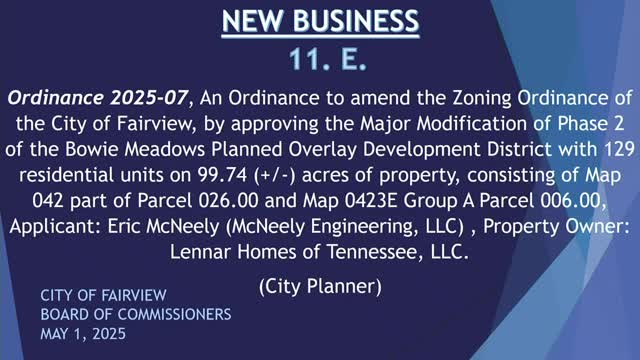
Summary
The Fairview Board of Commissioners voted to advance a major modification to Phase 2 of the Bowie Meadows planned-overlay district to a public hearing, removing a Wayne’s Lane access point, adding a cul-de-sac connection and adding detention ponds.
The Fairview Board of Commissioners voted Thursday to advance a major modification for Phase 2 of the Bowie Meadows planned overlay development to a public hearing and second reading. The modification removes a previously proposed ingress/egress point on Wayne’s Lane, shifts the connection to a cul-de-sac and adds additional stormwater detention ponds.
Planning staff member Ethan Greer said Lennar Homes now owns Phase 2 and that the revised point of access will be lower on the site and avoid a stream that runs along Wayne’s Lane. “With the removal of that entrance, there is no disturbance towards that stream,” Greer said. He added that the planning commission recommended the modification 7-0.
Vice Mayor McDonald and others praised the change, saying it increases green space, removes a problematic access point and should reduce runoff into Buie (Booy) Park. “I think in regards to this one… it increases green space,” McDonald said, and he welcomed the addition of detention ponds to “protect Buie Park” by collecting water and distributing it slowly.
Engineer Eric McNeely of McNeely Veil Engineering, representing Lennar, said he and Lennar can meet with commissioners about specific concerns such as the alignment onto Cox Run and traffic flow. McNeely and a Lennar representative were present for questions.
Because the modification is a major change, Greer said it will follow the same review process as the original planned-overlay approval: first reading, public hearing, and a subsequent final reading. The board moved to send the modification to public hearing; the planning commission had recommended approval.
No final construction approvals were granted at the meeting; any construction will require subsequent engineering, stormwater and construction-level review and possible minor staff-level modifications for pond placement.