
PGCPS details FY26 school-based budgeting, per-pupil allocations and timeline as charter funding questions persist
Get AI-powered insights, summaries, and transcripts
Subscribe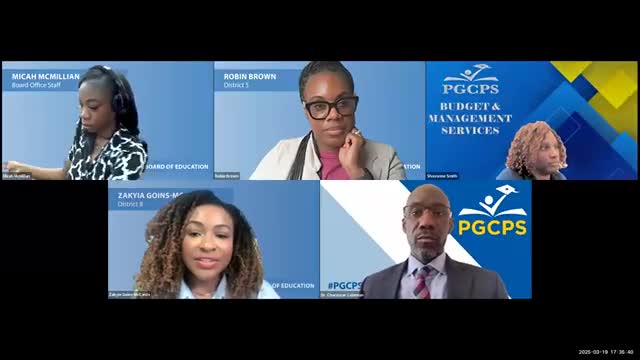
Summary
Shavonn Smith, Director of Budget and Management Services for Prince George's County Public Schools, told the committee the FY26 board-requested budget has been transmitted to the county and the district is moving into school-based budget allocations and staff-level reconciliations.
Shavonn Smith, Director of Budget and Management Services for Prince George's County Public Schools, told the Operations, Budget and Fiscal Affairs Committee on March 19 that the board-requested FY26 budget has been transmitted to the county and the district is finalizing the school budget book and school-based budgeting (SBB) allocations.
The district will allocate funds to each school using minimum school funding calculations, school-based locked allocations and centrally managed locked allocations, Smith said. “Now that we finalized the Board of Education requested budget for FY 'twenty 6, we've transmitted it to the county,” she said.
Smith described three staffing categories under SBB: unlocked positions that schools may purchase with allocated SBB funds; locked positions funded and staffed by central office for roles with special requirements; and “locked plus” positions, which central office funds but schools may supplement with SBB dollars. She used the example of special-education staff as centrally provided locked positions and described a central 0.5 library media specialist allocation that a school could purchase an additional 0.5 to get to a full position.
The district defines PPA as the per-pupil amount required by the Blueprint legislation and stated the minimum distribution rules are set by that law rather than by the local board. “PPA is our per pupil amount,” Smith said. She explained the PPA is multiplied by eligible enrollment for each program (foundation, compensatory education, English learners, special education, etc.) to determine school allocations.
Smith said principals will receive revenue and staffing information through the Apex budgeting tool. SBB “clinics” to train principals on the tool start at the end of March; the tool’s go-live date is April 7, when principals can begin formulating budgets in Apex, she said. The budget office will enter a reconciliation phase in May and early June to finalize staffing, incorporate final state aid and county approvals, and present a balanced FY26 budget to the board in June for transmission and state certification.
On charter-school funding, board members raised concerns that some charters may receive less under the new Blueprint formula. Smith said the district is still sorting through charter impacts and has scheduled further meetings; she said Office of the General Counsel (OGC) will be involved to interpret Blueprint rules for charters. “There are certain nuances to charter schools versus our non charter schools,” Smith said. She added that whether a charter's allocation is higher or lower will depend on the characteristics of its students and statutory rules in the Blueprint legislation.
Board members asked about the 2% administrative fee historically charged to charter schools and whether that fee or a potential 5% fee remains relevant under Blueprint; Smith said charter operators are concerned that at least 75% of PPA must be allocated to schools and that centrally managed supports could be misconstrued as a “withhold.” She noted some centrally managed services directly support charter schools and that charter operators can opt out of some services if they wish to increase their net allocation.
Committee members pressed the budget office for timing so principals and charter operators can plan hires and staffing. Smith reiterated the April 7 go-live date for the Apex tool, that staffing snapshots and reconciliations are ongoing, and that reconciliation in May/early June will address final enrollment and revenue adjustments.
The committee adopted the meeting agenda and approved the 02/19/2025 minutes by unanimous consent earlier in the session; no roll-call tallies were provided in the transcript for those procedural approvals.
Why it matters: The SBB allocations, per-pupil amounts set by Blueprint, and the district’s reconciliation timeline determine how much money individual schools and charter operators will receive and when principals can begin hiring. Several board members pressed staff for clarity so they can respond to constituent concerns about charter funding and staffing timelines.
What’s next: The budget office will complete school-level staffing and the SBB roll-out in April, reconcile revenue and staffing in May/June as state and county funding figures finalize, and present the FY26 balanced budget to the board in June for transmission to the county and certification with the state.