
Kosciusko County commissioners deny rezoning for 554-acre Polk Farms data‑center proposal
Get AI-powered insights, summaries, and transcripts
Subscribe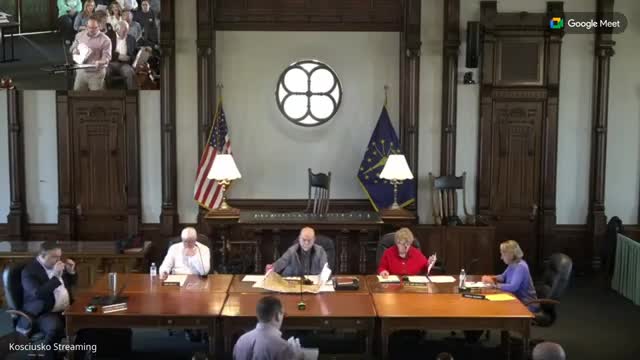
Summary
The Kosciusko County Board of Commissioners voted to deny a petition to rezone 554 acres from agricultural to I‑3 to allow a proposed Prologis data‑center campus; the planning commission had unanimously recommended denial and dozens of residents spoke at a public hearing.
Kosciusko County commissioners voted to deny a petition to rezone 554 acres of Polk Farms from agricultural to I‑3, rejecting a preliminary step proposed by developer Prologis that would have allowed a future special‑exception request for a data center.
The petition, filed by Polk Farms and presented by attorneys and representatives for Prologis, sought rezoning of land near Leesburg and Warsaw that backers said is uniquely sited next to converging high‑voltage transmission lines. Steve Snyder, speaking on behalf of the petitioners, said the rezoning would “open up an opportunity for the developer to go to the Board of Zoning Appeals and explain how that development could meet the standards imposed by your zoning ordinance.” JC, a Prologis representative, told commissioners the company chose the site because “it merely requires connection to the existing substation and the 345 lines that exist there.”
Opponents argued the acreage is prime farmland and urged the board to follow the unanimous recommendation of the Area Plan Commission to deny. Attorney Jack Birch, speaking for multiple landowners, said the request would be “spot zoning” in the middle of productive farmland and warned that voluntary conditions offered by the developer are not binding. A sequence of town residents, farmers and local FFA members described potential harms to agricultural production, water resources and community character.
Why it matters: The rezoning would have allowed Prologis to seek a special exception from the Board of Zoning Appeals for a data center. Supporters emphasized large projected tax revenue and payroll — the developer materials estimated multimillion‑dollar annual tax benefits and hundreds of jobs — while opponents said those projections and timelines are uncertain and that the county’s comprehensive plan prioritizes farmland preservation.
Key details: The petition covered roughly 554 acres adjacent to an existing NIPSCO substation. Proponents said the campus could bring substantial tax revenue and that the location avoids constructing new high‑voltage transmission lines. Opponents pointed to the county’s soil classifications and the potential permanent loss of productive cropland, and argued infrastructure and other impacts should weigh against rezoning.
Public comment: More than a dozen people spoke during the public hearing. Tim Pope, a landowner, said construction jobs were “good paying” and urged consideration of long‑term benefits. Beth Lam and others cited recent high‑profile data‑center delays elsewhere and questioned water and power estimates; Lam noted varying water‑use figures discussed at the technical review committee (her remarks referenced figures that moved from “19,000 gallons a day” up to “40,000–50,000 gallons a day”). Hayden Stuckey, an eighth‑generation farmer, said the land is “our legacy” and warned of a domino effect if prime farmland is rezoned.
Decision and process: After the public comment period, one commissioner moved to accept the Area Plan Commission’s unanimous recommendation to deny the rezoning; a second commissioner supported the motion. The board called the vote, members responded “aye,” and the chair announced, “Motion carries.” The denial prevents the developer from advancing to the Board of Zoning Appeals for a special‑exception hearing unless a new petition is filed.
What the record says about next steps: The denial is of the rezoning petition only. As several presenters and county legal counsel noted during the hearing, rezoning is distinct from any later BZA special‑exception review; if a future petitioner pursues rezoning again or the developer seeks another site, those would be new proceedings. Commissioners and speakers repeatedly referenced Indiana Code requirements for rezoning decisions and the county’s zoning performance standards (section 3.26) as the framework for later technical review.
Closing note: Commissioners said they had reviewed materials, visited data centers, and read resident feedback before deciding. The board did not approve the rezoning and therefore the county will not proceed to BZA review based on this petition.