
City moves to raise water and sewer rates to fund $80M+ capital plan; public hearing held
Get AI-powered insights, summaries, and transcripts
Subscribe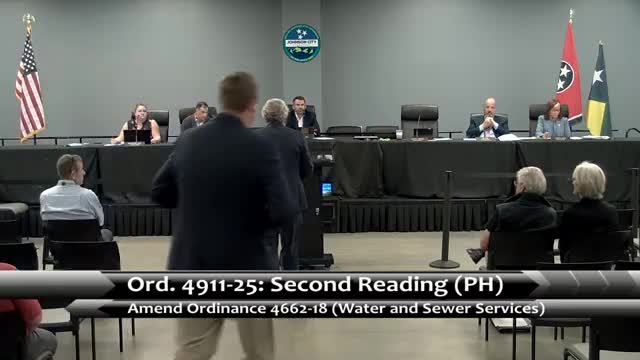
Summary
Commissioners approved second-reading rate ordinances for potable water and wastewater systems, citing needed replacements and upgrades across multiple plants and pipelines and presenting estimated monthly impacts to customers.
Johnson City commissioners on May 1 held public hearings and approved second-reading ordinances updating potable water and wastewater tap fees and user charges to fund a multiyear capital program of system improvements.
City water and sewer leaders said the ordinances implement rate adjustments recommended in master plans and a January rate study to fund about $54 million in debt-funded projects and roughly $26 million in recurring, rate-funded work over the coming multi-year period. The projects include major pipelines, storage and transmission improvements on the water side and several costly wastewater upgrades, including lift-station replacements and capacity work at the Brush Creek wastewater plant.
Tom Witherspoon, director of water services, described the work as long-term planning to maintain regulatory compliance and service reliability. "This is the ordinance that is specific to the potable water system and the recommended improvements for funding capital projects," Witherspoon said. He explained the city uses enterprise funds for utilities and said gradual rate adjustments were intended to minimize customer impact while funding needed capital.
City staff and the rate consultant presented modeled customer impacts. For a low-volume, fixed-income inside-city residential customer the changes translate to roughly $2.50 per month; an average family of four using about 4,100–4,500 gallons was shown with a combined water-and-sewer increase in the $3.75–$4.20-per-month range, depending on class. Staff estimated $54 million in debt-funded projects and approximately $26 million in rate-funded projects over the plan period.
Commissioners and staff emphasized the risks of deferring investment. "Water pays for water," a commissioner said, summarizing the enterprise fund principle that utility rates — not general taxes — support the systems. Public comment included support from the Boone Lake Association, whose representative Franke Haney said the wastewater investments were essential to protect water quality and recreation uses on Boone Lake and urged approval.
Both ordinances passed their readings after the public hearings. Staff said next steps include implementing the adjusted rates and continuing to deliver scheduled capital projects and related public communications about timing and customer impacts.