
Johnson City amends code to allow data centers with new restrictions after public concern over crypto mining
Get AI-powered insights, summaries, and transcripts
Subscribe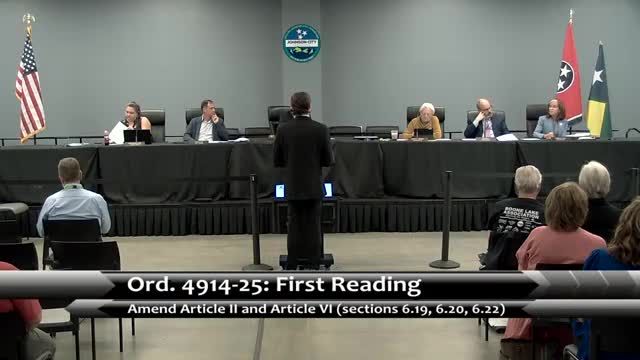
Summary
The City Commission approved a first-reading text amendment to permit data centers in I-2 heavy industrial zones with setbacks, buffers and possible sound-study requirements after residents urged the city to block cryptocurrency mining near neighborhoods.
The Johnson City Commission on May 1 approved on first reading a zoning text amendment that adds a definition for "data centers" and allows digital data operations only in the I-2 heavy industrial district subject to new siting and screening requirements.
The change matters because the ordinance is the city's first explicit set of rules for data centers and related activities, including cryptocurrency mining, and it sets conditions — indoor operations, a 200-foot setback from residential districts, a 60-foot front setback from public streets, and a requirement for type 4 buffer yards where industrial land abuts single-family zones — intended to limit noise and other neighborhood impacts.
City planner Bryce McNamer told commissioners staff had reviewed ordinances from other jurisdictions and concluded the heavy-industrial district was the appropriate location. "We do not currently have regulations on data centers," McNamer said during the presentation. He outlined technical criteria staff would require at site plan review, including screening of ground-mounted and roof-mounted mechanical equipment and staff authority to require additional studies addressing stormwater, traffic and sound impacts.
Residents who signed up to speak urged the commission to reject the amendment or to restrict cryptocurrency mining specifically. Sylvan Bruni of South Johnson City said the ordinance "looks like a routine update" but objected to the phrase "digital data operations and cryptocurrency mining" in staff materials and said the change would allow a recently closed bitcoin facility to relocate near his neighborhood. "I rise tonight in firm opposition to ordinance number 4 9 1 4 dash 25," Bruni said, adding that a 24/7 crypto operation would be "unconscionable" near families and students. Richard Scibilia, another South Johnson City resident, asked whether the commission could guarantee residents would not be harmed and said, "You cannot guarantee that our community will not be harmed by this."
Commissioners spent about an hour discussing the proposal's intent and limits. Commissioner Wise said the amendment is meant to create clear boundaries rather than to recruit crypto firms: "I want us to be in a position to do is put some meaningful boundaries around it before they're defining what's gonna happen in Johnson City," he said. City legal counsel also advised the commission it could not entirely bar a legitimate business from locating in the city by zoning alone: "you cannot prohibit legitimate business and completely exclude it from the city through zoning ordinances," the attorney said.
The ordinance requires that digital data operations be contained within enclosed buildings and provides staff discretionary authority to require an acoustic (noise) study before development; commissioners and staff said the city will issue a request for qualifications for acoustic engineers in coming months to define how sound will be measured and mitigated. McNamer said screening options could include walls, fences, berms and plantings, and that the code would require a type 4 buffer (35-foot width with a required fence or wall) where I-2 abuts single-family zoning.
The first-reading motion passed on a vote of the commission; the ordinance will return for public hearing at the May 15 meeting and for final action on June 5. Staff said that if the amendment is not approved, a data center could still be argued into other districts because the code currently lacks a specific definition and that the amendment is intended to remove ambiguity by defining the use and limiting where it may locate.
Commissioners and staff also flagged next steps beyond the zoning text: an updated noise ordinance and formal requirements for pre-development acoustic studies, which staff said could take several months to draft and implement.