
Council moves to empower city marshal, approves in‑car video systems and amends vehicle financing; false‑alarm ordinance language under revision
Get AI-powered insights, summaries, and transcripts
Subscribe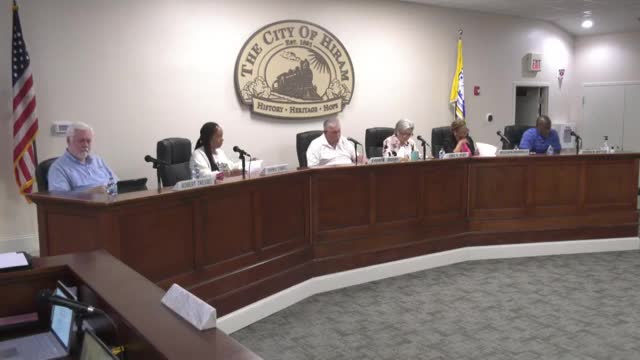
Summary
Council discussed creating a city marshal27s office under the police chief to give code enforcement officers authority to issue citations and approved five in‑car video systems; a vehicle financing amendment and a revision to the false‑alarm ordinance were also discussed.
The Hiram City Council heard a package of public safety items that included a plan to place code enforcement under the chief of police as a city marshal’s office, approval to purchase five in‑car video camera systems, and an administrative amendment to include financing costs for a police vehicle.
Chief of Police (name not specified in the transcript) told the council the organizational change is intended to make the code‑enforcement function more self‑sufficient and reduce the need to call marked units to issue citations. The chief said the current code enforcement officer is able and willing to pursue state certification: “What we—re trying to do now is get him into a position so and get that position, to a place where that they can be self sufficient without having to call a marked unit every time they need to issue a citation,” the chief said.
The chief also reported a technical amendment to a previously approved vehicle purchase. The council amended the prior approval for a Ford Maverick upfit to include the financing fee through the Georgia Municipal Association/GMA Magnolia Bank at 4.79% interest; the amended ceiling including administration fees was stated in the meeting as $41,003 plus interest.
On equipment, a motion to approve the purchase of five M500 in‑car video camera systems with body camera mounts and video storage—at a not‑to‑exceed cost of $65,720 funded by a police salary budget amendment—was made, seconded and approved in the meeting record: a councilmember moved to approve the purchase and the council voted in favor (motion passed; detailed roll‑call not recorded in the excerpt).
The chief said purchasing electronics via the state contract yields savings and faster delivery; he told council the department will use salary savings and a year‑end budget amendment to fund tablets and other electronics rather than financing them.
Separately, the chief reported that the city’s false‑alarm ordinance language is being revised after a judge expressed concern that the ordinance as written might require issuing a summons precisely on the third false alarm. The chief said staff has suspended application of the false alarm ordinance pending a change that clarifies a summons may be issued “anytime after the third” false alarm so that enforcement timing is discretionary rather than mandatory.
Why it matters: The marshal office change would broaden the enforcement tools available to code enforcement staff; in‑car video and updated vehicle financing ensure patrol vehicles and officers are equipped to modern standards. Rewriting the false‑alarm ordinance clarifies enforcement discretion and reduces the risk of unintended mandatory summonses for closely spaced alarms.
Next steps: The marshal office reorganization requires personnel certification and administrative updates; purchases will proceed under approved funding actions and funding source transfers noted during the meeting.