Get Full Government Meeting Transcripts, Videos, & Alerts Forever!
Get email alerts on the Parole Resentencing topic
No spam. Unsubscribe anytime.
MDOC explains parole process and warns of immediate releases after resentencing ruling; seeks legislative help for transitional support
Summary
Kyle Kaminski explained how the Parole Board evaluates cases and what the MDOC expects after a court decision that could trigger resentencing for hundreds of cases.
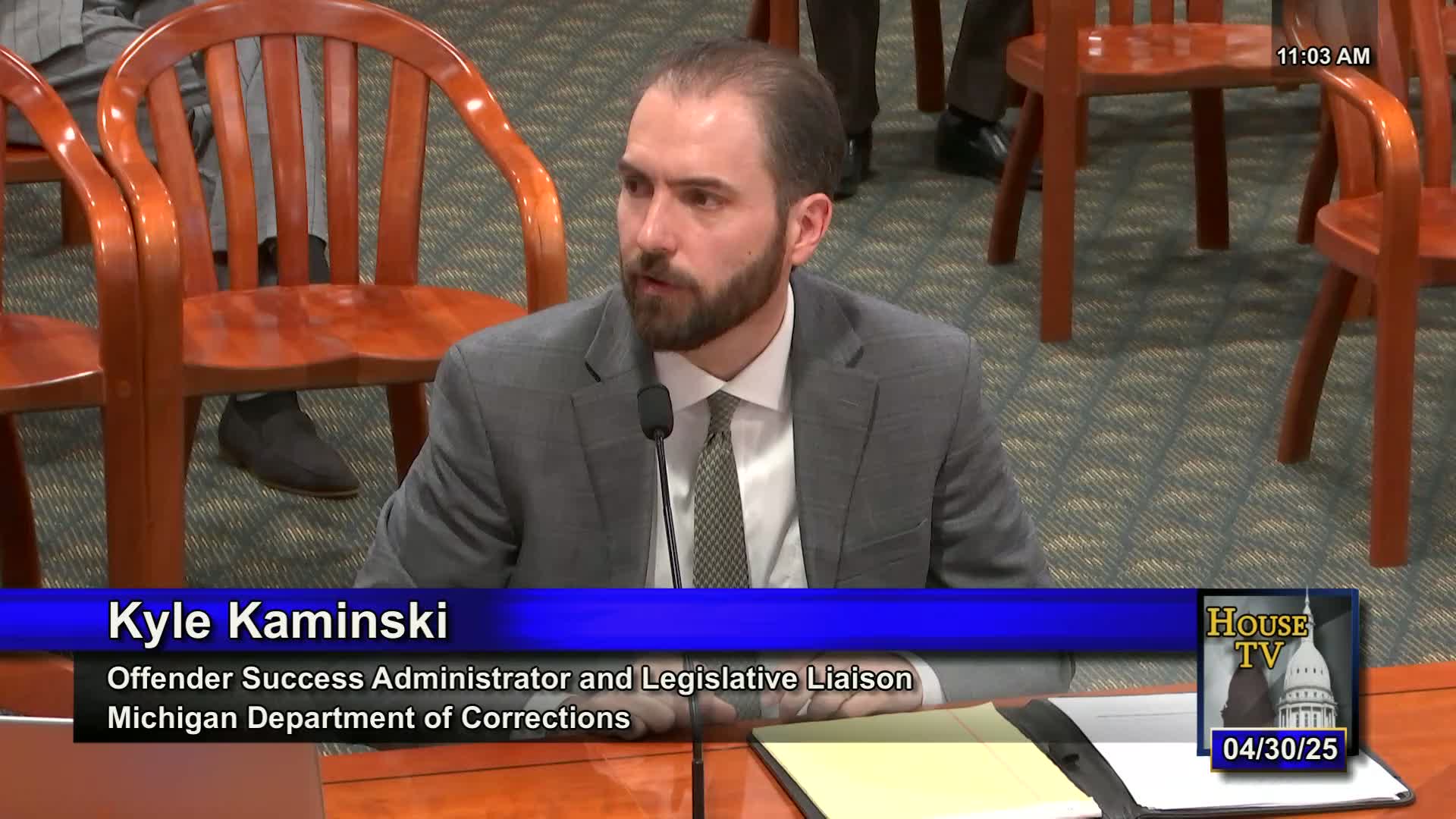
Kyle Kaminski, OS administrator and legislative liaison for the Michigan Department of Corrections, told the House Judiciary Committee how Michigan’s parole process works and what the agency projects will follow a recent court decision affecting young offenders.
‘‘The Parole Board’s main authority is to grant parole to somebody who has served their full minimum sentence,’’ Kaminski said, and that parole eligibility is governed by statute and by objective parole guidelines the board uses to classify cases as low, average or high probability of parole.
Kaminski described the board as a 10‑member panel appointed by the MDOC director, mixing MDOC staff and public members. He said the board uses structured decision‑making and that ‘‘if you are in the High Probability of Parole category, you fall under something called Objective Parole, which ... limits the reasons the Parole Board can deny you parole.’’ The board reviews eligible cases, conducts interviews (typically by video), and establishes supervision terms, including standard conditions and special conditions such as no‑contact orders and required programming.
The MDOC presented several performance metrics: parole approval rates have moved from about 50% two decades ago to roughly 68% today; the state paroled just over 6,000 people last year compared with about 11,000 in 2004, reflecting a smaller base population; and Michigan’s three‑year recidivism rate fell from about 45% to 22.7% over two decades.
Kaminski explained that the department notifies registered victims and prosecutors when a parole grant is made and that a grant is not executed until the statutory notice period has passed (statute requires at least 28 days; the department typically uses 30 days) to allow appeals of a grant. He said appeals are rare and require a showing of abuse of statutory discretion.
On absconders and returns to custody, Kaminski reported there are about 700 parole absconders currently, down from roughly 1,000 several years ago. He said new felony convictions and technical violations that return people to prison have each fallen to about one‑third of their levels 20 years ago.
Kaminski also briefed lawmakers on the consequences of a recent court ruling concerning offenders who were 19 or 20 at the time of their offense. "Our count is 582 right now," he said when asked how many cases the MDOC believes are affected. He told members the department also estimated roughly 300 additional earlier-younger cases (under earlier decisions) could be affected, producing an aggregate in the neighborhood of 900 cases subject to potential resentencing.
He said MDOC analysis identified groups among those 582 cases: about 41 cases likely to be subject to immediate discharge if resentenced (because of the way good‑time or disciplinary credits would apply under a new term), another roughly 22 in a similar immediate‑discharge band under Proposal B credit rules, and a larger set that would become parole‑eligible once recalculated (noting parole eligibility is not the same as automatic parole). Kaminski cautioned that some of those numbers may shift as courts review records and corrected birth dates or coexisting life terms are identified.
The MDOC urged the Legislature to consider a statutory fix that would allow the department to provide short‑term transition supports to people who are immediately discharged after resentencing. Kaminski said the department cannot pay for transitional housing, employment assistance or other reentry services for people it no longer has legal jurisdiction over and that Representative Amos O’Neil has introduced legislation to address that gap. "We would really love to see the legislature do that so that if we have one of these immediate discharge cases, we can at least do some transitional housing, employment support, social supports," Kaminski said.
Committee members raised victims' participation and notice. Kaminski said victims receive automated notice if they are registered and that the department will attempt to provide timely notice once a new judgment is received, but if a resentencing judgment leads to immediate discharge the MDOC may only be able to notify victims after it receives the court's paperwork because the department lacks authority to hold a person beyond a legal maximum.
Kaminski also described the Parole Board’s procedures for victim engagement: victims may submit materials, participate in interviews separate from the prisoner, and—when statutorily applicable—appear at public hearings for parolable life sentences.
He closed by inviting lawmakers to observe Parole Board interviews and to visit field offices and facilities for further context.