Get Full Government Meeting Transcripts, Videos, & Alerts Forever!
Get email alerts on the Criminal Justice Sheriffs topic
No spam. Unsubscribe anytime.
Michigan Sheriffs Association urges state action on mental‑health beds, jail funding and staffing
Summary
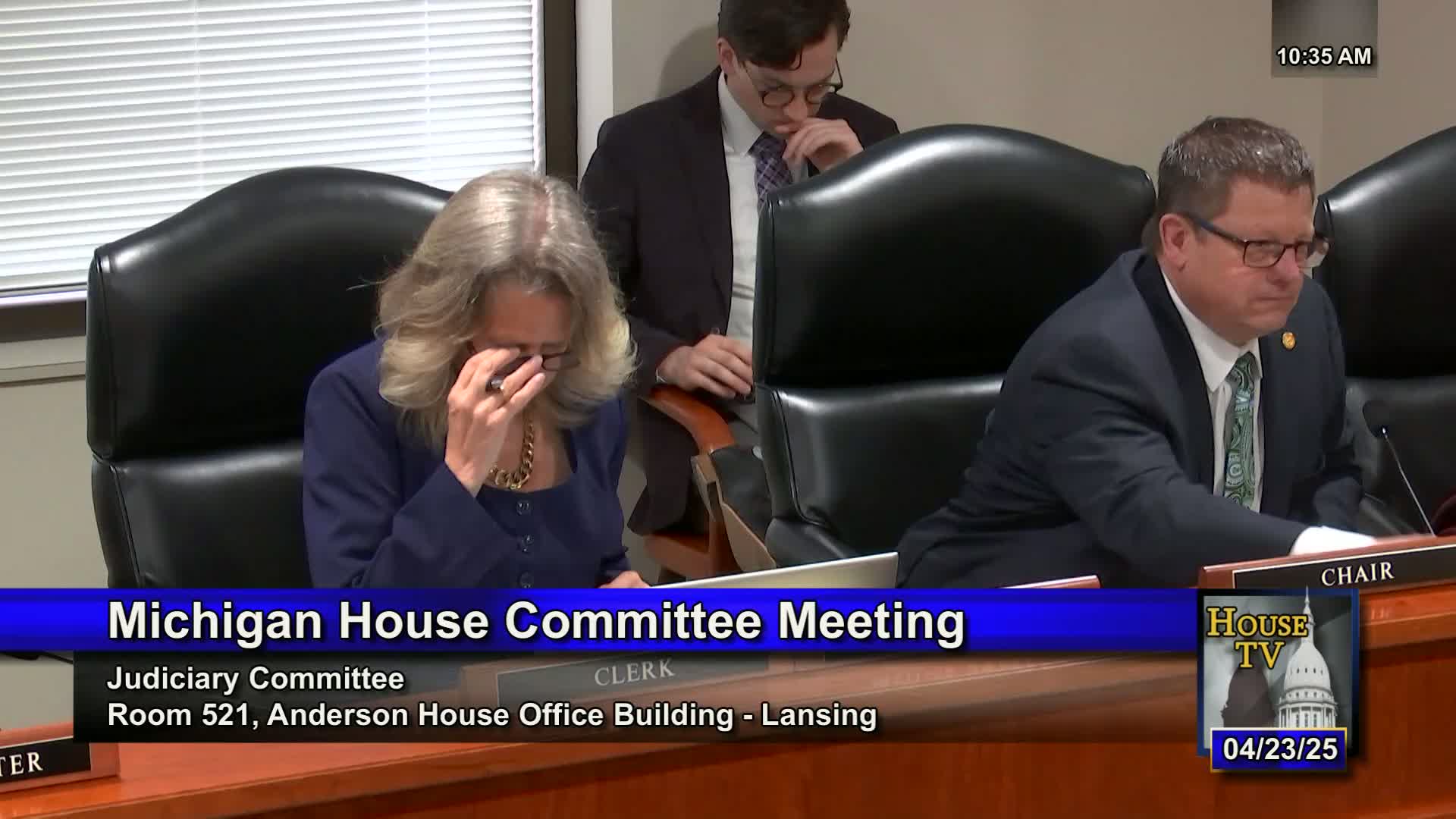
At a House Judiciary Committee hearing, the Michigan Sheriffs Association asked lawmakers to address shortages of mental‑health treatment beds, outdated state jail reimbursements and recruitment and retention barriers that officials say are straining county jails and public‑safety operations across Michigan.
At a House Judiciary Committee informational hearing, the Michigan Sheriffs Association told lawmakers that shortages of mental‑health treatment beds, low state reimbursements and difficulty hiring and retaining staff are increasing costs and operational strain for county sheriff offices across Michigan.
The association, which represents Michigan’s 83 elected sheriffs, highlighted several legislative priorities the group says would relieve pressure on county jails and improve public safety. Those priorities include removing a 1,000‑hour reemployment barrier for some retirees, updating Department of Corrections reimbursements for county‑housed inmates, easing limits on transporting co‑arrested juveniles and adults together for initial processing, and extending a 45‑day transfer window for some sentenced prisoners who must be moved to state custody.
Why it matters: county sheriffs say jails are serving as de facto mental‑health providers because community treatment capacity has shrunk, forcing sheriffs to hold people who are incompetent to stand trial or awaiting forensic evaluations in facilities not designed or funded for treatment. That creates safety and legal risks, the presenters said, and increases local costs that state reimbursements do not cover.
Matt Saxton, executive director of the Michigan Sheriffs Association, said the association’s work supports sheriffs statewide with training, victim services and operational assistance. "MSA is committed to maintaining and enhancing the office of sheriff through professional development, legislative advocacy, and public education," Saxton said. He noted the association is a 501(c)(3) with a budget the presenters described as approximately $1.3 million and membership and program revenues that do not fully cover operating costs.
Dan Fonas, deputy director, told the committee that "the most important issue in law enforcement right now is recruitment and retention," and described a specific barrier for counties that operate independent pension systems. Fonas asked lawmakers to allow those counties an option to waive a rule that prevents recently retired employees from returning to work more than 1,000 hours in a year; he said some counties lose experienced employees because the retirees must move to other agencies that permit more hours.
The association asked the legislature to raise several state reimbursement rates tied to housing inmates in county jails. Presenters described the current $35‑per‑day reimbursement for parole violators as unchanged since 1988 and said the actual local cost to house an inmate can be many times higher. They also asked for a $5 increase to each of three existing tiered reimbursement rates the association called 45/60/70 dollars per day (a typographical error on their slide was noted during the presentation); Fonas summarized the request as a modest increase that still would not fully cover local costs.
Officials emphasized delays in the Michigan Department of Corrections accepting prisoners sentenced to state custody. "When MDOC delays receipt of an inmate we were sentenced to send, we shoulder extra liability and cost," Fonas said; the association seeks full reimbursement when the department cannot immediately take custody. The group also proposed extending a guaranteed transfer window for individuals convicted of first‑degree murder from 45 to 90 days to reduce prolonged county detention for people who should be in state custody.
Sheriff Michael Poulan of Muskegon County and Sheriff Troy Goodnough of Monroe County described local programs aimed at reducing recidivism and improving community outcomes. Poulan noted countywide crisis‑intervention training and an embedded mental‑health partnership that allows officers to refer people directly to treatment resources. Goodnough described medication‑assisted treatment, peer support, an embedded clinician in the jail, GED and job‑readiness programs and a family‑services unit for reentry planning; he said Monroe County reported a 37 percent reduction in recidivism for people receiving those services.
The presenters reviewed the association’s volunteer and support programs: a victim‑services network of more than 600 volunteer advocates across 57 units (53 county units and three city units in Lansing, Grand Rapids and Holland), and a SMART memorial/assistance team that assists law‑enforcement agencies and families after line‑of‑duty deaths at no charge. Saxton said the association receives an $85,000 annual state grant from the Michigan Department of Health and Human Services to support volunteer training but called the grant administratively difficult to manage.
Committee members asked for clarifications. Representative Breen asked whether the DHHS grant could be affected by pending budget cuts; Saxton said he did not believe the $85,000 grant would be cut but that the program's administrative burdens are a recurring concern. Breen also asked about the state's new extreme‑risk protection order (ERPO) law; Saxton said law enforcement petitioned for roughly 291 ERPOs and that law enforcement initiated most petitions, calling the tool useful and not yet subject to observed abuse. Representative Johnson pressed on state mental‑health capacity; presenters said more dedicated treatment beds and better access to diversion services are needed so jails are not used as long‑term mental‑health placements.
The association listed eight legislative priorities it plans to advance with the legislature this session, including retiree reemployment flexibility, statutory qualifications for sheriffs, full reimbursement when MDOC delays receipt of sentenced inmates, higher per‑diem rates for jailed parole violators, adjustment of tiered reimbursement rates for certain sentenced inmates, authority to transport co‑arrested adults and juveniles together to initial processing, extension of the transfer period for certain automatic commitments, and strengthening MCOLES‑related reporting and vetting to prevent officers with problematic records from moving between agencies without disclosure.
The presentation concluded with committee members thanking the sheriffs and association representatives for the briefing. No committee votes or formal actions were taken at the hearing; presenters said they would continue to work with legislators on the specific bills and funding changes they proposed.