Get Full Government Meeting Transcripts, Videos, & Alerts Forever!
Get email alerts on the Mdoc Operations Staffing topic
No spam. Unsubscribe anytime.
Michigan Department of Corrections outlines operations, staffing pressures and pay changes
Summary
The Michigan Department of Corrections told the House Judiciary Committee it operates 26 prisons, 100+ field offices and supervises roughly 70,000 people statewide, and described recruitment and retention efforts including a higher starting wage and a faster path to top pay.
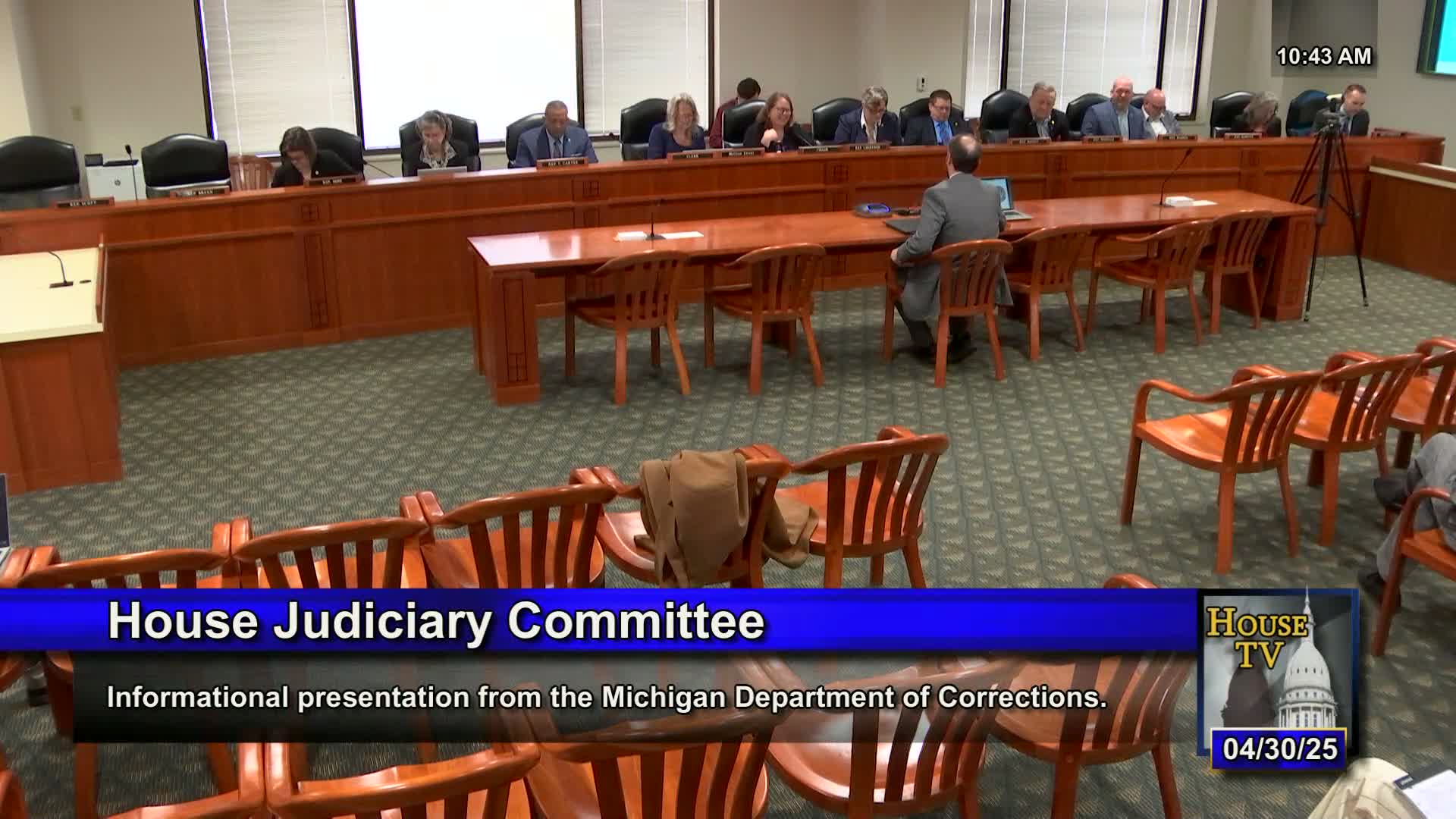
Chairwoman Likert called the House Judiciary Committee to order and introduced Kyle Kaminski, who presented an overview of the Michigan Department of Corrections’ structure, budget and staffing.
Kaminski, the OS administrator and legislative liaison for the Michigan Department of Corrections, told the committee the agency’s "primary focus is public safety," and said that public safety requires both secure facilities and successful reentry programming.
The department operates 26 prisons and the Detroit Detention Center under contract with the city of Detroit, Kaminski said, and maintains "just over 32,000 individuals in our prisons currently," along with about 32,000 people on felony probation and roughly 9,000 on parole — a daily jurisdictional population of more than 70,000 Michigan residents. He described the MDOC as effectively running "26 small cities" because facilities must provide many services from healthcare to food service and education.
Kaminski told lawmakers the MDOC is an agency of roughly 11,000 employees, with about half working in direct custody roles; staffing costs are "north of 72%" of the department’s roughly $2,000,000,000 annual budget. The department also operates Michigan State Industries factories that produce goods such as uniforms, license plates (produced in Adrian), optical and dental lab products and mattresses for state customers and nonprofit purchasers.
On staffing, Kaminski said the MDOC continues to face vacancies among correctional officers but has seen recent improvements. He gave the committee a vacancy figure of about 875 corrections-officer openings against a fully staffed custody workforce of roughly 5,200–5,500 positions. The department runs quarterly academies; the two most recent academies started with about 275 recruits each, he said, while earlier classes averaged about 180.
Kaminski described recruitment and retention as a two-part problem. In addition to hiring, he said, "the other half of the equation is retention," noting early-career turnover remains a challenge. The department has worked with the Office of the State Employer and the MDOC union, MCO, on compensation changes, including compressing pay steps so officers reach higher pay faster. He said starting pay will be $23.45 an hour on Oct. 1, and a new top step at 54 months will put long-tenured officers at about $35.22 an hour — "over $73,000 a year before overtime."
Members asked follow-up questions on staffing and workplace culture. Representative Harris, who had toured MDOC vocational operations, praised embedded agents and partnerships with local police and asked how public members of the Parole Board are selected; Kaminski described an application process and internal vetting. Representative Hope described a family history of corrections work and asked whether pension changes might affect retention; Kaminski said the department is focused on pay and workplace environment because those are levers it can directly influence.
Kaminski also told the committee the department actively manages bed capacity by taking individual housing units offline when population declines make beds unnecessary, which reduces staffing needs. He said the department has closed entire prisons in past years when population declines warranted it but was not recommending closures at the time of his testimony.
Kaminski closed by inviting committee members to visit MDOC facilities, field offices or the Parole Board's interview process to observe operations firsthand.