Get Full Government Meeting Transcripts, Videos, & Alerts Forever!
Get email alerts on the Centers Independent Living topic
No spam. Unsubscribe anytime.
Centers for Independent Living ask legislature for $6 million to expand services statewide
Summary
Disability Network Michigan told the House appropriations subcommittee that 15 Centers for Independent Living cover every county but remain underfunded; the network requested $6 million in additional state general funds to expand staffing and reach.
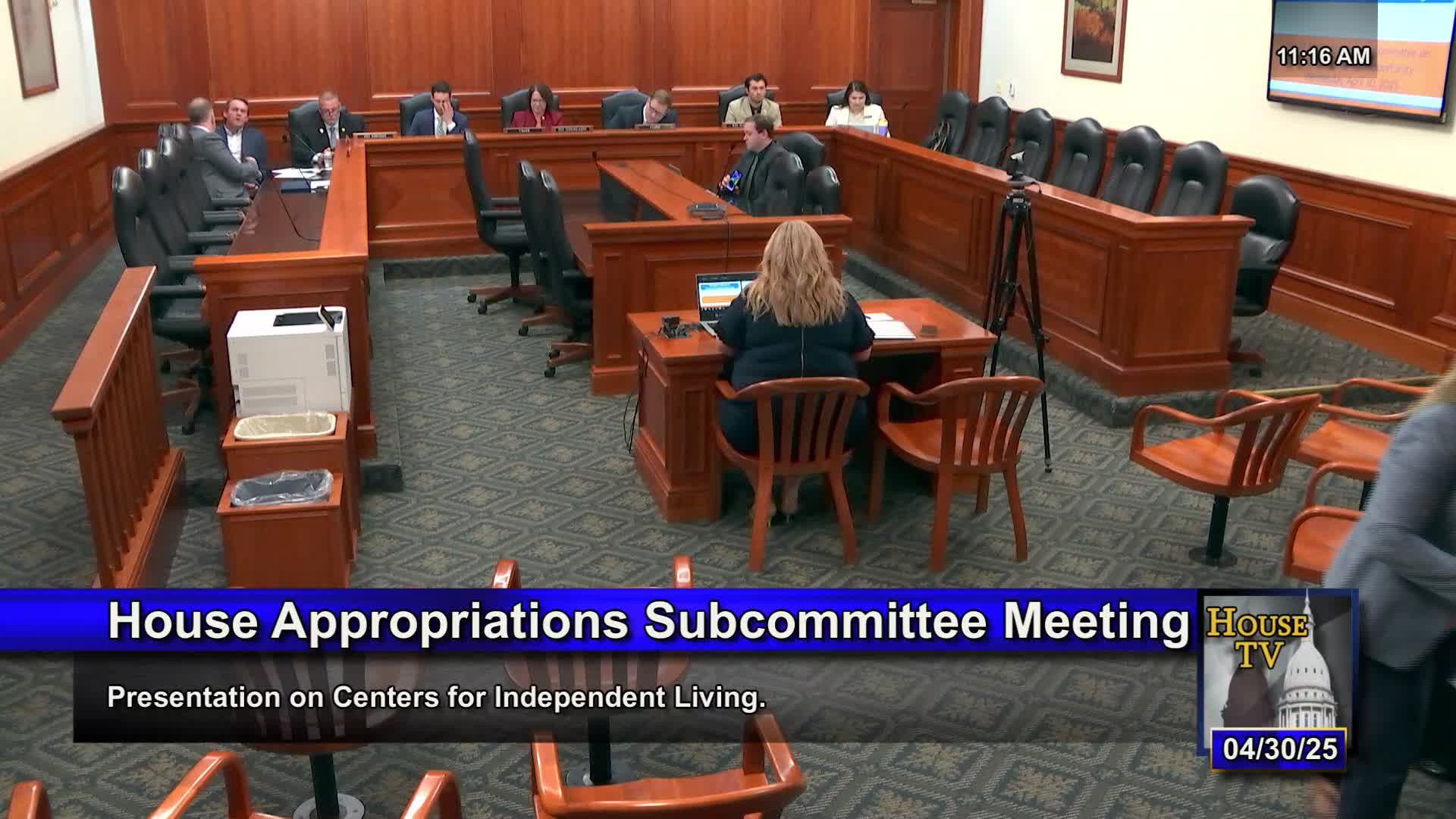
Terri Langley, executive director of Disability Network Michigan, told the House Appropriations Subcommittee on Labor and Economic Opportunity that Michigan’s Centers for Independent Living (CILs) operate statewide and requested an additional $6,000,000 in state general funds for fiscal 2026 to increase capacity and serve underserved areas.
Langley said CILs are "non residential, consumer driven, community based disability organizations," created under the Federal Rehabilitation Act of 1973 and required to be consumer-led. The network represents 15 centers that, Langley said, cover all 83 Michigan counties and employ more than 300 people combined.
Langley described the centers’ five federally required core services — peer support, information and referral, individual and systems advocacy, independent living skills, and transition to community‑based living — and gave examples of their work: loan closets for mobility equipment, adapted cooking classes, mock interviews for youth, housing transition assistance for people discharged from nursing facilities, and accessibility assessments for public spaces. She cited partnerships with state agencies including the Department of Natural Resources, the Secretary of State’s Bureau of Elections (for voting access and voter-assist terminals), the Michigan State Police Division of Emergency Management and Homeland Security, and the Michigan State Housing Development Authority.
On funding, Langley said CILs rely on federal grants, state general fund appropriations, local philanthropy and fees for service. She described a distribution formula the network uses that she said is 50% equity and 50% equality (with the equality portion split 60% by population and 40% by geography). Langley told the subcommittee the governor’s proposed FY26 line item repeats the fiscal 2025 investment of $19,700,000 and that centers are requesting an additional $6,000,000 to address capacity limits in areas including Detroit, Oakland–Macomb, Mid‑Michigan, Northern Michigan and the Upper Peninsula.
Langley gave activity figures from recent reporting: about 76,000 contacts statewide to CILs last year and roughly 12,000 consumers who received services. She said last year’s total distributed to centers was about $14,800,000 from the $19.7 million package, described program income and contract differences, and noted the network’s ongoing effort to produce an updated return-on-investment study; a 2019 calculation the network shared with the legislature estimated a $7 state savings for every $1 invested.
Langley emphasized that many people with disabilities remain unaware of CIL services, saying, "I do argue that we are the best kept secret in your districts." She also described situations where CILs reduced state costs by helping individuals leave nursing facilities or avoid longer hospital stays by making homes safe for return.
The subcommittee did not take an appropriation vote at the hearing. Langley encouraged members to refer constituents in need of assistance to their local center and said center staff are available for follow‑up questions.