Get Full Government Meeting Transcripts, Videos, & Alerts Forever!
Get email alerts on the Vocational Rehabilitation topic
No spam. Unsubscribe anytime.
Michigan Rehabilitation Services seeks state match to draw down federal funds, expand services
Summary
Officials from the Department of Labor and Economic Opportunity told a House appropriations subcommittee that Michigan Rehabilitation Services needs roughly $10 million in additional state general funds to draw down federal matching dollars and expand employment services for people with disabilities.
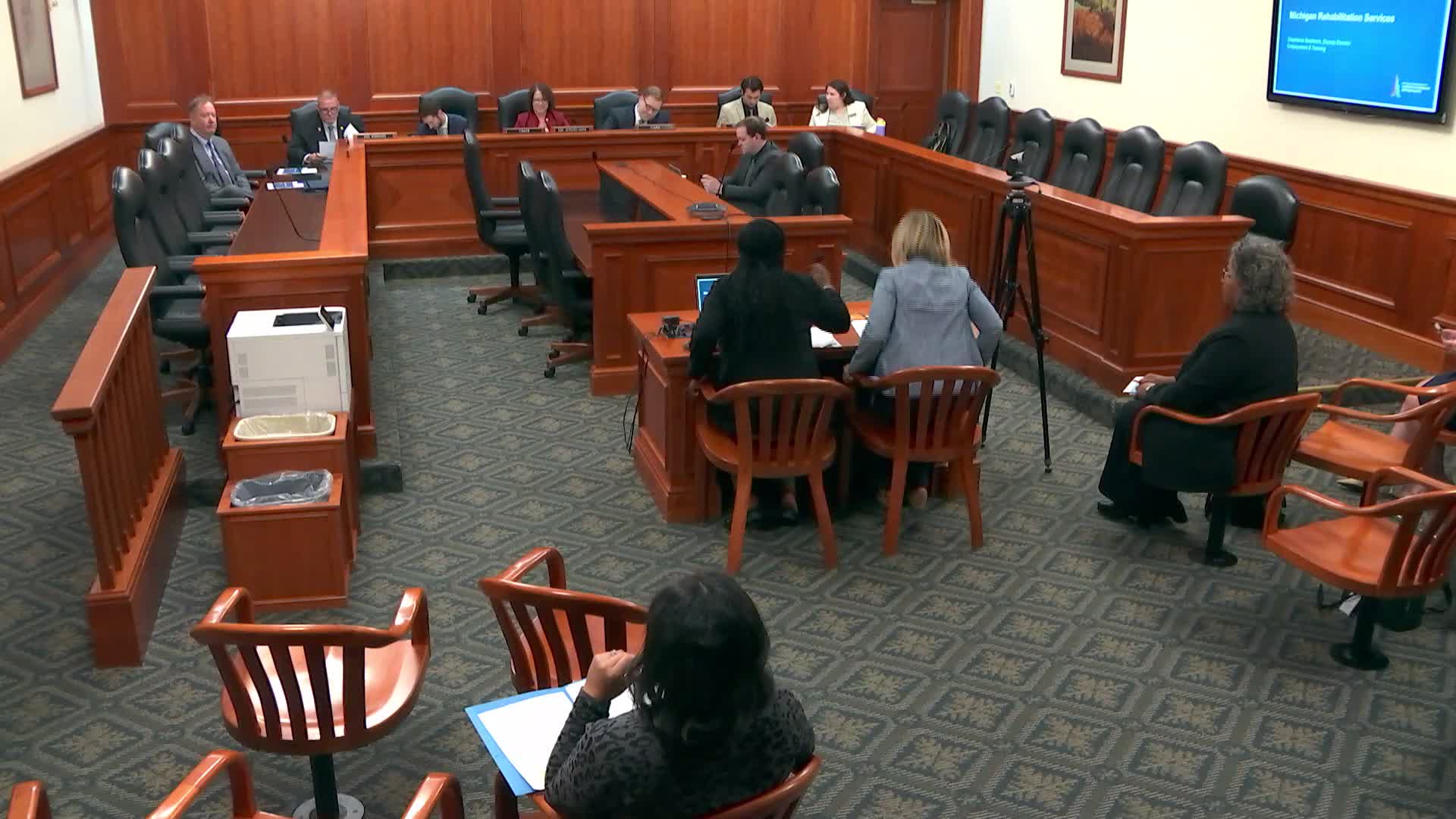
Stephanie Beckhorn, deputy director of employment and training at the Michigan Department of Labor and Economic Opportunity, told the House Appropriations Subcommittee on Labor and Economic Opportunity at a subcommittee meeting that Michigan Rehabilitation Services is requesting state general-fund increases to expand pre-employment and vocational rehabilitation services and to draw down federal formula dollars.
The request matters because the federal Vocational Rehabilitation (VR) grant that funds much of MRS’s work is a formula award that requires a state match. "For every dollar we put in in state funding, we can draw down $4 from the federal government," Beckhorn said, summarizing the program’s roughly 4-to-1 federal–state leverage and explaining why the state contribution affects Michigan’s ability to claim its full federal allotment.
MRS provides individually tailored services aimed at helping people with disabilities obtain and retain competitive integrated employment. Beckhorn told the subcommittee that the agency’s fiscal 2025 budget is about $130,000,000 and that nearly 79% of that — more than $102,000,000 — comes from federal sources administered through the U.S. Department of Education’s Rehabilitation Services Agency. She described how the program’s federal formula requires a state general-fund match to draw the federal award and said that without roughly $10 million in additional state match, “Michigan's share of the pie that the formula said would come to us goes back at the federal level, and it would be awarded to other states who have the match available.”
Beckhorn gave program-level detail: MRS operates the Michigan Career and Technical Institute in Plainwell, which served almost 500 students in the most recent complete year; last year MRS served almost 33,000 individuals with disabilities and worked with about 6,800 businesses across the state. She cited labor-market statistics to underscore the need for services: about 1,300,000 Michiganders have a disability (roughly 1 in 5), individuals with disabilities have an unemployment rate of about 15% compared with the statewide rate of about 5.5%, and the employment rate for people with disabilities was reported at about 37% versus 76% for the general population.
Beckhorn described the governor’s fiscal 2026 recommendations that MRS presented to the committee: $8,400,000 in state general funds for expanded pre-employment transition services (Pre-ETS) for students, which she said would draw down about $32,000,000 in federal funds (yielding roughly $40,400,000 total for those services); and roughly $2,000,000 in state funds for traditional vocational rehabilitation work, which she said would draw down about $7,000,000 in federal funds (about $9,200,000 total). Beckhorn said those increases would allow MRS to serve about 25% more individuals in the student Pre-ETS cohort (about 8,000 additional people) and project a 10% increase in customers who obtain an industry credential and full‑time employment.
During questions, committee members pressed MRS on geographic reach, partnerships and the populations it serves. Beckhorn said MRS staff are colocated in community settings and with Michigan Works! agencies and that the agency partners with organizations such as Goodwill Industries rather than competing with them. Representative Van Werkom asked what types of disabilities MRS serves; Beckhorn and Sigrid Adams, director of Michigan Rehabilitation Services, emphasized that MRS serves a wide range of conditions — physical, cognitive, sensory and other impairments — and that services are customized according to the functional limitations that result from a person’s disability. Adams said eligibility is based on whether a disability results in a substantial impediment to employment and noted that MRS uses medical documentation and individualized assessment to determine eligibility.
Adams described staff qualifications and training, saying many counselors hold master’s degrees and receive ongoing training so they can tailor services to varied, often complex needs. On program goals she said the agency focuses on individuals who want employment and on helping employers retain workers who develop new limitations, for example because of declining vision or changing physical capacity.
The presentation included client examples used to illustrate outcomes. Beckhorn described one client, Riley Strouch of Clinton Township, who received Pre‑ETS supports and mobility training and obtained a new retail job with more hours and higher pay; Beckhorn said, “Independence was incredibly important to Riley.”
At the start of the meeting, Representative Robinson moved to approve the minutes of the April 23 meeting; there were no objections and the minutes were approved.
The subcommittee members did not vote on the budget recommendations during the session. Presenters said the additional state funds would be used to capture federal match and expand services if appropriated in the fiscal 2026 budget.