Get Full Government Meeting Transcripts, Videos, & Alerts Forever!
Get email alerts on the Corrections Facilities And Work Projects topic
No spam. Unsubscribe anytime.
MDOC tells appropriations subcommittee it faces more than $320 million in five‑year facilities needs; work‑project funding limited
Summary
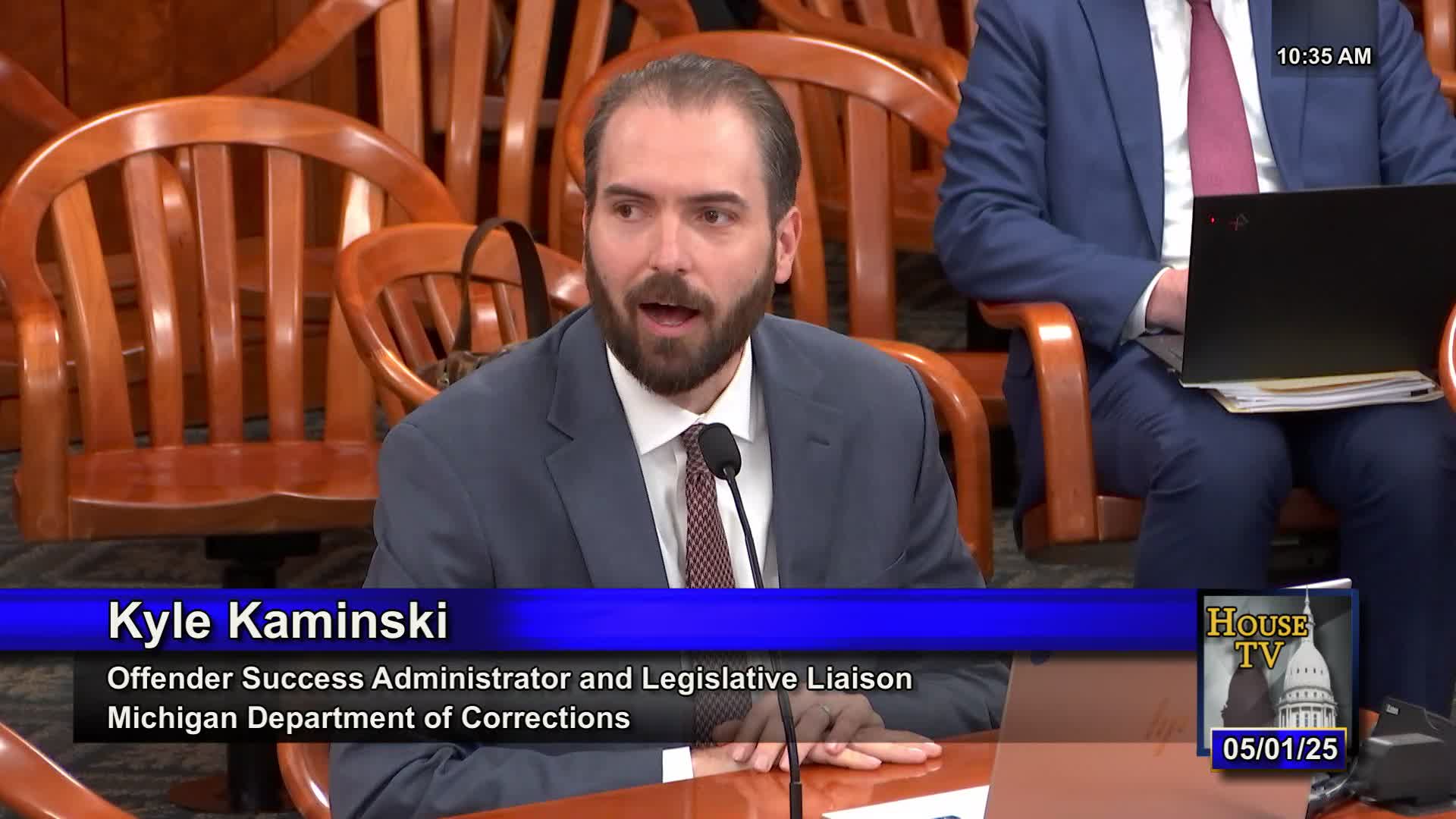
Kyle Kaminski of the Michigan Department of Corrections told the Appropriations Subcommittee — Corrections that prisons need more than $320 million in capital work over the next five years, while available facility‑tied work projects total about $215 million and cannot be transferred between facilities.
Kyle Kaminski, OS administrator and legislative liaison for the Department of Corrections, told the Appropriations Subcommittee — Corrections that the department has compiled more than $320 million in known capital needs for its facilities over the next five years and that available work‑project balances tied to facility appropriation lines total roughly $215 million.
"Our work projects really fall into 2 categories, the facility, physical plant, and infrastructure work projects, and then the non facility work projects," Kaminski said, summarizing how the department requests authority to carry forward unspent appropriations to complete multi‑year projects.
Kaminski told the committee the department operates 26 facilities containing more than 1,000 structures and over 5,000,000 square feet of building space. He said the newest prison, Bellamy Creek Correctional Facility in Ionia, opened in February 2001; the oldest operating prison, Marquette Branch Prison, has been in service since 1889. Those factors, he said, make maintenance and capital work both extensive and ongoing.
The department’s five‑year capital list includes about $280,000,000 of projects tied to individual facilities and another $40,000,000-plus for projects that affect multiple facilities, bringing the known total above $320,000,000. Kaminski said that figure excludes emergent repairs, which have become more frequent as infrastructure ages. He offered Woodland Correctional Facility as an example of a site with recurring water and sewer failures.
Kaminski said the department aggregates roughly $215,000,000 in available facility work‑project balances across all facility appropriation lines; about $100,000,000 of that is already earmarked for specific planned projects and about $115,000,000 remains unallocated. He emphasized that work projects are tied to the appropriation line for a named facility and "we cannot use that work project for a repair or a project at" a different facility.
He also described operational constraints that lengthen project timelines: most work occurs inside secure perimeters while facilities remain staffed and occupied, requiring sequencing, security protocols and escorted contractors. "Most of our larger projects take more than a year to plan, bid, and complete," Kaminski said.
Kaminski described the department’s use of non‑facility work projects for modernization and programming, including a multi‑year rollout of facility Wi‑Fi, IT upgrades such as a new offender management system, vocational and educational site development (the Thumb Educational Center was cited as an example), and pilot package scanners. He told the committee that most facilities already have a body scanner in an administrative entry area, and that package scanners are being piloted at two sites before statewide rollout.
Committee members asked for clarification about funding sources for security technology. Kaminski said non‑facility work projects or current‑year appropriations (for example, a contraband prevention fund recently added to the budget) could be used to purchase items such as body scanners, though facilities commonly direct work‑project balances toward construction and maintenance because of urgent capital needs.
There were no formal votes or motions tied to the department’s presentation. The committee asked follow‑up questions and heard the department’s overview in order to better understand where work‑project balances exist, which needs are already funded, and the limits on moving funds between facility appropriation lines.
Ending
No formal committee action was taken on the department’s report. Kaminski said the department expects to sequence and spend most available facility work‑project funds on identified projects over the coming years and to continue seeking work‑project authority to carry forward unexpended facility operating funds when needed.