Get Full Government Meeting Transcripts, Videos, & Alerts Forever!
Get email alerts on the State Budget topic
No spam. Unsubscribe anytime.
Michigan DNR asks Legislature for new revenue to shore up parks, fisheries and aging dams
Summary
Director Scott Bowen told the House Appropriations Subcommittee that the DNR needs new recurring and one-time funding to address deferred maintenance, declining license revenue and aging dams.
Director Scott Bowen told the House Appropriations Subcommittee on Agriculture and Rural Development and Natural Resources that the Department of Natural Resources' fiscal 2026 budget request seeks new revenue and one-time investments to address deferred maintenance across parks, fisheries and dams.
Bowen said the department is facing long-term funding constraints as hunting and fishing license revenue has declined and fee levels have not kept pace with inflation. “We need to have a real conversation about conservation funding,” Bowen said, noting the DNR has not raised license fees since 2014 and that many costs are roughly 30 percent higher than 11 years ago.
The DNR presented a package of proposals to the subcommittee including: converting the Recreation Passport to an opt-out model (the department estimates raising participation toward 60 percent would generate additional revenue and expand local grant awards), updates to hunting and fishing license and watercraft registration fees, and a one-time $15 million general fund request targeted for dam work on DNR-managed infrastructure. The department also requested supplemental one-time spending from the Game and Fish Protection Trust Fund and additional federal spending authority to support culvert removal, stream connectivity restoration and administration of high-speed internet easement activities on department lands.
Why it matters: DNR officials said they manage the state’s largest portfolio of public land in the lower 48, host more than 36 million park visitors in 2024 and oversee fisheries and hatcheries that support tourism and local economies in northern and rural communities. The department reported constrained revenue mixes: roughly 68 percent of funding is from restricted sources (licenses, camping, timber and mineral leases), 17 percent from federal funds and 14 percent from the general fund.
Key figures and proposals presented
- Park and visitation data: DNR staff said state parks had more than 36,000,000 visitors in 2024 and that visitation rose roughly 9,000,000 over four years. - Recreation Passport: current participation ~38% under the opt-in model; DNR estimates a 60% participation rate under an opt-out model would produce additional revenue (the presentation estimated about $21,300,000 in additional revenue tied to increased participation and later described an additional $17,200,000 distribution by statute). The department warned the change could be partially offset by an estimated $4,100,000 annual reduction from exempting resident veterans. - Hunting and fishing licenses: not adjusted since 2014; the department urged updates to offset rising operational and conservation costs. - Watercraft registration: not adjusted since 1993; DNR estimated that raising registration fees could add about $3,500,000 to the waterways fund (with roughly $2,500,000 to parks and recreation, $1,000,000 to waterways grants) and about $3,400,000 to marine safety funding for law enforcement and grants to county sheriffs. - Dams: DNR manages an inventory of about 200 dams (average age cited as 62 years). The department requested a $15,000,000 one-time general fund allocation for urgent dam work; staff cited recent failures and large remediation costs (Black River Dam repair costs were presented as an estimated $3,000,000 for renovations with an additional $2,800,000 to mitigate newly formed wetlands after a failure). - Deferred maintenance and emergencies: fisheries assets cited at more than $350,000,000 in responsibility; deferred projects between wildlife and fisheries estimated at $40,000,000 (noting that estimate excluded dams). The department described generator failures at hatcheries (one generator fire and a $85,000 interim generator cost while waiting an estimated 52 weeks for a replacement) and other aging equipment (examples included a 1970s tractor still in use).
Committee questions and follow-ups
- Representative McKinney asked where high-speed internet infrastructure funded by federal grants would be installed on DNR lands; the department said requests are industry-driven and typically involve Upper Peninsula and northern Lower Peninsula locations and that the supplemental request would allow the DNR to leverage a grant and memorandum of agreement from the state's LEO office to process those requests.
- Representative Roth asked about dredging and coordination with the Department of Environment, Great Lakes, and Energy (EGLE), noting low water levels and PFAS-related constraints on dredging; Bowen and staff acknowledged the concern and were urged to coordinate with EGLE.
- Several members, including Bowen and Dan Lord (DNR finance and operations chief), described how inflation has increased costs for hatchery supplies (liquid oxygen up 32% from 2013 to 2023), vehicle chassis and trucks, fuel, gravel, and contracted services, leading to deferred work and fewer seasonal hires.
Actions and formal business
The subcommittee approved previous meeting minutes after Representative Roth moved to approve them; no recorded roll-call tally was provided during the meeting.
What's next
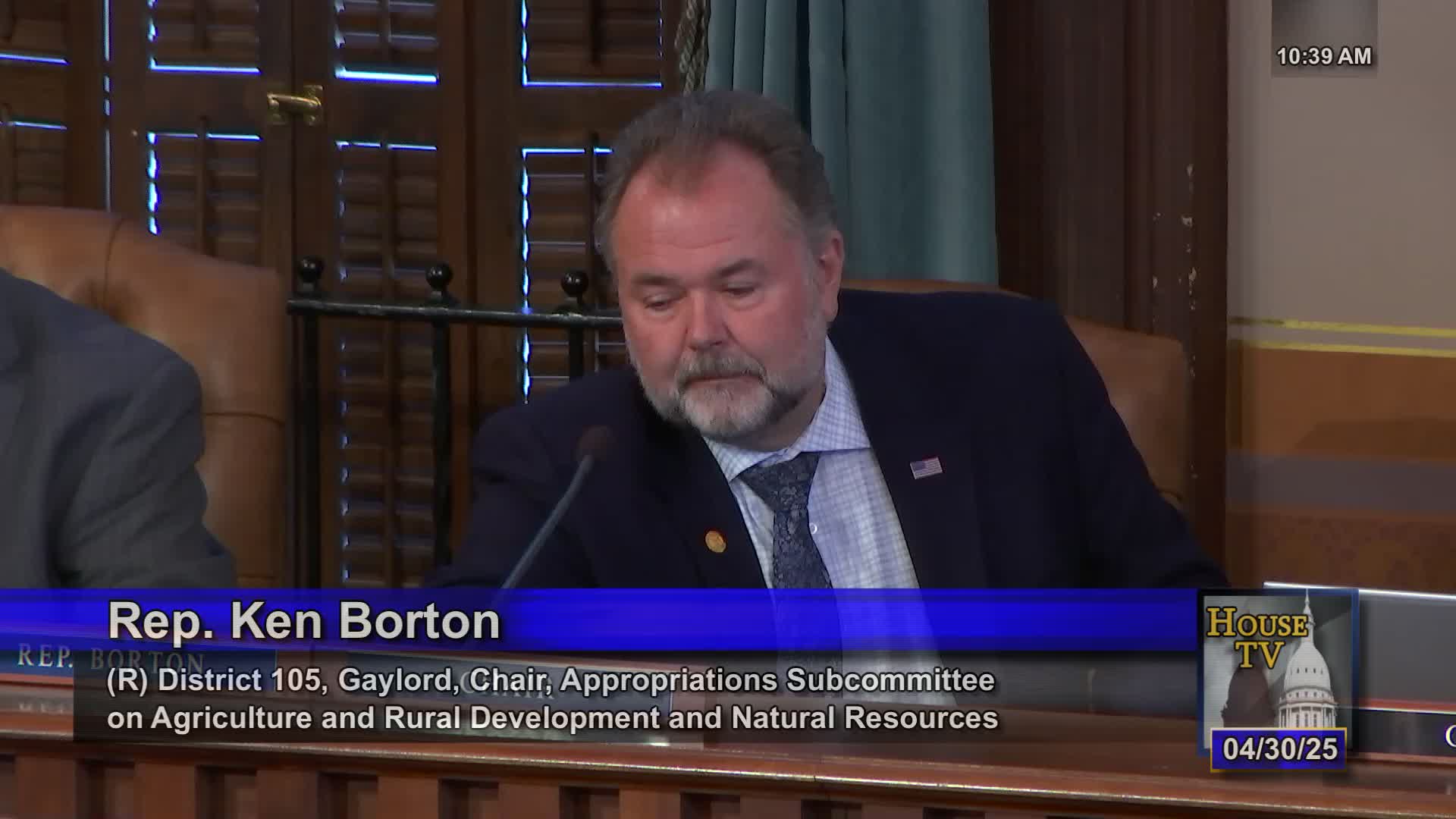
Chair Borton said the DNR would be invited back for a longer session to allow more detailed questioning. DNR staff requested the supplemental and statutory changes be considered during the budget process; the department emphasized that addressing deferred maintenance now could avoid higher emergency costs later.
Ending: The presentations and exchanges concluded with members expressing broad support for preserving the state's outdoor assets while reserving questions about fee changes, economic elasticity and coordination with other state agencies.