Get Full Government Meeting Transcripts, Videos, & Alerts Forever!
Get email alerts on the Sugar Industry topic
No spam. Unsubscribe anytime.
Michigan Sugar Company tells Agriculture Committee that Farm Bill delay and recent closures threaten domestic supply
Summary
John Boothroyd of Michigan Sugar Company told the Agriculture Committee that the state’s sugar-beet industry faces low commodity prices, industry closures and an outdated federal Farm Bill, and he described the company’s footprint, workforce and recent efficiency investments.
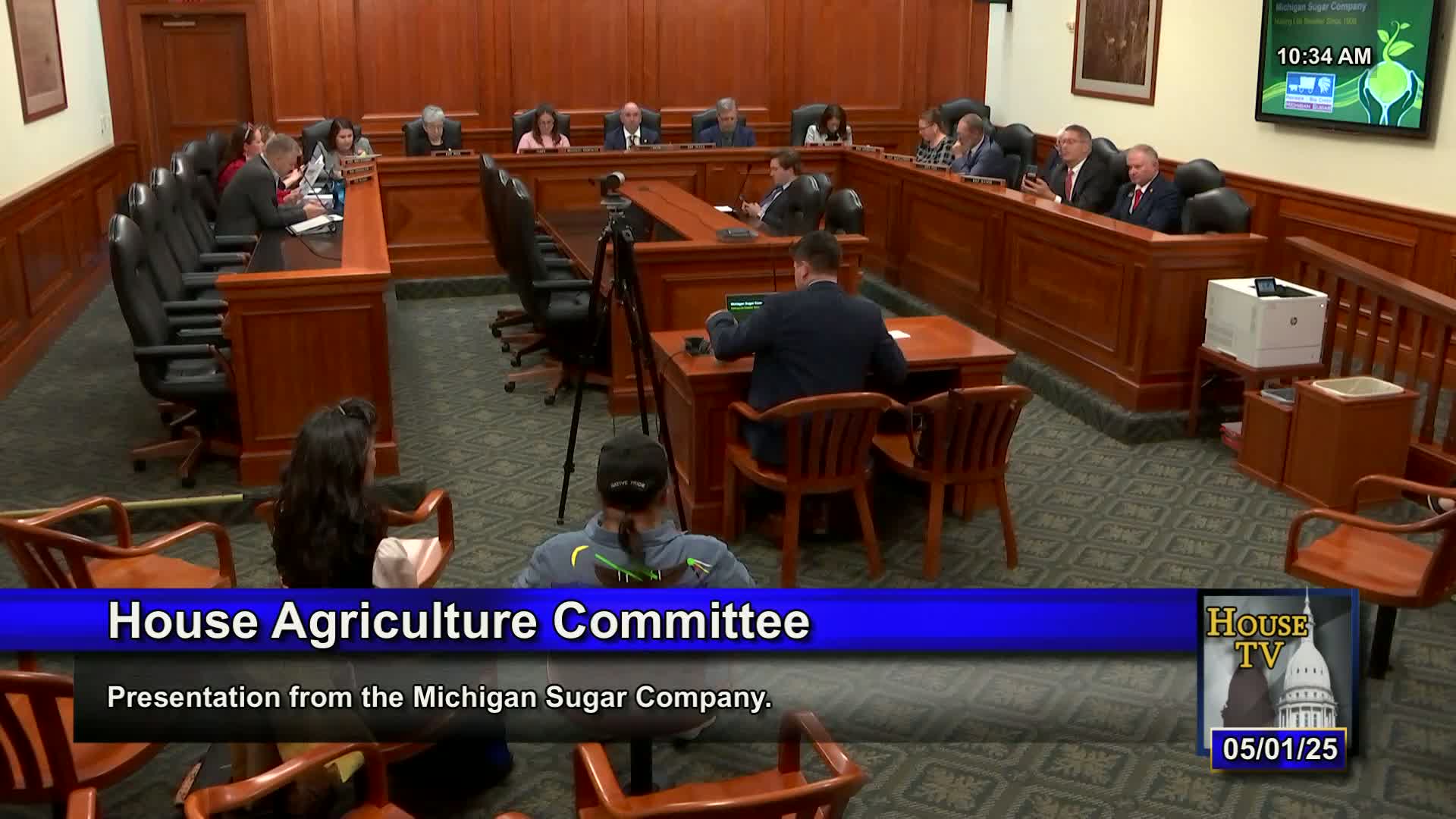
John Boothroyd, director of government relations for Michigan Sugar Company, told the Agriculture Committee that Michigan’s sugar‑beet industry is large, tightly margined and vulnerable to international pressure and a delayed federal Farm Bill.
Boothroyd said Michigan Sugar is a grower‑owned cooperative and that ‘‘of the eight sugar beet companies in the country, all of them . . . utilize the cooperative model’’ and that sugar beet sugar supplies a majority of U.S. sugar. He told committee members the company manages roughly 140,000 acres of sugar beets in 17 to 20 Michigan counties and processes about 4,800,000 tons of beets into roughly 1.3 billion pounds of sugar in a campaign season.
The matters Boothroyd raised matter because he said the United States imports about 30 percent of its sugar and that recent U.S. plant closures reduce domestic capacity. ‘‘Last Tuesday, the red factory that you see in the South of California announced its closure,’’ Boothroyd said, adding that the Texas sugar industry ‘‘no longer exists’’ after recent shutdowns. He urged lawmakers to consider the downstream effects of policy on food supply and said the company’s primary federal ask is completion of a new Farm Bill to restore a stronger safety net for growers.
Boothroyd described Michigan Sugar’s economic footprint and operations. He said the company’s headquarters is in Bay City and that factories operate in Bay City, Carroll, Croswell and Sebring, with additional facilities in Ohio. He reported an annual direct economic impact to the state of about $700 million and estimated indirect impacts between $1.5 billion and $2 billion depending on the calculation method. He said Huron County is the company’s largest single county by acreage, with about 55,000 to 56,000 acres.
On workforce and production details, Boothroyd said Michigan Sugar employs over 1,000 year‑round workers (mostly unionized manufacturing positions), about 1,100 seasonal workers and that the company annually pays more than $90 million in wages. He said most seasonal workers are U.S. citizens, retirees or long‑term seasonal travelers who come in RVs rather than H‑2A visa workers. ‘‘We don’t use H‑2A,’’ Boothroyd said, noting the program’s cost and complexity.
He outlined the company’s sustainability and efficiency work. Since becoming a cooperative in 2002, Boothroyd said Michigan Sugar cut energy consumption by about 40 percent and that 87 percent of factory operations now use natural gas. He described a $109 million desugarization project that came online in May 2024 and which he said will produce roughly 80 million additional pounds of sugar without adding acreage.
Committee members asked clarifying questions. Vice Chair Pies asked about imports and tariffs; Boothroyd replied that sugar is ‘‘unique as a row crop’’ and that the U.S. is a net importer because world markets are distorted by heavy subsidization in some producing countries. Representatives also asked about differences between cane and beet sugar, workforce sourcing and how efficiency gains were achieved; Boothroyd cited equipment upgrades, fuel switching (coal to natural gas) and process innovations as drivers of energy savings.
No formal committee action or vote followed Boothroyd’s presentation. After questions, the committee moved to the next presentation.