
House committee refines S.127 drafting: domicile definition, floor‑area rules and resale safeguards debated
Get AI-powered insights, summaries, and transcripts
Subscribe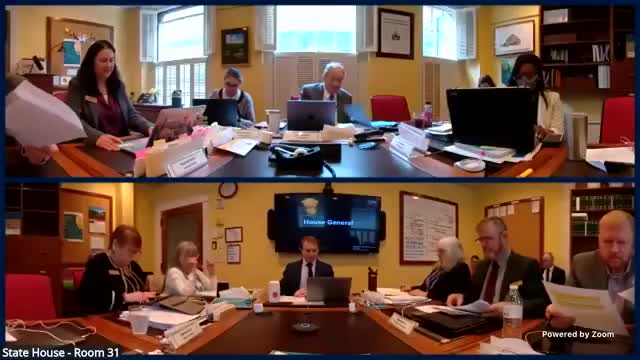
Summary
During a May 2 meeting, the House Committee on Dental and Housing reviewed drafting instructions for S.127, focusing on whether to define “primary residence” as domicile, how to count residential floor area for project eligibility, and possible checks to discourage sham sales and require municipal reporting.
Members of the House Committee on Dental and Housing met May 2 to review drafting instructions for S.127, the Senate companion to the committee’s housing bill, focusing on three substantive points: whether to use the legal concept of domicile instead of a non‑technical “primary residence,” how to measure residential floor area for project eligibility, and how to discourage quick resale or “sham” transactions that would defeat eligibility requirements.
The committee’s legislative counsel and members said the meeting was intended to identify drafting questions the staff should resolve before the committee requests a revised bill text and considers a vote. “This memo is merely everything not related to chips,” one committee member said while explaining the memo of agreed drafting instructions; the reference separated a discrete set of changes for staff to incorporate.
Why it matters: definitions and measurement rules in the statute determine who qualifies for housing incentives and how municipalities and the administering agency will interpret project applications. Ambiguities could create loopholes that allow properties to be converted quickly and avoid local requirements or transfer taxes, members said.
On domicile versus primary residence, the committee heard from John Gray of the Office of Legislative Council, who described “primary residence” as an imprecise, nontechnical phrase and noted an existing statutory reference: “Domicile is the principal dwelling of a person domicile in the state of Vermont.” Members said using domicile or “principal dwelling” would align the bill with statutory language and avoid implying a day‑count requirement. One committee member, identified in the meeting as Debbie, said she worried that a phrase like “primary residence” could be read as requiring a specific time‑in‑state test (“like you have to be here for 6 months”), whereas domicile captures intent to return after temporary absences.
Committee members discussed examples—sabbaticals, National Guard call‑ups, or temporary rentals—where a homeowner might be absent for months but still intend the property as their home. The committee agreed the draft should avoid creating an automatic day‑count test; members asked staff to consider a domicile‑based approach and to return with draft language.
On project eligibility, the committee reviewed a numeric threshold used in the draft (the memo described a 60% baseline and an increase to 70% in a recommended version) requiring a certain share of gross floor area be “dedicated to housing.” Members debated whether to specify gross or net floor area and how to treat adaptive reuse projects that contain large nonresidential spaces such as gymnasiums or theaters. One member noted these large common spaces could make it difficult for a converted building to meet a strict percentage test.
Committee members repeatedly framed this as a policy choice: either adopt a prescriptive measurement approach with detailed definitions (which would lengthen and complicate the statute) or give the administering agency discretion to interpret “dedicated to housing” in rulemaking and project reviews. Several members said they favored giving the agency discretion rather than codifying detailed building‑by‑building calculations; one member noted the alternative would be hundreds of pages of technical definitions. The committee expressed a working preference to retain the 70% target while delegating net/gross determinations and other measurement details to the agency’s rulemaking.
The administering agency referenced in the discussion appears in the transcript as “Pepsi”; committee members said the statute’s general standard will be subject to that agency’s interpretation and to any implementing rules it adopts. Members also discussed requiring an informational reporting obligation for municipalities as a light‑touch check: towns could report known instances where properties were not occupied as primary residences, providing a way to detect patterns without imposing an immediate enforcement regime.
To address quick resales and artificial transactions designed to circumvent the statute, the committee discussed adding language clarifying that initial offers must be bona fide (for example, inserting the word “initially” or “initially offered” into the draft) and requiring documentation of leasing or occupancy agreements. Members acknowledged these checks are imperfect—lawyers and real‑estate professionals can structure transactions—but said public filing of agreements and an informational municipal reporting requirement would create transparency and give towns leverage to raise concerns.
Next steps and direction: the committee directed legislative staff to draft language reflecting the group’s preferences (use of domicile/principal dwelling language rather than a day‑count test, retention of a roughly 70% residential floor‑area threshold, and reliance on agency rulemaking for measurement details) and to add the discussed reporting and initial‑offer clarifications. Members asked staff to consult with the agency identified in the transcript as “Pepsi” on measurement questions and to invite VHCD (mentioned by members) to report back next session on how the program is working.
No formal motions or votes were recorded during the session. The committee paused to allow members time to review the draft and agreed to stay in session until staff could provide revised text, if possible.
Meeting logistics and context: committee staff said Ways and Means had signaled readiness to take up the bill the following Tuesday; the committee discussed scheduling and coordination with leadership. The meeting reflected detailed drafting work rather than final policy decisions: members repeatedly emphasized they were providing consensus drafting instructions for staff rather than taking a formal vote at that moment.
For clarity: the committee did not adopt a final statutory text during this meeting. The record contains multiple points where members asked staff to prepare specific drafting options and to return with a revised bill text for a possible vote later in the day or at a follow‑up meeting.