
Committee questions provision letting public bodies discuss interest rates behind closed doors
Get AI-powered insights, summaries, and transcripts
Subscribe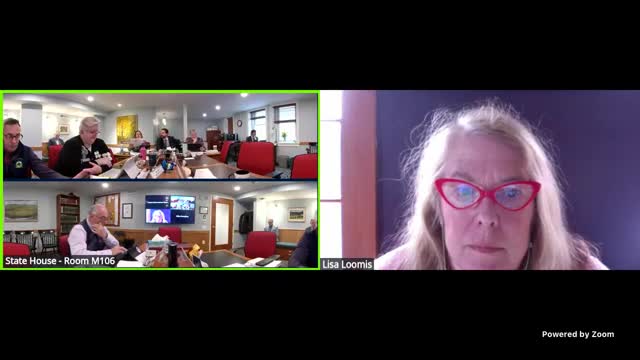
Summary
The House Government Operations & Military Affairs Committee questioned a provision in S.59 that would allow public bodies to meet in executive session to discuss interest rates when the governmental entity acts as creditor.
On May 2 the House Government Operations & Military Affairs Committee revisited a provision in S.59 that would allow public bodies to enter executive session to discuss information "related to interest rates" when a governmental entity is acting as creditor.
Lisa Loomis, a witness at the committee meeting, told lawmakers: "All interest paid on any public loans is my money, or your money, or our money. So we have a right to know interest rates." She and executive director Mike Donahue asked why deliberations about interest rates might be confidential and urged the committee to understand the provision’s origin.
Tucker Anderson, legislative counsel, said the subdivision at issue applies to publicly financed loans where the government acts like a creditor, not to ordinary public borrowing or indebtedness. "This is not applicable to public borrowing or public indebtedness. This is where the governmental corporation is the creditor acting like the bank," Anderson said. He explained that in many contexts agencies that offer loans as part of their statutory duties may handle rate-setting and related deliberations that are treated as confidential until a final decision is public.
Anderson added that most financial information of this type becomes public once the public body adopts the interest rate as an action; executive session would cover the deliberation leading up to that decision. He also said that the current Public Records Act includes an exemption for confidential business information (trade secrets, proprietary financial data) and that existing law already allows public bodies to enter executive session to consider records protected by that exemption.
Committee members pressed whether the provision was necessary: if the financial information is already protected under the Public Records Act, does this language add anything. Some lawmakers suggested narrowing the text to apply only to specific state agencies or to the narrow set of circumstances that prompted the Senate insertion. Members said they would try to trace the provision’s origin in the Senate and consider striking or narrowing it if that better reflected legislative intent.
Committee members gave no final vote; they said staff would research the provision’s source and return with clarified language or options.