Get Full Government Meeting Transcripts, Videos, & Alerts Forever!
Get email alerts on the Lincoln Native American Policy topic
No spam. Unsubscribe anytime.
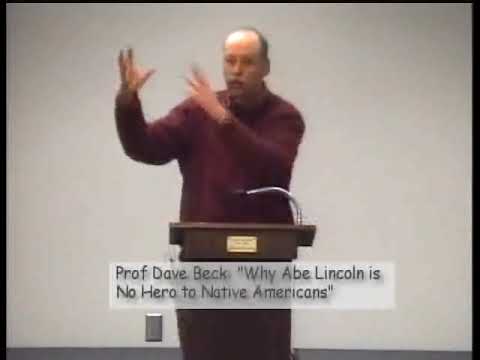
Lincoln’s Civil War-era Indian policy tied to Mankato executions, removals and Sand Creek massacre, lecturer tells Missoula audience
Summary
Dave Beck, acting chair of Native American Studies at the University of Montana, told a Missoula lecture that Abraham Lincoln’s presidency oversaw actions—most notably the 1862 Mankato executions, forced removals and frontier massacres—that shaped long-standing federal treatment of American Indian tribes.
Missoula — Dave Beck, acting chair of the Native American Studies department at the University of Montana, told an audience that Abraham Lincoln’s record on relations with American Indian tribes includes decisions and events that American Indian communities remember as executions, forced removals and massacres.
Beck said the most singular act tied to Lincoln’s presidency is the hanging of Dakota prisoners after the 1862 uprising in Minnesota, and he described that episode, removals from Minnesota and elsewhere, and frontier violence including the Sand Creek massacre as central to how many American Indians view Lincoln’s legacy.
Beck opened by framing tribal-federal relations as grounded in treaties and a trust relationship: "Indian tribes are political units within The United States," he said, adding that treaties often recorded both rights retained by tribes and rights granted to them. He placed nineteenth-century policy options—assimilation, protection, removal and (he said, by some actors) extermination—in context and said those choices shaped subsequent events.
The lecture traced how corrupt Indian affairs administration, withheld annuities and failed treaty provisions fed the Dakota War of 1862. Beck described how treaty payments were diverted by traders and officials, leaving Dakota people with little cash or food after crop failures. He said that in one sequence of post‑uprising military tribunals, "303 Dakota people were sentenced to be executed" and that President Lincoln examined the trial records and ultimately ordered 39 sentences carried out but pardoned one, resulting in the execution of 38 Dakota men on Dec. 26, 1862, in Mankato, Minnesota.
Beck quoted a federal military officer’s language from the period to show the tenor of some commanders on the frontier: he recited General John Pope’s line that Beck said read in a report, "It is my purpose utterly to exterminate the Sioux, if I have the power to do so," and noted other commanders and officials used exterminationist rhetoric. Beck said Lincoln "was conflicted about this" and cited an exchange reported to have occurred with Minnesota politician Alexander Ramsey in which Lincoln replied, "I could not afford to hang men for votes." Beck used that exchange to illustrate Lincoln’s political calculations amid frontier pressure.
Beck said the Civil War also shuffled tribes in Indian Territory (present-day Oklahoma), where several southeastern tribes — the Cherokee, Creek, Chickasaw and Choctaw — split in allegiance and where Confederate agents negotiated treaties. He said the Union ultimately mustered some tribes and Native soldiers into Union service, sometimes after long delays and amid starvation.
On the Plains, Beck described the Nov. 29, 1864 attack at Sand Creek, Colorado, led by Colonel John Chivington. He said the attack targeted Cheyenne and Arapaho camps and left many men, women and children dead; the transcript account provided an unclear toll for that attack. Beck also related how Cheyenne leader Black Kettle survived Sand Creek only to be killed later in an 1868 attack attributed to Col. George Armstrong Custer.
Beck discussed broader legal and policy frameworks that affected tribes after Lincoln’s presidency: he summarized the Marshall Trilogy as establishing tribes as "domestic dependent nations," explained the doctrine of congressional plenary power as the legal basis for later congressional actions affecting tribes, and quoted the Lone Wolf v. Hitchcock line of cases as an important example of courts deferring to congressional authority in allotment and land‑transfer matters.
Audience members asked whether the pattern of removals, massacres and treaty violations amounted to genocide. Beck said scholars sometimes distinguish cultural from biological genocide and described federal efforts aimed at cultural destruction (for example, later boarding‑school policies) while noting that some actions by individuals and militias had genocidal effects. He emphasized the need to separate wartime atrocity reports from verified facts while also recording the enduring impact of the events he described.
Beck framed the Mankato executions as the event most uniquely associated with Lincoln in Indian country, and he cautioned that removals, broken treaties, starvation and frontier massacres predated and outlasted Lincoln’s presidency but occurred on his watch. He closed by encouraging listeners to consider both Lincoln’s actions and the broader, long-running federal policy patterns that shaped Native communities.