Get Full Government Meeting Transcripts, Videos, & Alerts Forever!
Get email alerts on the Emancipation Proclamation topic
No spam. Unsubscribe anytime.
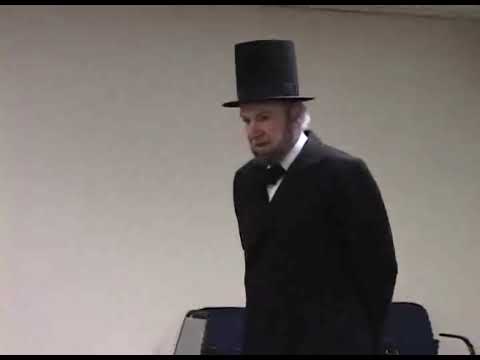
Presenter Identifying Himself as Abraham Lincoln Recounts Path to Emancipation at Library Reception
Summary
At the opening reception for the "Forever Free" exhibit, a presenter identifying himself as Abraham Lincoln reviewed his life, the Civil War and the Emancipation Proclamation, and answered audience questions about the proclamation's scope, the Freedmen's Bureau and wartime politics.
At the opening reception for the exhibit "Forever Free: Abraham Lincoln's Journey to Emancipation," a presenter identifying himself as Abraham Lincoln gave a first‑person account of his life, Civil War leadership and the path to emancipation, then answered audience questions about wartime decisions and the immediate postwar response.
The presenter described his background and legal and political career, recalled the crisis at Fort Sumter and the early war, and said that after the Union victory at Antietam he "took the opportunity 5 days later to issue the preliminary emancipation." He said the formal Emancipation Proclamation took effect on New Year's Day 1863 and that the proclamation applied only "to territory controlled by the hostile military." The presenter added that those enslaved in loyal border states and in areas already under Union control were later freed by "an amendment to the constitution," which he said he worked to secure and have ratified in 1865.
Why it matters: the presenter framed the proclamation as a deliberate military and political move that altered the character of the war. "It raised the ante in the great veil war," he said, arguing the measure transformed a conflict over Union into "a war for freedom." He gave wartime totals cited in his talk: an initial call for 50,000 volunteers, a later congressional authorization of an army of "a million men," and that "over the next 4 years, 2,200,000 men at the North served in the Union armies" with a maximum Northern strength of about a million; Southern maximum strength he cited as about 600,000. He said "over 600,000 soldiers, North and South, perished in the great American Civil War."
The presenter addressed the policy choices behind emancipation and postwar aid. On the scope of executive power he said, "By what power did I have to free slaves anywhere except in a military area?" and explained the proclamation's legal rationale as a commander in chief's military measure. When asked about federal assistance to formerly enslaved people, he said the closest program was "the Freedmen's Bureau," and added, "Unfortunately, my, successor emasculated the Freedmen's Bureau," calling federal aid to freed people limited.
During a short question-and-answer session, audience members pressed him on the Mexican-American War and President James K. Polk's motives; the presenter said that war was "fought to add slave territory to the union, pure and simple." He also addressed a question about political fortunes and reelection in 1864, arguing he believed the Confederacy would not have prevailed even had he lost, and described why he appointed former rivals to his cabinet: to give regions and party factions representation and to "keep an eye on them there." The event closed with a brief exchange and thanks from the presenter.
The remarks were delivered as part of the museum program accompanying the exhibit; the presentation included historical narrative, quoted figures and personal reflections offered in first person by the presenter who identified himself as Abraham Lincoln and was followed by audience questions.