Get Full Government Meeting Transcripts, Videos, & Alerts Forever!
Get email alerts on the City Budget topic
No spam. Unsubscribe anytime.
Mesa staff outline FY 2025–26 proposed budget: $20M rental-tax loss, new fire stations and a $147M utility transfer
Summary
City staff told the Mesa City Council May 1 that the proposed FY 2025–26 budget absorbs a roughly $20 million annual loss from the state’s elimination of the residential rental tax, funds new public-safety facilities and operations, and relies on a $147 million utility-to-general-fund transfer set by a 2020 ordinance.
Mesa City staff presented the proposed fiscal year 2025–26 budget at a City Council study session May 1 and warned the council the plan reflects a roughly $20 million annual revenue loss from the state’s elimination of the residential rental tax, sizable new public-safety spending and a $147 million utility-fund transfer that supports policing and fire services.
Brian Brady, staff member, told the council, “In this budget, this is a significant budget as far as what it is bringing into or providing additional service to the city above and beyond the current level of services.” Brady highlighted several large service additions included in the proposal, notably new fire stations, a police substation and a new full-service library.
Nut graf: The presentation framed the budget as a trade-off between continuing historic service expansions — including three new fire stations, the Northeast Public Safety Facility and the Gateway Library — and offsetting structural pressures created by recent state changes and negotiated salary adjustments. Staff said the utility-to-general-fund transfer (set by ordinance) remains a central piece of public-safety funding while the city uses reserves and department reductions to bridge near-term shortfalls.
Staff and key numbers Christy Griffin, budget operations coordinator, walked the council through revenue and transfer mechanics and specific line items. Griffin said the state’s removal of the residential rental sales tax reduces the general governmental fund by “about $20,000,000 impact ongoing.” She also summarized other revenue and cost drivers staff included in the forecast: the recently enacted flat state income-tax change (staff estimated about $7 million–$10 million impact ongoing) and citywide salary benchmark and step-pay adjustments that Griffin said total roughly $27 million–$30 million ongoing.
Griffin described the city’s utility transfer formula and the ordinance that governs it: “The transfer is determined by gross utility revenue... we take that number and then we multiply it by 30%,” she said, referring to an ordinance the council adopted in 2020 that set the transfer at 30% of gross operating revenues. For the coming fiscal year staff presented a transfer amount of about $147,000,000; staff said roughly $136,100,000 of that transfer will be allocated to public-safety budgets and about $11,000,000 to other general-government departments.
Public safety and operations added in the proposed budget Brady and staff outlined specific operational additions in the proposed budget: two new fire stations (Lehi Station 223 and Hawes Crossing 224) and associated staffing; the planned Northeast Public Safety Facility, described as the first police substation added since 2005; and three new fire stations coming online in the next year as part of a multi‑year expansion.
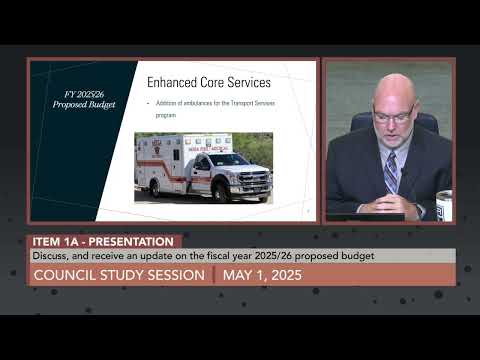
On staffing and equipment, Brady and Griffin provided counts: staff described adding roughly 12 new crew members per new station and said the budget includes nearly 100 firefighters to staff recent station additions. On emergency medical transport, Griffin said the city recently “purchased 7 new ambulances” and added 59 full‑time equivalent positions to support transport operations (she described 48 FTEs tied directly to ambulance crews, five FTEs for a rover pool and five new billers plus a coordinator). Griffin cautioned that the general fund initially carries those start‑up costs and that fees are intended to recover the expense over time.
Other items highlighted by staff included the Gateway Library (staff noted the city has not built a full‑service library since 1995), additional park operations at Eastmark, continued ARPA‑funded programs being absorbed into ongoing funding (examples cited by staff included behavioral-health supports and the Mesa Business Builder small‑business program) and cybersecurity license renewals purchased initially with ARPA funding.
Reserves, forecast changes and timing Christy Griffin presented updates to the multi‑year forecast. She said recent updates — including higher‑than‑forecast building permit revenues, slightly stronger state shared revenues and departmental year‑end vacancy savings — improved the FY 2024–25 estimate from a projected negative $18.1 million in April to a negative $4.3 million in the latest update. Griffin reported the forecasted ending reserve balance in the fifth year is now about 9.4% (it had been 7.8% in April).
Councilmembers pressed staff about assumptions embedded in the utility forecast and future rate adjustments. Griffin and Brady said the transfer is calculated from forecasted gross utility revenues (after pass‑throughs) and that staff has included multi‑year, smoothed rate assumptions in its model (staff referenced typical annual assumptions in the range of about 4%–6% for some utilities and higher for certain commercial classes). Brady emphasized council will revisit utility rates in the fall and may choose to defer or change projects instead of raising rates.
Process, community meetings and next steps Staff listed upcoming public engagements and calendar dates: community budget meetings on May 7 (Red Mountain Recreation Center) and May 14 (downtown Mesa), tentative budget adoption on May 19, a public hearing and adoption of the five‑year capital improvement program on June 2, and final adoption of the FY 2025–26 budget and the secondary property‑tax levy hearings in mid June (staff cited June 16 for the secondary property‑tax adoption). Staff also said the tentative budget will include pie charts and attachments that show the general governmental fund resource and expenditure splits.
Decision vs. discussion The May 1 session was a presentation and discussion; staff did not take a formal vote on the budget at the meeting. The council did take unrelated formal action during the session to acknowledge receipt of executive‑session minutes (motion by Councilmember Duff, second by Councilmember Go Forth; vote recorded as six ayes with the mayor absent). Staff reiterated the council will have opportunities to tweak allocations between May 19 and final adoption but warned the tentative adoption on May 19 sets the maximum budget that can be allocated unless the council reduces that total.
Ending Staff asked the public to use the budget page on the city website to submit feedback and noted the council will receive summaries of public comments before the tentative adoption. The council and staff agreed to provide the assumed multi‑year utility‑rate schedule and to include the general‑fund pie charts with the May 19 tentative budget packet so members and the public can see the revenue and expenditure flows staff used in the forecast.