Get Full Government Meeting Transcripts, Videos, & Alerts Forever!
Get email alerts on the Glacial Lake Missoula Ice Age Floods topic
No spam. Unsubscribe anytime.
Geologist describes scale of Glacial Lake Missoula floods and urges congressional recognition, visitor center
Summary
At a Missoula Public Library lecture, a geologist outlined evidence that repeated Ice Age floods carved landscapes from Western Montana to the Pacific, described the scientific history, and urged local support for visitor facilities and two bills pending in Congress.
A geologist who spoke at the Missoula Public Library on Feb. 20, 2007, described the size and reach of the Ice Age floods tied to Glacial Lake Missoula, urged local support for a visitor center in Missoula and asked attendees to encourage their congressional delegations to cosponsor federal legislation to recognize the floods.
The presenter said Glacial Lake Missoula held roughly 500 cubic miles of water at its highest stands and that the lake could have drained over a period of “somewhere between 2 days and 2 weeks.” He described maximum local water depths of up to about 2,000 feet near the ice dam and estimated peak discharge at constrictions as high as 9.4 cubic miles of water per hour. “Think about that. 10 times the flow of all the rivers of the world today,” the geologist said, describing the floods that carved the Channel Scablands of central Washington and the Grand Coulee.
The lecture traced the scientific debate behind the flood interpretation, recounting early 20th-century controversy around geologist J Harlen Bretz’s catastrophic-flood hypothesis and noting Joseph T. Pardee’s later work linking the floods to Glacial Lake Missoula. The presenter said visual evidence such as giant ripple marks in the Camas Prairie and large gravel bars, as well as scoured basalt channels and transported boulders, supported the interpretation now accepted by the geoscience community.
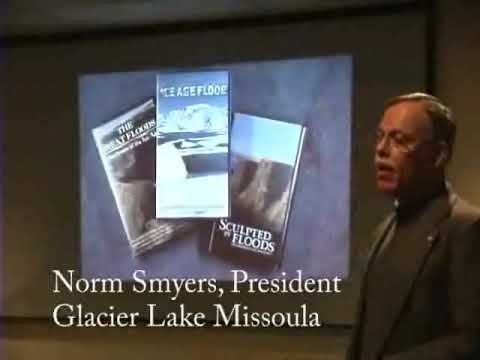
Beyond the science, the speaker outlined local heritage and tourism goals. He described a vision for a visitor center near Missoula’s ballpark to concentrate visitor parking and guide tours into downtown, saying the Ice Age Floods story could keep visitors in the region “one more day.” He said the Ice Age Floods Institute has produced field trips, videos and chapters across four states and that a regional study and guidebook were completed and forwarded to federal officials in 2001.
The presenter also discussed recent federal legislation introduced to recognize the Ice Age Floods. He said two bills had been introduced (a Senate bill and a House bill) and that a previous Senate bill (identified by the speaker as Senate Bill 206) had once passed a chamber unanimously. He asked the audience to encourage their senators and representatives to cosponsor current bills; no formal vote or municipal action was taken at the library event.
The talk closed with historical context for how acceptance of the flood interpretation developed over decades and how recognition could tie into recreation, education and regional economic benefits from added tourism.