Get Full Government Meeting Transcripts, Videos, & Alerts Forever!
Get email alerts on the Aprn Independent Practice topic
No spam. Unsubscribe anytime.
Senate committee hears divided testimony on bill to let experienced APRNs practice without physician delegation
Summary
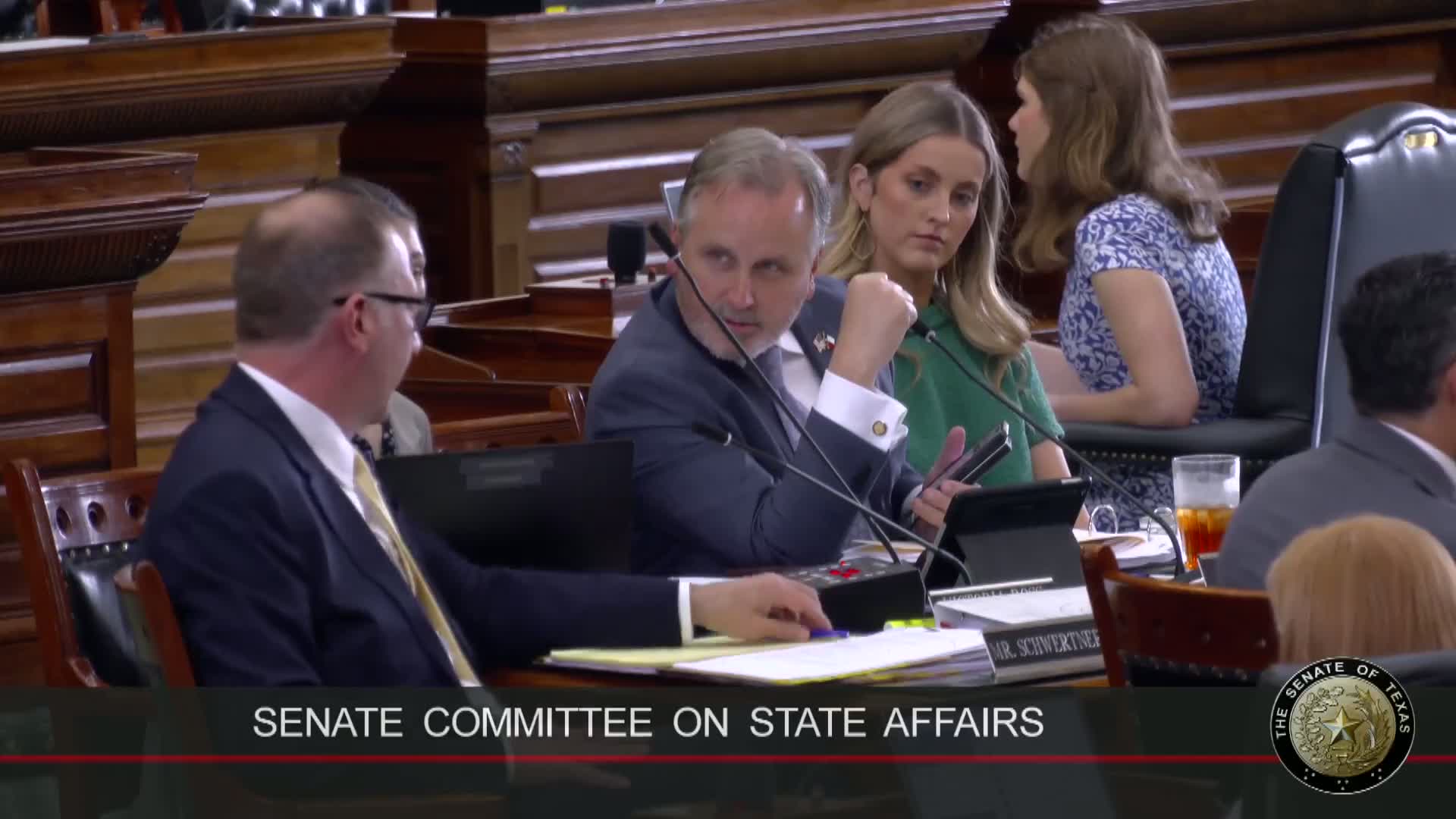
The Senate Committee on State Affairs spent most of its hearing on Senate Bill 3055, a proposal to let certain advanced practice registered nurses (APRNs) practice without a physician delegation in many rural Texas counties, with testimony sharply divided between supporters who said the change would expand access to care and opponents who warned it would amount to a de facto expansion of medical practice.
The Senate Committee on State Affairs spent most of its hearing on Senate Bill 3055, a proposal to let certain advanced practice registered nurses (APRNs) practice without a physician delegation in many rural Texas counties, with debate sharply divided between supporters who said the change would expand access to care and opponents who warned it would amount to a de facto expansion of medical practice.
Proponents said the bill is a targeted access measure for rural areas and keeps patient safety intact because APRNs would still be licensed and nationally certified. Erin Bettis, a nurse practitioner and University Health System clinician, told the committee, “SB 3055 does not change scope. If this bill passed, my colleagues in rural Texas would be doing the same exact job tomorrow as they are doing today. Nurse practitioners practice advanced practice nursing, not medicine.” Supporters also cited earlier pandemic waivers and the experience of 27 states that have removed delegation requirements as evidence independent practice can be safe and increase provider supply.
Opponents from the physician community argued the bill changes who performs diagnosis and treatment. Ray Callas, president of the Texas Medical Association, called the measure “definitely a scope of practice bill and it is something that is very concerning to me,” and warned that differences in training between physicians and APRNs are substantive, not quantitative. Internal medicine physician David Widmer told the committee, “Quality of care improves with appropriate physician led team based care models, which promote oversight and collaboration while keeping patient safety the priority.”
Key provisions discussed at the hearing include a population-and-experience pathway laid out in the bill: eligibility for independent practice would be limited to APRNs practicing in counties under a population threshold (the bill references the Medicaid-based rural definition of about 68,750 residents, affecting roughly 208 counties in the sponsors' estimate). The substitute and floor discussion proposed transition periods for newly graduated APRNs (a 4‑year / 8,000 clinical‑hour supervised interval before independent practice) and grandfathering language for long‑practicing APRNs (10 years or 20,000 clinical hours under delegation in some versions reviewed by the committee). Supporters said the bill would allow APRNs already serving rural areas to expand clinics and improve local access without the monthly delegation fees many describe as onerous; several rural clinic leaders testified they spend tens of thousands annually on physician oversight arrangements.
Physicians and medical groups pressed the committee on several practical issues: whether the Texas Board of Nursing has the statutory authority, staffing and subject matter expertise to regulate independent APRN practice in areas the submitters called closely aligned with medicine; what processes would be used to adjudicate clinical complaints that raise medical‑standard issues; and how malpractice and liability will be handled if nonphysicians have independent prescriptive and diagnostic authority. As one physician put it, “There is no shortcut. The practice of medicine is the product of an extensive and standardized education and supervised clinical skills training that cannot be wished away.”
Committee members also explored the bill’s details with witnesses: whether delegation fees could be addressed by other legislation (Senate Bill 2695 was discussed in the hearing as an alternative approach addressing rural supervision and delegation fees), whether independent APRN practice would actually draw more clinicians to rural counties, and whether state oversight resources would be sufficient if the Board of Nursing took on significantly expanded licensing responsibilities. Multiple witnesses suggested layered policy responses — more residency slots, loan‑repayment programs and other incentives for physicians — rather than a statutory removal of supervision requirements.
By the end of the hearing the committee had heard hours of invited and public testimony representing APRNs, university nursing programs, critical‑access hospitals, medical specialty societies, private physicians and patient advocacy groups. No final vote was taken; the committee left SB 3055 pending for further consideration.
Ending: The committee will consider possible changes and additional data before advancing the measure. Committee staff were asked to assemble licensing, complaint, and workforce data to help members weigh access gains against regulatory and patient‑safety concerns.