Get Full Government Meeting Transcripts, Videos, & Alerts Forever!
Get email alerts on the Artificial Intelligence Governance topic
No spam. Unsubscribe anytime.
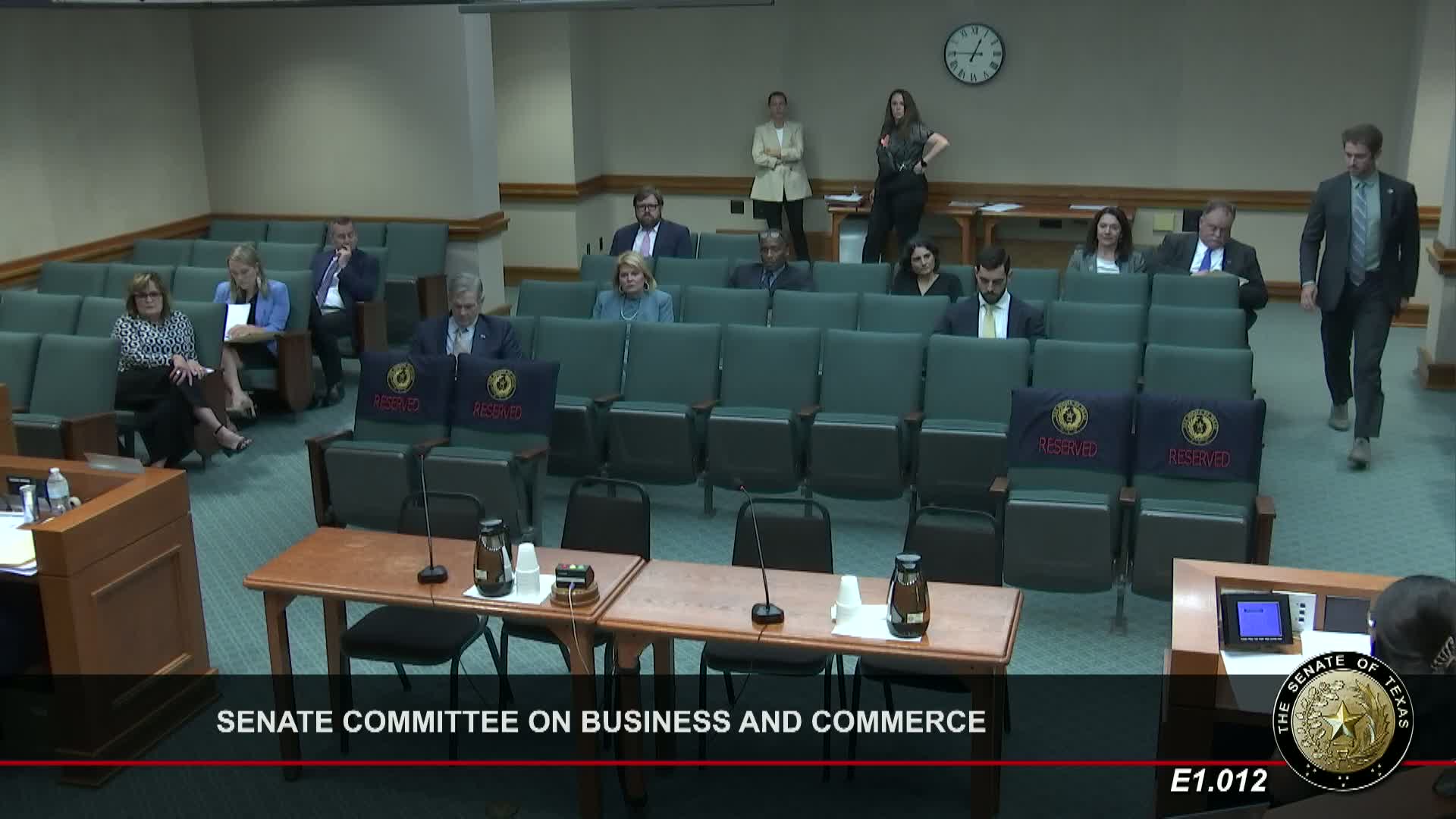
Senate committee hears broad support for HB 149, an artificial intelligence governance bill
Summary
The Senate Committee on Business & Commerce heard hour-long testimony on HB 149, the Artificial Intelligence Governance Act, with supporters praising its outcomes-based approach and sandbox provisions; the committee left the bill pending after public testimony.
The Senate Committee on Business & Commerce on Thursday heard testimony on HB 149, the Artificial Intelligence Governance Act, which sponsor Senator Fortner told the panel would create a framework for ‘‘reasonable’’ AI development while preserving innovation.
The measure, Senator Fortner said, would require government agencies to disclose when individuals interact with AI systems, bar AI designed to ‘‘negatively manipulate human behavior’’ or to perform social scoring, protect biometric identifiers from nonconsensual capture, prohibit unlawful discrimination and address deep-fake child exploitation. Fortner also described an AI sandbox and an AI council to study regulatory updates and to oversee testing in controlled environments.
Supporters from across industry and policy groups told the committee they favor the bill’s mix of defined prohibited harms and flexible, outcomes-based rules. David Dunmoyer of the Texas Public Policy Foundation said HB 149 ‘‘signals to the country and the world that we are gonna be the epicenter [of] responsible innovation with AI.’’ Dominic Cruciani, an attorney who has written on AI, said HB 149 ‘‘installs a new sheriff in this digital town’’ by updating rules to reflect widespread, human-like AI actors.
Witnesses from privacy and civil‑society groups urged limited changes. Ann Bedorin of Texas Appleseed said she supports the bill overall but asked the committee to consider giving regulators limited examination authority within the sandbox so problems can be identified before harms occur. Representatives for Clearview and Technet sought clarifications about law‑enforcement access to facial‑recognition services and alignment with other state laws, and Glenn Hammer, president and CEO of the Texas Association of Business, urged technical edits and urged the committee to keep statewide consistency amid many AI bills.
There was no committee vote; after public testimony the chair closed testimony and left HB 149 pending. The committee recorded multiple supporters from industry and advocacy groups and signaled further technical discussions ahead.
The hearing combined policy detail and stakeholder requests: proponents emphasized enumerated harms and a 60‑day cure period and lighter investigative powers for the attorney general, while civil‑rights and privacy advocates asked for clearer enforcement windows and regulator access to detect misuse during sandbox testing. Committee leaders said staff would continue to work with stakeholders on technical language.
No final action was taken on HB 149 at this hearing; the bill remains pending.