Get Full Government Meeting Transcripts, Videos, & Alerts Forever!
Get email alerts on the Bilingual Education topic
No spam. Unsubscribe anytime.
Senate committee hears testimony supporting Texas Seal of Biliteracy bill
Summary
Supporters told the Senate Committee on Education that Senate Bill 1414 would create a statewide Texas Seal of Biliteracy to recognize multilingual high school graduates and address gaps in the current acknowledgement for emergent bilingual students.
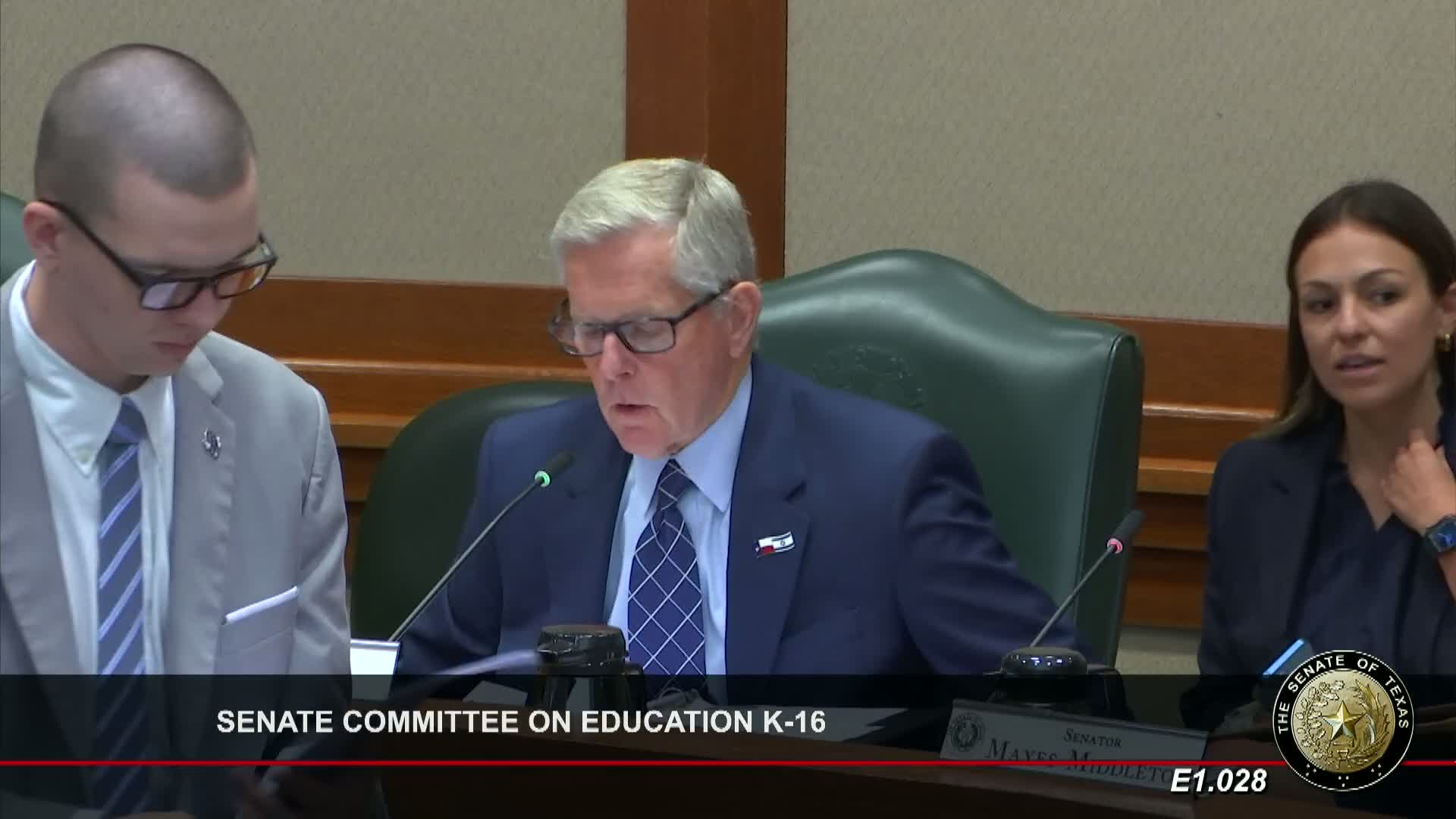
The Senate Committee on Education heard testimony May 1 on Senate Bill 1414, a measure to create a Texas Seal of Biliteracy that would provide a uniform statewide credential for students proficient in two languages.
Proponents told the committee the bill would expand recognition, promote equity and support workforce readiness by allowing a literal seal or transcript notation that signals language proficiency to colleges and employers. "Senate Bill 1414 would establish the Texas Seal of Biliteracy to provide a uniform statewide credential for students fluent in two languages," Senator King said while laying out the measure.
Experts and advocates who testified said the current performance acknowledgment in Texas is limited. "For over a decade, Texas schools have had the option to recognize high school students graduating with advanced achievement in more than one language. But that pathway ... excludes emergent bilingual students who make up one in four students in our public schools," Dr. Chloe Latham Sykes, deputy director of policy at IDRA, told the committee.
Dr. Elisa Hernandez Neisler, legislative chair for the Texas Association for Bilingual Education, said the seal would make multilingual skills "available to all Texas students, providing them with a standardized credential that is respected by colleges." Jaime Puente, director of economic opportunity, noted economic benefits, saying bilingual high school graduates without a college degree can earn roughly $28,000 a year compared with $27,000 for monolingual peers, and that bilingualism can increase lifetime earnings with higher degrees.
Committee members asked about demonstration methods in the bill, including portfolios or projects. Sykes said the proposal follows national best practices used in other states by offering multiple ways for students to demonstrate advanced language skills beyond standardized tests and GPA.
Public testimony was limited to invited and registered witnesses; the committee left the bill pending subject to the call of the chair.
The bill's backers urged the committee to adopt the committee substitute that had been filed before testimony. No formal vote was taken during the hearing.