Get Full Government Meeting Transcripts, Videos, & Alerts Forever!
Get email alerts on the Juvenile Justice Probation Monitoring topic
No spam. Unsubscribe anytime.
Senate trims and tests juvenile-justice provisions in broader public-safety bill after floor fights
Summary
Floor votes removed a proposed "super predator" category and defeated several surveillance expansions while lawmakers adopted a compromise that kept tampering with electronic monitors a misdemeanor in some cases; the larger public-safety package advanced after multiple roll-call and floor-amendment votes.
Lincoln — A prolonged floor debate on Thursday over juvenile-justice language included in a broader public-safety package ended with lawmakers rejecting a measure that would have created a so-called "super predator" category for certain juveniles and adopting a targeted compromise on electronic monitoring penalties.
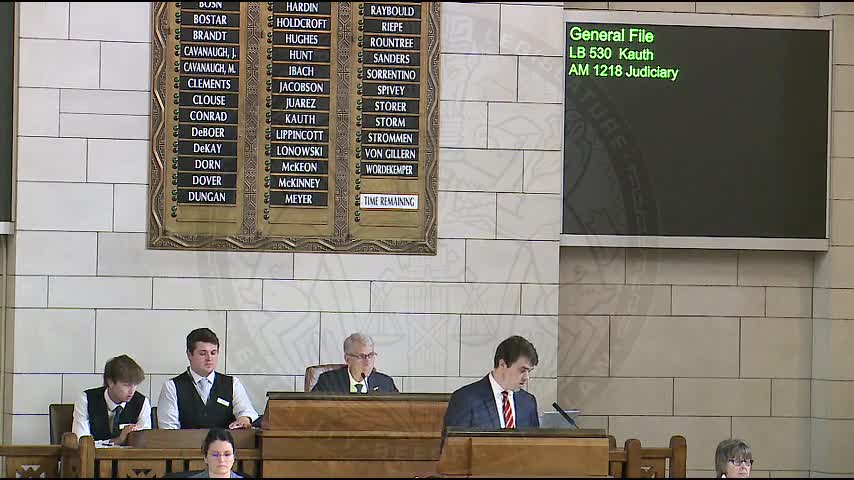
Senator Julie Kaut, sponsor for the committee package (LB530 and associated provisions), told the Legislature the bill responds to concerns about excessive speeding and vulnerable road-user protections but that it also includes several related public-safety provisions negotiated in committee. The judiciary-led package was divided into multiple parts on the floor; several contested juvenile-justice sections drew extended debate and floor amendments.
What the floor did: Senator Spivey offered a series of floor amendments aimed at removing or narrowing juvenile-justice provisions she and other critics said risked harsher, long-term punishments for youth. The body rejected FA 1-63, which would have struck section 17 (the provision opponents described as creating a "super predator" category) on a roll call of 14 ayes, 25 nays. Spivey then proposed FA 1-64 (striking a requirement that probation generate monthly lists of juveniles for law enforcement); that amendment failed on a 12-25 vote. However, Spivey and the committee chair reached a negotiated compromise on electronic-monitor tampering: FA 1-65 replaced language that would have upgraded tampering with monitoring equipment to a felony with a compromise that keeps tampering a misdemeanor in relevant cases; FA 1-65 passed on a roll call of 37-0.
Senator Spivey framed her opposition as concern for rehabilitative outcomes for youth, particularly those from Douglas County neighborhoods she said are disproportionately affected. Speaking for the package, Senator Devanne Boson (chair, Judiciary Committee) said she would continue negotiations and emphasized that the committee would take remaining concerns through select-file work.
Other contested votes and the process: The package contained four divisions; the Senate adopted the first division (AM 12-18) and later the remaining divisions after individual floor votes. A later committee amendment (AM 12-19) concerning enhanced penalties when drug dealing results in death or serious bodily injury (the sponsor’s LB6 component) was adopted. Several proposed floor amendments to remove surveillance language were rejected while the electronic-monitor compromise was accepted as a good-faith adjustment before select-file negotiations.
Outcome: After adopting the divided committee amendments and resolving contested juvenile-justice language by floor votes, the Legislature advanced the larger public-safety bill (LB530) to E & R initial on a recorded vote of 33 ayes, no nays.
Why it matters: The votes narrow—but do not eliminate—several new sanctions and information-sharing proposals affecting juveniles on probation. Opponents warned that language creating new categories or expanding data-sharing with law enforcement could increase incarceration and chill rehabilitation; supporters said some provisions improve safety and court supervision mechanisms. Lawmakers signaled more work between general and select files to refine the balance between accountability and rehabilitation.