Get Full Government Meeting Transcripts, Videos, & Alerts Forever!
Get email alerts on the Elections Administration topic
No spam. Unsubscribe anytime.
Senate adopts broad elections update including petition and ballot rules, advances LB521
Summary
The Legislature adopted a multi-bill committee amendment to LB521 that updates Nebraska election procedures — standardizing petition forms, changing voter ID rules, clarifying counting and recount processes and adding several bills into the package — and advanced the measure to E & R initial.
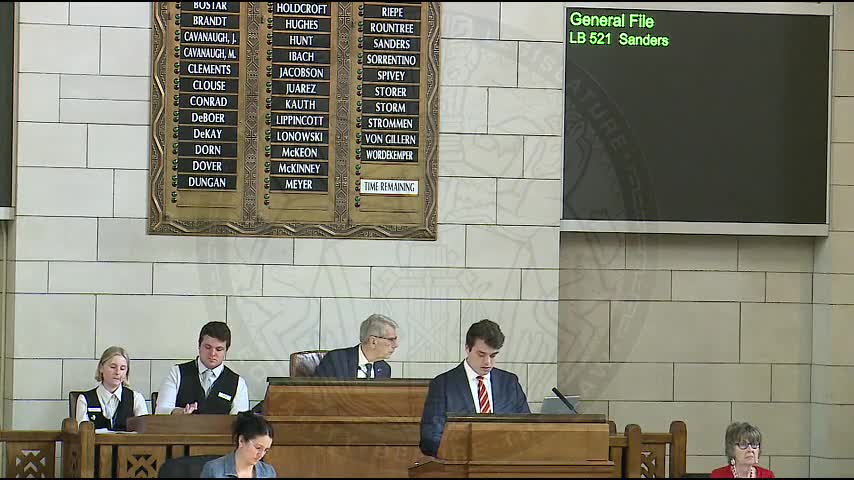
Lincoln — The Nebraska Legislature on Thursday adopted a large committee amendment to Legislative Bill 521, a government committee priority that bundles a broad set of updates to the State Elections Act.
Senator Machaela Sanders, chair of the Government, Military and Veterans Affairs Committee, said AM 11-52 is a “Christmas tree” amendment that folded in four other bills the committee had already approved unanimously and made modest additional changes to streamline petitions, identify verification and vote-counting procedures.
Why it matters: LB521 updates long-standing procedures that election officials and the secretary of state recommended, standardizes forms and clarifies how petitions, signature verification and candidate objections are handled statewide. Proponents said the changes strengthen ballot integrity and reduce administrative confusion; critics warned that some provisions could chill First Amendment activity if not adjusted.
Key provisions: The adopted amendment standardizes petition forms, sets procedures for verifying petition signatures and identification envelopes, clarifies candidate filing and withdrawal processes, adjusts timing rules for special elections near legal holidays, and prescribes rules for counting-watchers and the vote-counting environment. It also adds four other committee bills into the package: LB19 (allowing cities of metropolitan and primary class to place city elections on even-year presidential/general election calendars by city charter amendment), LB238 (a narrow Open Meetings Act exemption for the Foster Care Review Advisory Committee), LB243 (correcting sunset and notice language in the Open Meetings Act) and LB659 (reforms to vote-counting-device testing and watcher/observer procedures).
Public comment and floor debate: Senator Conrad raised a specific concern about a provision that would bar petition circulation within 200 feet of a secure ballot drop box and would make violations a class 5 misdemeanor. Conrad warned the measure could “chill protected First Amendment activity” for petition circulators and noted differing drop-box locations and practices across counties. Chair Sanders and committee staff indicated they would work with colleagues on the concern going forward; the committee amendment was adopted without floor changes.
Votes and procedure: The committee amendment AM 11-52 was adopted on a recorded vote (41 ayes, no nays), and LB521 advanced to E & R initial (42 ayes, no nays). The committee reported unanimous support for the bills included in the package at their hearings.
Specific items called out on the floor: Senator John Kavanaugh explained LB19, which gives Omaha and Lincoln the option to move city elections to coincide with statewide presidential and general elections by charter amendment; Douglas County election officials told the Legislature the move could save Omaha up to $1 million in election costs. Senator Anderson described LB659’s vote-counting testing reforms, which require party representatives and technicians to participate in pre-election machine tests and require local certification to the secretary of state.
Limits and next steps: Although the committee amendment includes criminal sanctions tied to petition-distance rules, several senators asked for follow-up work to ensure enforcement won’t unintentionally penalize lawful petition circulators. Sponsors said the committee would work with election officials and the secretary of state if further technical fixes are needed as the bill proceeds to select file and final reading.