Get Full Government Meeting Transcripts, Videos, & Alerts Forever!
Get email alerts on the Pharmacy Benefit Managers topic
No spam. Unsubscribe anytime.
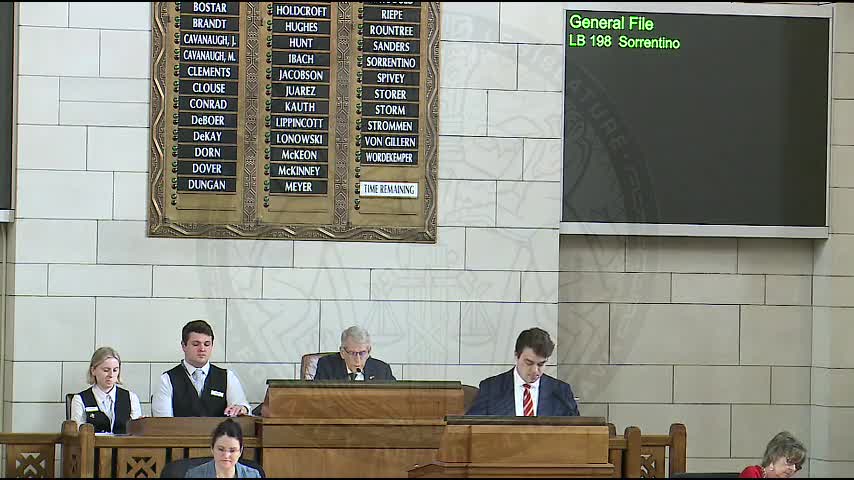
Senate adopts package to tighten pharmacy benefit manager rules, advances LB198
Summary
The Nebraska Legislature adopted committee amendments to LB198 to expand regulation of pharmacy benefit managers, bar certain shipping mandates and phase out spread pricing; the bill passed to E & R initial after unanimous floor votes.
Lincoln — The Nebraska Legislature on Thursday adopted a committee amendment to Legislative Bill 198 that tightens state oversight of pharmacy benefit managers and advances the bill to E & R initial.
Senator Terrell Sorrentino, sponsor of LB198, said the amended bill addresses multiple PBM business practices and “should allow substantial savings” for state Medicaid and employer-sponsored plans. The measure was amended by the Banking, Commerce and Insurance Committee and the floor adopted additional technical fixes before voting to advance the bill.
Why it matters: PBMs act as middlemen between insurers and pharmacies; proponents say greater transparency, prohibitions on certain contracting practices and protections for independent specialty and community pharmacies can improve patient access and lower program costs. Opponents had been concerned about unintended preemption under federal law, but sponsors said the amendment was drafted to fit within the U.S. Supreme Court’s guidance in Rutledge v. PCMA.
Most important points: The adopted committee amendment (AM 12-01 with a small clarifying change in AM 12-29) contains multiple provisions negotiated with stakeholders. Among the changes the Legislature adopted are: restrictions on mandatory direct-to-patient shipping and “white-bagging” practices for certain specialty medications; protections preventing PBMs or carriers from steering patients exclusively to affiliated pharmacies; provisions easing excessive data-reporting burdens on small specialty pharmacies; a prohibition on spread pricing in new PBM contracts beginning in 2026 and a full ban by Jan. 1, 2029; and language allowing pharmacists to decline dispensing when reimbursement is below the pharmacy’s acquisition cost without retaliation.
Senator John Jacobson, chairing the Banking and Insurance Committee during the floor debate, described the package as “the beginning of a fairly long journey” and called the amendment “the low-hanging fruit” that stakeholders had negotiated in good faith. Jacobson also filed AM 12-29, a short technical tweak clarifying the standard for “substantially similar costs,” which the floor adopted without opposition.
Supporters and process: Senator Sorrentino said the committee amendment is the product of more than a dozen stakeholder meetings, including the Nebraska Pharmacists Association, the Nebraska Hospital Association, Blue Cross Blue Shield of Nebraska and PBM trade groups. He told colleagues that the three largest PBMs—Caremark, Optum and Express Scripts—manage benefits for the majority of U.S. patients and that the bill’s changes apply to Nebraska’s Medicaid program as well.
Senator Machaela Duncan, a member of the Banking, Commerce and Insurance Committee, voiced support on the floor, calling the package “a really good faith step forward.” Senator Doug Hallstrom, who also spoke in favor, urged further study and noted the size of potential PBM “spreads” documented in other states’ audits.
Votes and next steps: The Legislature adopted the technical amendment AM 12-29 (moved by Senator Jacobson) by voice and later formally recorded the committee amendment AM 12-01 as adopted (roll call recorded as 37 ayes, no nays on the adoption of the committee amendment). The bill then advanced to E & R initial on a recorded vote of 39 ayes, no nays.
Context and limitations: The bill’s sponsors repeatedly referenced the U.S. Supreme Court decision in Rutledge v. PCMA as legal precedent allowing states more leeway to regulate PBMs without being preempted under ERISA. The bill’s text and committee amendment avoid prescription of plan benefits and instead regulate pricing practices, patient access and reporting. Sponsors said the bill is designed to withstand legal challenge based on current federal case law, but it does not guarantee immunity from future litigation.
What the bill does not do: The legislation does not set specific reimbursement rates for drugs, does not itself order statewide audits, nor does it mandate that PBMs adopt any particular commercial contract terms beyond the prohibitions and transparency requirements written into the amendment.
Outlook: LB198 now goes to the next legislative steps (E & R engrossing). Sponsors said they expect continued work in an interim study to examine additional PBM practices and implementation details.