Get Full Government Meeting Transcripts, Videos, & Alerts Forever!
Get email alerts on the Behavioral Health Parity topic
No spam. Unsubscribe anytime.
Senate committee advances bill to align Alaska Medicaid rules with federal behavioral-health parity requirements
Summary
The Senate Health and Social Services Committee moved SB 45 from committee after testimony from behavioral-health providers and advocates who said current Medicaid documentation rules for behavioral health are burdensome and impair access to care; the bill would require reporting, a market review and federal Medicaid plan amendments.
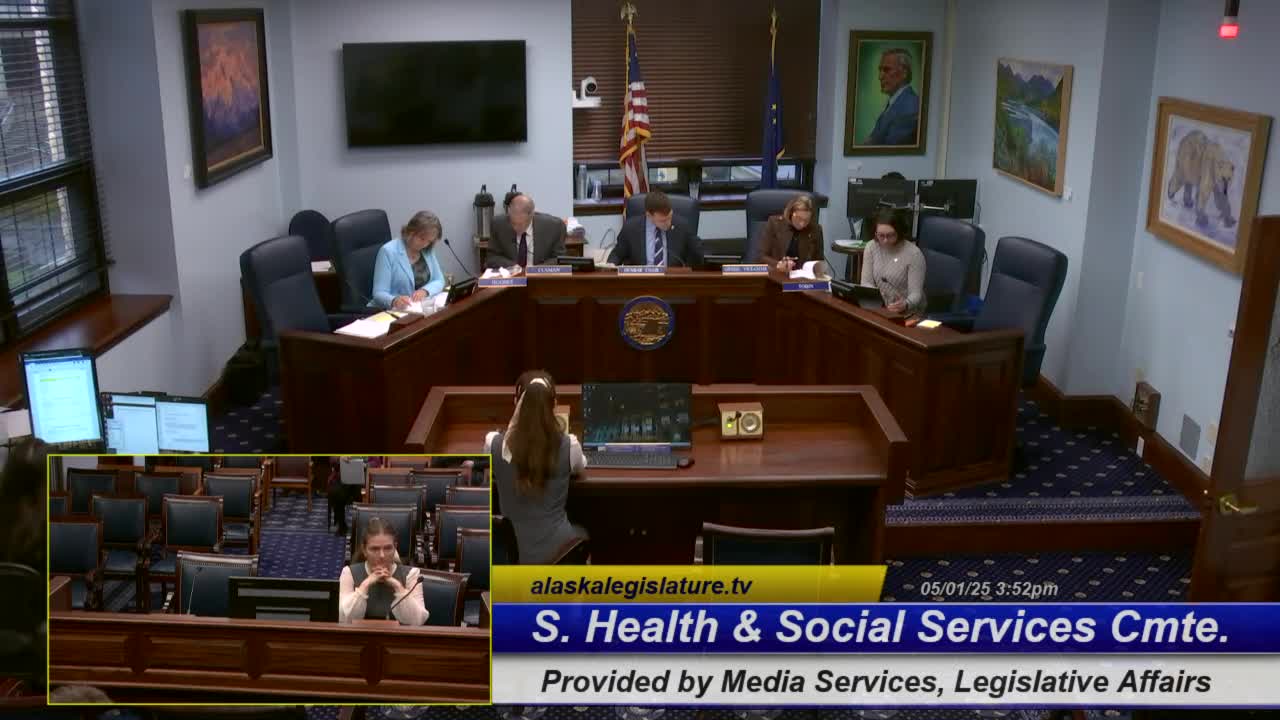
Juneau ' The Senate Health and Social Services Committee voted May 1 to move Senate Bill 45 out of committee after hearing providers and advocates describe how Alaska's Medicaid documentation and regulatory framework can delay behavioral-health care.
SB 45 would require the Department of Health to align state Medicaid rules and practices with federal behavioral-health parity law, investigate complaints about behavioral-health coverage, and produce annual reports describing comparability of medical- and behavioral-health treatment limitations. The bill also directs the department to submit any necessary Medicaid plan amendments and conditions certain sections on federal approval.
Lance Johnson, chief operating officer of the Alaska Behavioral Health Association, told the committee that behavioral-health providers must follow roughly 130 pages of Alaska regulations while medical care is tied to a much shorter documentation standard. "If you go to the doctor for a broken hand, you'll get an exam, you'll get an x-ray, you'll get a cast all on the same day," Johnson said. "When you go to a behavioral health provider for a broken heart, you must do a screening intake week 1, an assessment week 2, a treatment plan week 3. If you're lucky, you'll get your first treatment service week 4." He warned the mismatch reduces clinical availability and leaves many untreated.
Maxwell Mercer, who runs children's mental-health services for Community Connections in Ketchikan, said his agency can serve about 20 percent of referred families because administrative burdens limit capacity. "The administrative burden really gets in our way and really limits the number of kids and families that we can help," Mercer said.
Committee aide Ariel Wigan read the text of version A during the hearing; Wigan described provisions requiring annual reporting by March 1 on medical- and behavioral-health criteria for medical necessity, any numerical and non-numerical limits, and whether those criteria are applied comparably. The bill also calls for a one-time departmental report by March 1, 2026, describing methodology, market review, corrective steps and plain-language findings, and it conditions the effective date of sections on HHS approval of state Medicaid plan amendments by Dec. 31, 2025.
Committee members asked about fiscal sources referenced in the fiscal note; Susan Kessler and Tracy Domplin of the Department of Health confirmed the department has received some Mental Health Trust Authority funding and state mental-health general funds for related work and offered to provide additional detail.
Vice Chair Senator Tobin moved SB 45, version A, from committee with individual recommendations and an attached fiscal note dated Jan. 24, 2025 with OMB component number 2665. There were no objections and the bill was advanced.
Testimony emphasized that SB 45 is not an immediate fix but would mandate a process for parity review and corrective steps meant to persist beyond any single administration.