Get Full Government Meeting Transcripts, Videos, & Alerts Forever!
Get email alerts on the Transfer On Death Title topic
No spam. Unsubscribe anytime.
Alaska Senate committee hears bill to allow transfer-on-death titles for vehicles, boats and some manufactured homes
Summary
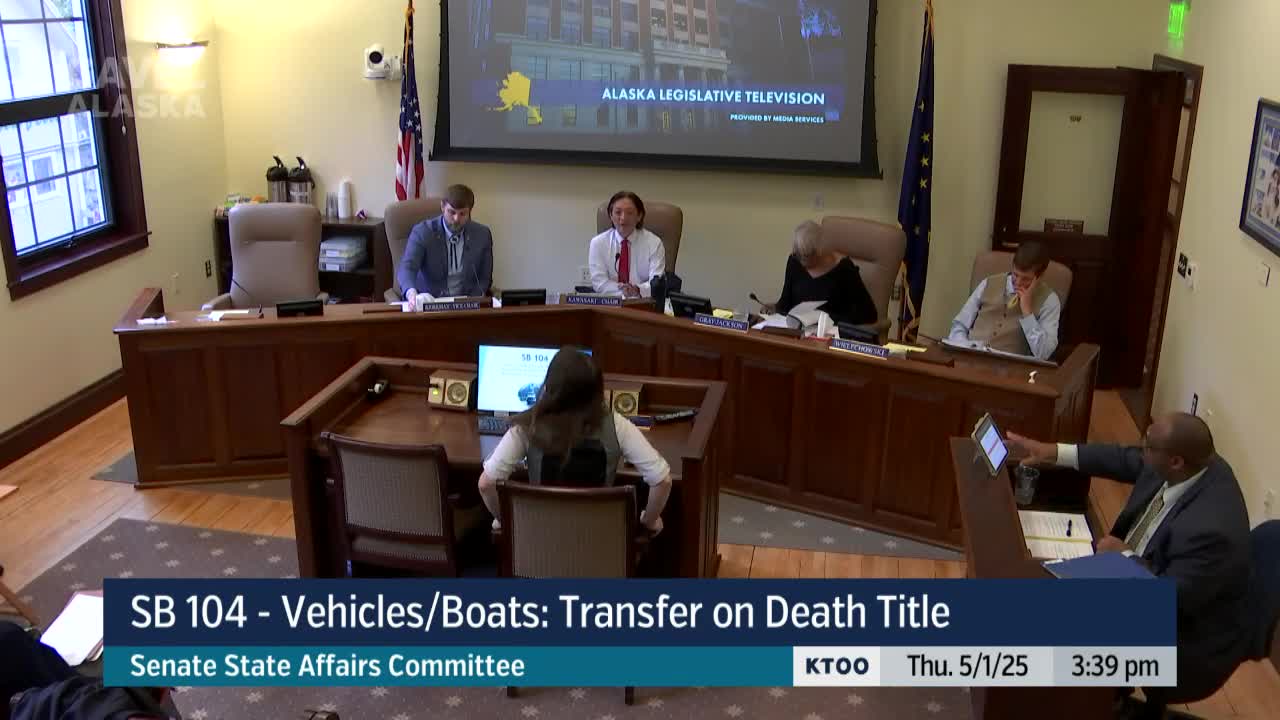
The Senate State Affairs Committee heard testimony May 1 on SB104, which would let Alaskans put transfer‑on‑death beneficiary designations on vehicle, boat and certain manufactured‑home titles to allow those assets to pass outside probate.
Juneau — The Senate State Affairs Committee on May 1 heard testimony on Senate Bill 104, a measure that would let Alaskans put a transfer‑on‑death (TOD) designation on vehicle and boat certificates of title and on certain manufactured homes that are not permanently affixed to land.
Sponsor staffer Jenna Calhoun told the committee the measure “extends this legal instrument to boats, vehicles, and certain manufactured homes that are titled through the DMV.” She said the change is modeled on Alaska’s transfer‑on‑death deed for real property, enacted in 2014, and would allow these titled personal property assets to pass to a named beneficiary outside probate.
Proponents told lawmakers the change would reduce probate costs, speed family access to vehicles and boats, and help small family businesses that depend on a vessel or vehicle. Attorney Chelsea Ricola, testifying online, said she “fully support[s] this bill as providing access to justice,” citing pro bono work that shows vehicles and boats commonly create small probate matters that nevertheless consume court resources.
Abigail O’Connor, chief fiduciary officer at Peak Trust Company, said the bill “solves a timing problem for the surviving family members” and helps with insurance and continuity when a family needs prompt access to a vehicle or boat. Juneau attorney Christopher Walker called the proposal “a common sense measure” that fills a gap in current tools for avoiding probate on certain personal property.
The bill would allow an owner to name up to two beneficiaries and to revoke or change the beneficiary while alive without notifying the beneficiary. A designated beneficiary may disclaim the asset; recipients accept the vehicle subject to conveyances, encumbrances, liens or other interests that existed on the date of the owner’s death. As witness Linda Halbert, an insurance professional from Fairbanks, explained, the right to decline is an important safeguard if debts or maintenance obligations make the asset impractical for a recipient.
Committee members questioned how creditor claims and co‑ownership interests would be handled. Attorneys said the bill mirrors the TOD deed framework: creditor claims against the decedent’s estate can be asserted during a one‑year period after death, and an encumbrance that travels with the asset remains the responsibility of the person who accepts it. Chris Walker explained the transfer‑on‑death vehicle title as drafted would apply only to a sole owner or the last surviving owner; fractional interests held by concurrent or joint owners are not converted into sole ownership by this provision.
Senator Wilikowski raised a statutory reference (AS 28.10.201) in the bill’s definition of “vehicle”; staff said they would re‑check the cited section to ensure the cross‑reference is correct. Sponsor staff said the committee will return to a sectional analysis at a later hearing and kept public testimony open. The committee did not vote on SB104 on May 1.
The committee accepted invited testimony from: Chelsea Ricola, attorney (Foley & Pearson, Anchorage); Christopher Walker, attorney (Faulkner Banfield, Juneau); Abigail O’Connor, chief fiduciary officer (Peak Trust Company, Anchorage); and Linda Halbert, insurance professional (Fairbanks). The authors and witnesses noted implementation details — an application and fee to the Department of Administration (DMV) to fund administration — will be required to operationalize the program.
If enacted, Senate Bill 104 would allow owners to pass titled vehicles, boats and some non‑permanently sited manufactured homes outside probate, subject to existing creditor rights and lien priorities. Lawmakers said they will revisit the measure for a sectional review at a later committee meeting and asked staff to confirm statutory cross‑references and the precise list of titleable manufactured homes.