Get Full Government Meeting Transcripts, Videos, & Alerts Forever!
Get email alerts on the Aidea Workforce Housing Sb14 topic
No spam. Unsubscribe anytime.
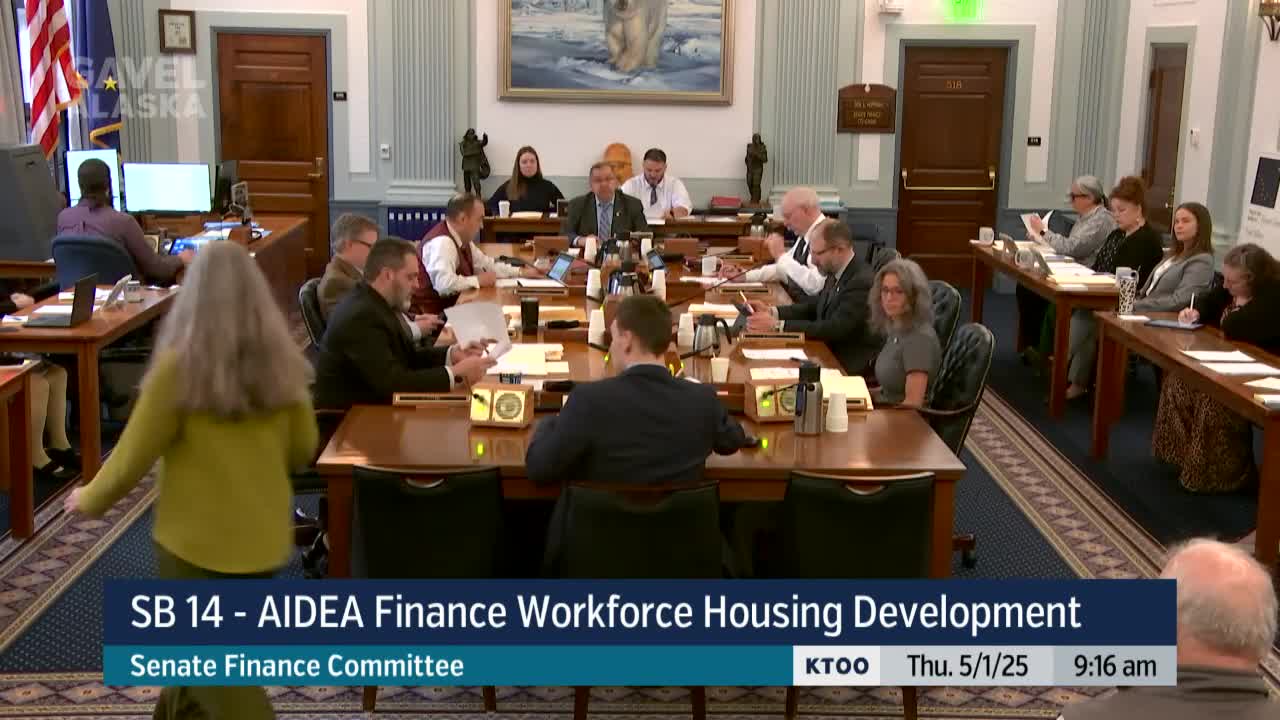
Senate Finance Committee hears testimony on bill to allow AIDEA to finance workforce housing projects
Summary
Senate Bill 14 would add workforce housing to the Alaska Industrial Development and Export Authority’s financing objectives, enabling AIDEA to support construction of multifamily workforce housing using loan participation and other financing tools; the committee held invited testimony and set the bill aside for further consideration.
Senate Bill 14, introduced May 1 by Senator Forrest Dunbar, would add workforce housing to the Alaska Industrial Development and Export Authority’s (AIDEA) mission and allow AIDEA to use its lending tools to finance construction of workforce housing projects containing five or more dwelling units.
Senator Forrest Dunbar, prime sponsor, said the bill is designed to address Alaska’s housing shortage by authorizing AIDEA to deploy creative financing tools — including loan participation and other mechanisms — to help local governments and private developers build multifamily and other workforce housing. The bill defines “workforce housing” using an affordability standard based on the U.S. Department of Housing and Urban Development’s median-income calculations.
Michelle Brown, representing Housing Alaskan Public Private Partnership, gave invited testimony in support and told the committee that state-level financing tools can “stimulate the development of affordable housing” by offering lower interest rates, longer terms and mezzanine finance options. Brown said clarifying AIDEA’s authority would allow it to explore proven financing structures that partner public and private dollars to reduce risk and lower upfront and long-term development costs.
Committee members pressed sponsors and agency representatives on how AIDEA would structure financing and whether the authority would compete with or undercut private lenders or Alaska Housing Finance Corporation (AHFC).
Brandon Brevinsky, Deputy Director at the Alaska Industrial Development and Export Authority, and Mark Davis, AIDEA special counsel, said AIDEA’s loan participation program is typically used in consortium-lender arrangements rather than as a standalone direct lender. Brevinsky and Davis told the committee AIDEA generally participates alongside commercial lenders; a deputy director characterized the loan participation portfolio at roughly $400 million with no delinquencies reported during the hearing. AIDEA staff said participation can take the form of assuming a portion of a commercial loan (reported participation up to 90% of a loan in examples discussed) for terms the authority negotiates after due diligence.
Public testimony included comments from Nathia Theroux of Alaska Public Interest Research Group and Jason Norris, a resident with background in housing finance; both supported SB14. Theroux and other invited witnesses said state-level financing and AIDEA participation could help bridge gaps that private-sector and AHFC financing currently do not fill.
Committee members raised concerns about drafting that gives AIDEA broad discretion on financing methods and urged future engagement with banking institutions and AHFC to clarify whether AIDEA’s role would be direct lending, loan participation, guarantees or other risk-mitigation products.
Senators asked AIDEA to participate in future hearings; committee staff reported a single fiscal note from the Department of Commerce, Community and Economic Development indicating the department could implement the bill within existing authority (fiscal note recorded as zero net cost). The committee set SB14 aside for further consideration and planned to summon additional agency witnesses in subsequent hearings.