Get Full Government Meeting Transcripts, Videos, & Alerts Forever!
Get email alerts on the Capital Projects Housing topic
No spam. Unsubscribe anytime.
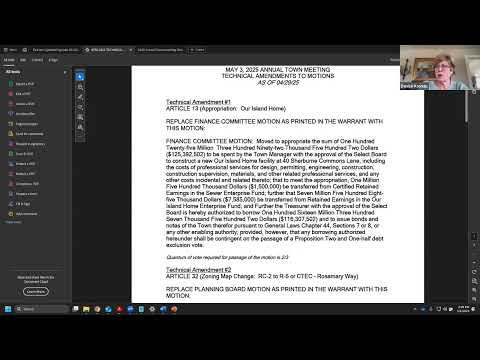
Finance Committee rejects technical amendment raising Island Home supplemental appropriation to $125.39 million
Summary
A proposed technical amendment to Article 13 that would increase the Island Home/Sherburne Commons supplemental appropriation to $125,392,502 failed 5-4 after lengthy discussion about guaranteed maximum price contracts, contingency funding, enterprise retained earnings and cost-per-bed comparisons.
The Nantucket Finance Committee voted 5-4 on May 1 to reject a technical amendment that would have increased Article 13's appropriation for the Island Home/Sherburne Commons project to $125,392,502.
Town staff told the committee the supplemental article reflects construction bids that exceeded earlier estimates and that the total appropriation needed is $125,392,502. Brian, a town staff member presenting the item, told members the committee previously voted on a borrowing authorization of $105,000,000; the supplemental article adds appropriations and funding sources to cover the higher guaranteed maximum price (GMP).
Under the technical amendment staff proposed: transfer $1,500,000 from certified retained earnings in the Sewer Enterprise Fund; use $7,585,000 of retained earnings in the Island Home Enterprise Fund (the presenter said that about $3,085,000 of that is for furniture, fixtures and equipment and that roughly $4.04 and a half million would be used for options on two cottages at the Sherburne Commons site); and carry a $116,307,502 borrowing balance to be issued as bonds and notes contingent on a Proposition 2—2 debt-exclusion vote. The proposed project budget also includes a stated $10,000,000 in contingencies (described in presentation as $5.5 million for general contingency and $4.5 million for tariff or similar callouts).
Committee members pressed staff on when the GMP would be locked; town staff said the contract signing would occur in June and that construction could begin in September. John, a town staff member involved in procurement and project delivery, explained the delivery method and said the GMP becomes firm when the guaranteed maximum price contract is signed. Craig Piper of SMRT, the architect, said site and project comparability is difficult and offered to provide comparative per-bed cost analyses for later meetings. Committee members noted Nantucket's higher construction costs, prevailing-wage requirements for municipal construction, and contingencies that would revert to the town if unused.
Members debated whether to reopen the committee's earlier vote on the original $105 million authorization and discussed parliamentary steps that would affect what voters see at Town Meeting. Several members said the finance committee's rejection of the technical amendment did not themselves prevent the select board or a town meeting motion from offering the higher number to voters; staff and members explained that amending the finance committee motion on the floor of Town Meeting would be possible but would require a majority amendment and a two-thirds vote for the borrowing.
The motion to adopt the new numbers was made by Peter and failed by roll call, 5-4. The committee discussed whether to reopen its prior vote on the $105,000,000 motion but declined to do so before moving on to other agenda items.
Committee members expressed concern about project cost increases, the potential use of retained enterprise earnings, prevailing-wage impacts on cost per bed, and the mechanics of borrowing approval under Proposition 2—2. Staff committed to supply additional comparative data and clarified that unspent allowances and unused contingency funds would revert to the town.