Get Full Government Meeting Transcripts, Videos, & Alerts Forever!
Get email alerts on the School Budget topic
No spam. Unsubscribe anytime.
Molalla River SD 35 budget committee reviews proposed 2025–26 budget; projects small enrollment decline, revenue losses and rising retirement costs
Summary
Budget committee members reviewed the district’s proposed 2025–26 budget, which assumes modest enrollment declines, lower special revenues after federal pandemic aid and state grant expirations, and rising public-employee retirement costs that could increase employer contribution rates in 2027–28.
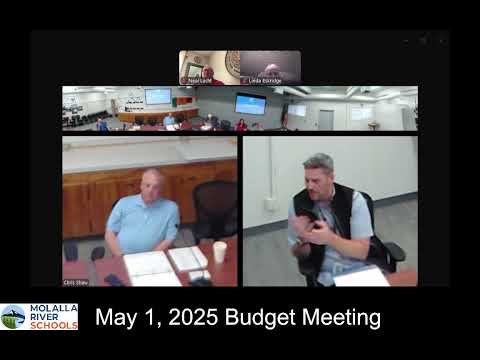
The Molalla River SD 35 budget committee met to review the district’s proposed 2025–26 budget, hear an overview of assumptions and funding changes, and set a path to final adoption later this spring.
District staff presented the proposed budget and told the committee the plan reflects a modest decline in enrollment over the next eight to 10 years, an anticipated drop in special revenue because some pandemic-era and state grants have ended, and higher employer retirement costs that will push long-term contribution rates higher.
The presentation, given by district staff member Andy, described the proposal as “our best shot” while acknowledging it is provisional and will be updated as new state and federal figures arrive. Andy said the district based the 2025–26 plan on the Oregon Department of Education’s March 5, 2025 state school fund estimate and on local property-tax projections. He said the district expects local revenue to total just over $12,100,000 (about a $540,000, or roughly 4 percent, increase) and that special revenue grants are projected to decline from about $4.6 million to $4.3 million, in part because House Bill 3499 and some early-literacy and Title II-A funds have sunsetted.
Committee members heard enrollment projections showing a gradual decline in elementary enrollment over the next several years, with corresponding cohort shifts into middle and high school grades before those cohorts also decline. Staff also said the district’s special-education average daily membership has continued to grow even as total enrollment edges down.
On expenditures, the committee was shown that general-fund payroll and payroll-related costs together exceed $25 million in the proposed budget and that employer retirement costs are increasing. Andy told the committee the district is currently paying roughly 4 percent for the employer “rate” component plus a separate unfunded actuarial liability payment, which together run about 22 percent of payroll now; he warned the committee that when certain relief bonds expire in 2027–28 the employer rate could rise toward about 30 percent, substantially increasing district retirement costs.
The staff forecast also summarized recent debt and fund-balance activity: the district increased its fund balance by about $688,000 in 2022–23, had a roughly $658,000 debt expense in 2023–24, adopted a 2024–25 budget with $1.7 million of debt-to-spend that is now expected to finish the year closer to $986,000, and proposes roughly $600,000 of debt spend in 2025–26. Andy said the board’s policy seeks a 16 percent ending fund balance, while staff presented scenarios showing a 10 percent ending balance as a planning reference.
Committee members asked for clarification about cash position, capital reserve transfers and bond proceeds. Staff confirmed proceeds from a recent property sale and a transfer related to turf/sports-field work will appear in the capital reserve fund (Fund 401) and that some projects (the middle school project funded partly by a state “Awesome Grant” and by bond proceeds) are legally restricted to their designated funds. Andy also explained the district uses Local Government Investment Pool (LGIP) accounts and separate accounting so bond and grant dollars remain distinct from the general fund.
Staff walked the committee through the proposed budget document structure and fund-by-fund pages, calling attention to the general fund (about $42.7 million including beginning fund balance), special revenue schedules, federal funds, student-investment and state grant funds (including Measure 98 and SIA), nutrition program changes tied to the Community Eligibility Provision (CEP), and capital and risk-management funds. The presentation noted that the district does not place permanent positions on temporary grant funding and emphasized an ongoing negotiations process with employee groups.
The committee was given next steps: staff will update the document as new figures arrive; the budget committee is scheduled to consider approval of appropriations at its May 15 meeting and the board budget hearing is scheduled for June 12, when the board will consider adoption. Committee members were invited to submit follow-up questions to Andy and district staff before the next meeting.
The meeting also included routine committee organization: Larry Hampton was elected chair of the budget committee by unanimous voice/hand vote, and Tony Lishka was elected vice chair by unanimous vote.