Get Full Government Meeting Transcripts, Videos, & Alerts Forever!
Get email alerts on the Education Assessments topic
No spam. Unsubscribe anytime.
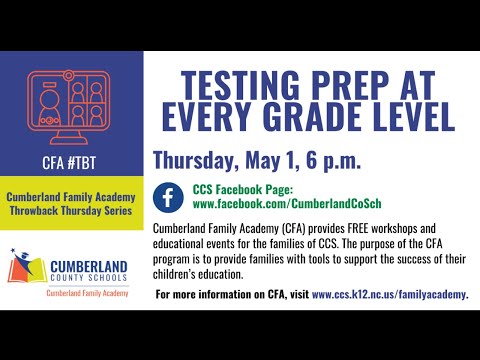
Cumberland County Schools staff explain state tests, scoring, retest options and parent resources
Summary
Cumberland County Schools staff outlined the three types of state-required assessments, scoring rules, accommodations, retest opportunities and where parents can find individual student reports and practice tests.
Cumberland County Schools staff told parents at a recent information session that North Carolina requires three types of state assessments — career and technical education (CTE) post‑assessments, end‑of‑grade (EOG) tests for grades 3–8 and end‑of‑course (EOC) tests for certain high‑school courses — and explained how scores, accommodations and retest options work.
The information matters because test results affect high‑school course grades, individual student records and some statutory programs such as the Read to Achieve law tied to third‑grade reading. Staff also outlined where parents can find individualized student reports and released practice tests on district and state websites.
Kim [last name not provided], a staff member in Cumberland County Schools’ data and accountability office, framed the session by saying, “We’re going to focus on three types of required exams in North Carolina.” Chip [last name not provided], a career and technical education staff member, walked parents through how CTE assessments are structured and scored.
Staff described the assessments and scoring as follows: CTE state assessments are typically 100 multiple‑choice items administered in a district CTE platform (CTE NC Test) and are scaled; Chip said, “If the student makes 70 or higher, they are considered proficient,” and a score of 90 or above indicates mastery. Many CTE courses are assessed via credentialing or performance tasks, but about 32 state‑mandated CTE assessments remain in the statewide program.
High‑school EOCs apply when a student is enrolled in certain courses (biology, English II, NC Math 1 and NC Math 3). Kim explained that typical item counts for those high‑school tests are about 60 items (sometimes up to about 65), that item types can include multiple choice, technology‑enhanced items and constructed responses, and that testing sessions generally run two to three hours with district‑recommended times and a maximum of four hours to accommodate identified needs.
For EOGs (grades 3–8), staff said students take reading and math each year and science in fifth and eighth grades; item counts typically range from about 45 to 65 depending on grade and subject. Kim noted that third‑grade reading ties to the state Read to Achieve legislation: “If [a student] is proficient on that test … it does satisfy that legislation.”
On scoring and reports, Kim described achievement levels used for EOGs and EOCs (level 3 indicates sufficient understanding; level 4, thorough understanding; level 5, comprehensive understanding) and said parents can view an individual student report in the PowerSchool parent portal. That report includes an achievement level, a scale score, a percentile ranking, and Lexile and Quantile measures (reading and math measures), with links to explanations.
Staff addressed accommodations and scheduling. Kim said exceptional children (EC) students or those needing makeup testing may test on dates outside the main window to allow for required modifications; principals manage building‑level logistics for testing environments, and central office teams will advise when calendar adjustments are possible. On proctoring, Kim said the state no longer requires a proctor in every room and districts may use hallway proctors for multiple rooms.
When parents asked about consequences of low scores and refusal to test, staff explained the difference between grade placement and assessment results. For grades 3–8, placement is at the principal’s discretion and a single assessment does not automatically determine promotion. For high school, credits determine grade placement and EOC results count toward course grades; Kim said, “Those exams count 20% of their grade.”
Staff also explained retest opportunities: students who do not reach proficiency on EOGs or EOCs can take a second opportunity to test (generally during teacher work days) after remediation; both the original and retest scores may appear in records. Kim stressed the district sends a letter to parents detailing remediation plans and the second‑opportunity testing schedule, and that parents may opt in or opt out of remediation services.
For parents seeking resources, staff recommended first contacting the child’s teacher for targeted support. Kim pointed parents to the district’s Data and Accountability web pages and the North Carolina Department of Public Instruction family guides and released tests for practice items. She cautioned about relying on undated internet resources: “I would be careful not to just Google how do I help my child with the North Carolina end of course test … because we don't know how old those sites are.”
Staff closed with practical advice for families: maintain normal routines, ensure adequate sleep and a healthy breakfast on test days, avoid scheduling appointments that create makeup testing needs, and support children emotionally about testing but avoid adding last‑minute pressure.
Questions about district scheduling, testing room conditions and supports for students needing extended time were raised by multiple parents and addressed by district staff, who said principals evaluate and, where possible, relocate students or adjust calendars when conditions (for example, HVAC failures) would undermine testing conditions. Central office staff said they will review tutorials and testing resources with principals at an upcoming leadership meeting.
The session did not produce formal actions or policy changes; staff described existing district and state rules and the steps parents and school administrators can take ahead of the testing window.