Lifetime Citizen Portal Access — AI Briefings, Alerts & Unlimited Follows
Mayor proposes $1.3 billion, six-year FEPP levy to expand preschool, childcare, school health and career pathways
Loading...
Summary
The Seattle mayor's office and the Department of Education and Early Learning on May 1 presented a six‑year, $1.3 billion proposal to renew the Families, Education, Preschool and Promise (FEPP) levy, saying the package would expand preschool and childcare, add school‑based health centers and create career pathways including a new Path to Trades program.
The Seattle mayor's office and the Department of Education and Early Learning on May 1 presented a six-year, $1.3 billion proposal to renew the Families, Education, Preschool and Promise (FEPP) levy, saying the package would expand preschool and childcare, add school-based health centers, and create career pathways including a new Path to Trades program.
The proposal, introduced to the City Council Select Committee on Families, Education, Preschool and Promise, would maintain funding categories for early learning, K–12 supports and college‑and‑career readiness while adding new slots, increased subsidies and direct supports for childcare workers. Deputy Mayor Tiffany Washington called the proposal part of an "Every Child Ready" initiative and said the levy represents an "upstream" investment to reduce future costs and harms.
Committee Chair Maritza Rivera said the administration and the Department of Education and Early Learning (DEEL) collaborated on a package that reflects council priorities. Rivera emphasized the local role of the levy and clarified that Seattle Public Schools are a separate, state-funded entity: "This levy is to fund educational needs that are outside of Seattle Public Schools' responsibility, such as childcare, preschool, K through 12 academic support, K through 12 health and safety services, and postsecondary opportunities like the successful Promise program."
What the proposal would fund
According to the presentation, the package is structured into three investment "buckets": Ready to Start (prenatal to age 3, childcare subsidies, childcare worker supports and the Seattle Preschool Program), Ready to Learn (after‑school and summer enrichment, tutoring, mental and physical health supports, and school safety), and Ready to Launch (Seattle Promise, a UW transfer pathway and a new Path to Trades program).
Officials and presenters cited these specific figures in the committee briefing: - Total levy amount: $1.3 billion over six years. - Seattle Preschool Program: add 600 seats for a total of 3,100 annually. - Childcare assistance and subsidies: the proposal adds 800 new childcare slots and would "more than double" available subsidies to families, with the presentation saying a total of 1,400 childcare subsidy slots annually (as described by the presenters). - Childcare workforce supports: direct support proposed for 5,000 childcare workers (retention stipends and related supports). - School health centers: five new school‑based health centers, bringing the presentation total to 34 sites citywide, with telehealth services noted for broader reach. - Expanded after‑school and summer programs: the presentation estimated access for about 19,000 youth annually. - Ready to Launch: an $82.4 million allocation for college and career readiness programs, intended to serve about 1,475 college students annually through Seattle Colleges tuition supports and UW transfer programming.
Officials said the package was developed from multiple years of community engagement, including surveys, focus groups and site visits, and that implementation details and procurement timelines would follow if the council approves sending the levy to the November ballot. Director Dwayne Chappell (Department of Education and Early Learning) said the proposal "carries within it the hopes, concerns, and wisdom of thousands of Seattle families." He and Deputy Mayor Washington said an implementation and evaluation plan would be brought back to the council in early 2026 if voters approve the measure.
Public comment and priorities
More than 20 people provided in‑person and remote public comment. Speakers included nonprofit leaders, Seattle Public Schools staff, health practitioners and parents; the predominant stance among commenters was support for continuing and expanding levy investments. Common themes: - Restorative practices and school climate: multiple commenters asked for explicit, dedicated funding for restorative practices coordinators in schools to reduce exclusionary discipline and support student mental health. Leon Caspi, restorative practices program manager for Seattle Public Schools, told the committee that city funds had enabled placement of coordinators in eight schools and that continued funding was needed to retain those positions. - School‑based health centers: clinicians and pediatricians, including Dr. Cora Bruner of Seattle Children's Hospital, urged sustained funding for school‑based clinics and cited their role in increasing access to medical and behavioral health care for students who otherwise face barriers. - Seattle Promise and postsecondary pathways: Rosie Raimondo, chancellor at Seattle Colleges, described Seattle Promise's growth and use as a pathway to college for first‑generation students and supported continued levy funding for the program. - Childcare and workforce support: providers and childcare center representatives said levy funds are critical to affordable, high‑quality childcare and to retaining early childhood staff; one presenter asked the committee to treat childcare workers as educators and compensate them accordingly. - Path to Trades and career pathways: several council members and commenters supported the proposed Path to Trades program as a way to expand access to middle‑skill union jobs and apprenticeships.
Representative public comments included: Nadia Gutierrez, on behalf of El Centro de la Raza, who said the organization is "in strong support for the FEPP levy proposal of 1,300,000,000.0 investment in Seattle's children, youth, and families." Ted Howard, speaking for the superintendent's office, summarized program goals and described levy impacts on childcare subsidies and workforce retention.
Council response and next steps
Committee members expressed bipartisan support for the broad priorities in the package while reserving detailed budget questions for the implementation plan and budget materials. Committee members asked about procurement, whether existing contracts would be reprocured under a competitive process (DEEL staff said contracts run through mid‑2026 and that a competitive process will follow the implementation plan), and about outreach to families with nontraditional work schedules for childcare services.
Councilmembers also raised operational matters for the implementation plan: the prominence of substance‑use prevention and recovery in school health centers, the logistics of expanding childcare to nontraditional hours, and detailed cost assumptions for each program area. Chair Rivera and DEEL staff said central staff would collect council questions and provide a deeper budget analysis through the formal questions process.
Formal actions
No votes or formal motions were taken at the May 1 meeting. The committee did not send the levy to the ballot at this meeting; councilmembers were briefed and asked to submit questions. The city will pursue a public hearing (scheduled May 12 at 5 p.m., per the committee) and the executive said it intends to bring an implementation and evaluation plan to the council in early 2026 should voters approve the renewal.
Why it matters
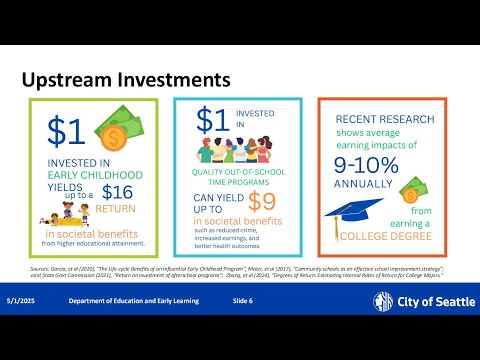
The FEPP levy has been a recurring local funding stream for more than three decades; supporters contend that stable local investments in early childhood, K–12 supports, health services and postsecondary pathways produce long‑term public benefits and reduce future costs in areas such as criminal justice and social services. The proposal's roughly $1.3 billion price tag and six‑year term make it one of the largest local investments in children and families the city has asked voters to consider in recent years.
What to watch next
- The Select Committee's public hearing on May 12 and any written Q&A returned by the executive office and DEEL. - The detailed implementation and procurement timeline that DEEL said it will present if the levy is approved by voters; that plan will specify competitive processes and allocation details for school‑level and community‑based organization awards. - Specific budget breakdowns and clarifications on numbers described in the presentation (for example, the exact mix of childcare subsidy slots, Seattle Preschool Program seats, and the administrative percentage of the levy).
Speakers (excerpt of individuals who commented or presented on the levy)
- Maritza Rivera, Chair, Select Committee on Families, Education, Preschool and Promise (government, Seattle City Council) [first reference: 19.97] - Tiffany Washington, Deputy Mayor, Mayor's Office (government, City of Seattle) [first reference: 2693.55] - Dwayne Chappell, Director, Department of Education and Early Learning (government, DEEL) [first reference: 2701.95] - Jonathan Swift, Chief Financial Officer, DEEL (government, DEEL) [first reference: 2704.755] - Marissa Roussell, Deputy Director of Impact and External Affairs, DEEL (government, DEEL) [first reference: 2704.755] - Nadia Gutierrez, Representative, El Centro de la Raza (nonprofit) [first reference: 178.46] - Daniel Narvaez, Representative, El Centro de la Raza (nonprofit) [first reference: 289.78] - Charice Jones, Director, Homeless School‑Based Health Centers and Clinical Operations, NeighborCare Health (nonprofit/health) [first reference: 381.98] - Sierra Parsons, South Seattle educator and restorative practitioner, Waublock (nonprofit/education) [first reference: 495.16] - Leon Caspi, Restorative Practices Program Manager, Seattle Public Schools (government, Seattle Public Schools) [first reference: 605.125] - Jill Colaserto, Consulting Teacher, Restorative Practices, Seattle Public Schools (government, Seattle Public Schools) [first reference: 766.89] - Katie Scribe Leary, Educator and consultant, Seattle Public Schools restorative team (government, Seattle Public Schools) [first reference: 889.21] - Ted Howard, Representative, Superintendent's Office (government, Seattle Public Schools) [first reference: 1146.935] - Rosie Raimondo, Chancellor, Seattle Colleges (government/education) [first reference: 1279.5851] - Marie Ramirez, Restorative practitioner, Waublock (nonprofit) [first reference: 1442.825] - Olivia Allen, Children's Funding Project (nonprofit) [first reference: 1556.905] - Amanda Griswold, Creative Kids Learning Center (business/nonprofit) [first reference: 1681.39] - Jay Wesley Saint Claire, former chief juvenile court judge (citizen/expert) [first reference: 1755.875] - Marcus Gittens, Levy Oversight Committee member and educator (citizen/nonprofit) [first reference: 1875.52] - Dr. Ernest Jabali Stewart, Co‑founder, Waublock (nonprofit) [first reference: 1972.84] - Christina Black, Levy coordinator, Franklin High School (education) [first reference: 2081.47] - Trish Haggerty, Educator (education) [first reference: 2225.5198] - Dr. Cora Bruner, Professor of Pediatrics and Adolescent Medicine, Seattle Children's Hospital (health) [first reference: 2364.76]
Authorities
[{"type":"policy","name":"Families, Education, Preschool and Promise (FEPP) levy renewal proposal","referenced_by":["fepp-levy-renewal-2025-05-01"]}]
Actions
[]
Discussion vs. decisions
Discussion points: - Expanding preschool and childcare slots and subsidies; - Funding and staffing restorative practices coordinators in schools; - Increasing school‑based health centers and mental health resources; - Creating Path to Trades and supporting Seattle Promise and UW transfer pathways; - Childcare workforce supports, including retention stipends for 5,000 workers.
Directions/assignments: - DEEL and the mayor's office will finalize implementation details and return an implementation and evaluation plan to council in early 2026 if the levy is approved by voters. - Councilmembers were asked to submit questions to central staff (trustee: Jasmine Marwaha) for detailed budget and procurement information.
Decisions: - No formal votes were taken. The committee received the executive presentation and will consider next steps (a public hearing and later ballot action by the full council if they choose to send the measure to voters).
Clarifying details
[{"category":"levy_amount","detail":"Total levy amount described in the presentation","value":1300000000,"units":"USD","approximate":false,"source_speaker":"Tiffany Washington"},{"category":"term","detail":"Levy term described in the presentation","detail":"six years","value":"6","units":"years","approximate":false,"source_speaker":"Tiffany Washington"},{"category":"spps_served","detail":"Number of Seattle Public Schools students referenced as having access to school health services","value":51000,"units":"students","approximate":false,"source_speaker":"Tiffany Washington"},{"category":"spp_seats","detail":"Seattle Preschool Program slots (additional and total as presented)","detail":"add 600 seats for a total of 3,100 annually","source_speaker":"Tiffany Washington"},{"category":"childcare_slots","detail":"New childcare slots and total subsidies as described","detail":"add 800 childcare slots; presentation stated total of 1,400 childcare subsidy slots annually","source_speaker":"Tiffany Washington"},{"category":"childcare_workers","detail":"Childcare worker supports","detail":"direct support for 5,000 childcare workers (retention stipends, etc.)","source_speaker":"Tiffany Washington"},{"category":"school_health_centers","detail":"New school-based health centers","detail":"add 5 centers for a total of 34 sites citywide","source_speaker":"Tiffany Washington"},{"category":"after_school_reach","detail":"After school and summer enrichment reach","detail":"estimated 19,000 youth annually","source_speaker":"Tiffany Washington"},{"category":"ready_to_launch_budget","detail":"Ready to Launch allocation","detail":"$82,400,000 described for college and career programs","value":82400000,"units":"USD","approximate":false,"source_speaker":"Tiffany Washington"}]
Proper names
[{"name":"Seattle","type":"location"},{"name":"El Centro de la Raza","type":"organization"},{"name":"NeighborCare Health","type":"organization"},{"name":"Seattle Public Schools","type":"organization"},{"name":"Seattle Colleges","type":"organization"},{"name":"Seattle Promise","type":"program"},{"name":"Odessa Brown Children's Clinic","type":"organization"},{"name":"Children's Funding Project","type":"organization"},{"name":"Waublock","type":"organization"}]
Community relevance
{"geographies":["Seattle","King County"],"funding_sources":["local property tax levy"],"impact_groups":["children and youth","early childhood educators and childcare workers","families with young children","Seattle Public Schools students"]}
Meeting context
{"engagement_level":{"speakers_count":22,"duration_minutes":113,"items_count":1},"implementation_risk":"medium","history":[{"date":"1990-01-01","note":"City has used families and education levies for more than three decades; speakers referenced 35 years of voter support."}]},