Get Full Government Meeting Transcripts, Videos, & Alerts Forever!
Community advisory group presses EPA, PRPs for more sampling and flood-risk planning at Smurfit Stone site
Summary
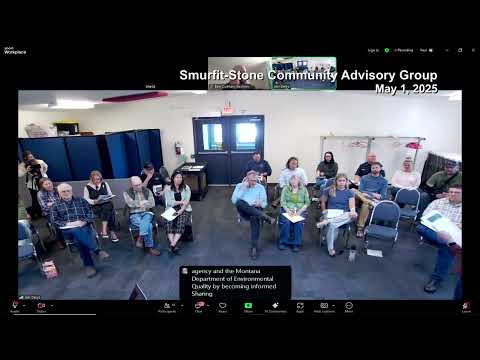
At a Smurfit Stone Community Advisory Group meeting, residents, technical volunteers and agency staff reviewed the site's Superfund remedial-investigation progress, pressed for denser sampling of sludge, groundwater and downstream river sediments, and raised concerns that berms and ponds could erode in large floods and mobilize contamination.
Members of the Smurfit Stone Community Advisory Group (CAG) and federal and state regulators on Monday reviewed recent remedial-investigation work at the former Smurfit Stone mill site and pressed for more sampling of sludge, shallow groundwater and downstream sediments to clarify contaminant pathways and flood-related erosion risks.
CAG administrative member Jen Harrington said the group has advocated for the community to be represented in every step of the Superfund process and urged more protective sampling. "That 1 in 10,000 is an acceptable rate for our community ... to me, that's just unacceptable," Harrington said, referring to comparisons raised in earlier risk discussions.
The meeting focused on three linked concerns: (1) whether current soil and groundwater sampling density is sufficient to map contaminant "hot spots" from historic wastewater operations and dumps; (2) whether the shallow groundwater and historical pond network can transport contaminants to the Clark Fork River; and (3) the stability of berms and ponds in a large flood that could create a new channel and mobilize buried wastes.
The CAG and several technical presenters described the site's long industrial history, noting operations beginning in 1955 and a 54-year industrial era that closed after the owner announced a permanent shutdown in late 2009. Presenters said the site footprint is large (the presentation cited roughly 3,200 acres total, with an industrial core of about 100 acres and roughly 900 acres of former wastewater areas) and that contamination of concern includes dioxins/furans, PCBs and metals.
Bru…
Already have an account? Log in
Subscribe to keep reading
Unlock the rest of this article — and every article on Citizen Portal.
- Unlimited articles
- AI-powered breakdowns of topics, speakers, decisions, and budgets
- Instant alerts when your location has a new meeting
- Follow topics and more locations
- 1,000 AI Insights / month, plus AI Chat