Get Full Government Meeting Transcripts, Videos, & Alerts Forever!
Get email alerts on the Medical Debt topic
No spam. Unsubscribe anytime.
Cleveland program erases roughly $165.2 million in medical debt for city residents using ARPA funds
Summary
City council and nonprofit partner Undue Medical Debt announced the abolition of about $165.2 million in medical bills for Cleveland residents after a city-funded program purchased and erased accounts; council says roughly $1 million in ARPA funds remain unspent.
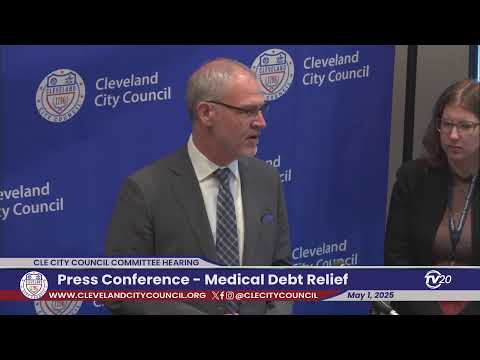
Councilman Chris Harsh and the city of Cleveland announced that a city-backed program with the nonprofit Undue Medical Debt purchased and abolished roughly $165,234,311.18 in medical debt for Cleveland residents, officials said at a council event.
The program used an American Rescue Plan Act allocation to buy medical debt portfolios from hospitals and secondary-market holders and then erase qualifying accounts, officials said. Council members described the project as a way to direct federal pandemic-recovery dollars to individual residents.
Councilman Chris Harsh said the initiative "has been able to relieve $165,234,311.18 of debt for Cleveland residents," and that the work reached Clevelanders specifically while leveraging additional philanthropic funds to erase debt for people outside the city.
The effort was created using an initial ARPA allocation of $1,900,000, Harsh said; the program ultimately cost the city "well under" that figure and left "about over a million dollars remaining" from the initial allocation. Harsh said the city’s ARPA outlay for the program represented roughly "0.2% of Cleveland's ARPA allocation." He also said the program aided 161,481 Cleveland residents (he called that "almost half the population").
Courtney Story, vice president for government initiatives at Undue Medical Debt, described the nonprofit's methods and eligibility rules: the organization purchases debt in bulk from hospitals, health systems and the secondary market, then erases accounts for individuals who meet criteria. "Individuals qualify for relief if they earn up to 400% of the federal poverty level, or if their medical debt exceeds 5% of their annual income," Story said. She added that there is "no application, no red tape, no strings attached" and that notices are sent to affected residents by mail.
Story said Undue's work in Cleveland "has abolished over a hundred and $65,000,000 in medical debt for more than a 60,000 people in Cleveland," and later staff clarified the nonprofit's figure as about 61,000 unique Cleveland residents assisted. In response to differing counts, council and Undue staff noted the numbers are nuanced because relief is applied per account and some individuals received relief in multiple cycles.
City officials and Undue representatives described the program’s distribution method: purchases from the secondary market can be targeted to ZIP codes so funds benefit city residents; purchases directly from hospital systems can include people who sought care in Cleveland but do not live in the city, and Undue said it raises philanthropic funds to cover those nonresident accounts rather than using Cleveland ARPA dollars.
Officials gave additional context on the population helped: Harsh said the median annual income for families assisted was about $54,000 and that the average amount of debt eliminated was "a little over a thousand dollars." He also said two people had more than $250,000 eliminated, and that most accounts were much smaller. Undue said the approach also stops secondary collectors from continuing to pursue or add fees to purchased accounts.
Councilwoman Rebecca Moore, a former consumer-law attorney, discussed the limits of local authority in regulating hospital billing and called for federal and state action on surprise billing and transparency. "That has to be regulated at the federal level," Moore said, adding that state preemption limits what the city can do on pricing and billing rules.
Council members said they plan to determine how to reallocate the remaining ARPA funds from the original $1.9 million appropriation. Harsh and other council members described the project as a model for using federal recovery dollars to help residents directly and said they might revisit similar efforts in the future.
Officials encouraged residents who receive notices to share their stories; Story said notices began arriving in mailboxes the prior week and include a QR code to provide testimony.