Get Full Government Meeting Transcripts, Videos, & Alerts Forever!
Get email alerts on the Community Violence Intervention topic
No spam. Unsubscribe anytime.
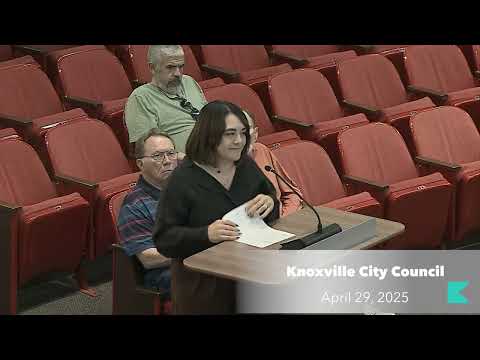
Council delays vote on contract with outside violence‑reduction contractor after community opposition
Summary
Knoxville City Council postponed consideration of a proposed contract extension with the National Institute for Criminal Justice Reform to manage street outreach and violence‑reduction services, following public opposition from local providers and a request for broader community engagement and accountability reporting.
The Knoxville City Council postponed consideration of a proposed contract that would have extended and expanded the role of the National Institute for Criminal Justice Reform (NICJR) in managing community violence intervention work in the city.
The resolution, as introduced by the administration, would have authorized up to $519,750 for new implementation services over a limited period and brought the total contract value with NICJR to an amount not to exceed $826,800. The administration described the proposed scope as an expansion of NICJR—s prior technical assistance to include direct hiring and near‑term management of outreach workers while the city builds local capacity.
Supporters and some service providers said NICJR brings national expertise and continuity. "I have always been impressed with their expertise, their knowledge," said Candice Allen, who described working with NICJR on training and management. Denise Jackson, a volunteer mediator, said NICJR "can provide the needed training for local organizations" and warned a lapse in activity could harm momentum.
But local outreach leaders and several public commenters urged the council to pause and strengthen a locally led approach. "You have the opportunity not to end the work, but to strengthen it, to keep the approach rooted in the city," said Denzel Grant, a local outreach leader, who urged the council to vote against the resolution. Vivian Scheid and Rashad Woods also told the council that local groups already active in the streets should receive direct funding and that a long contract with an outside organization risks sidelining trusted local partners.
Administration officials, including Director Middlebrook of the Office of Community Safety and Empowerment, said NICJR has worked with the city for about 18 to 24 months providing training, coaching and technical assistance and that the expanded contract was designed to reinitiate outreach quickly for the summer while building local managerial capacity. "This would be expanding that initial scope, to allow for a limited period of time, for them to provide oversight of and implementation of outreach work and so, hiring, and directly managing outreach partners," Director Middlebrook said.
Council members raised multiple concerns: some urged immediate reinstatement of outreach work ahead of summer; others demanded more community engagement, clearer reporting and limits on contract length. Councilwoman Singh moved to postpone the vote to allow a community meeting; that motion and subsequent amendments resulted in a council decision to postpone the resolution for two weeks. Several members asked the administration to schedule a public workshop during the pause and to provide clearer reporting and milestones; administration officials agreed to make every effort to convene NICJR and community partners for an informational meeting before the next council session.
What was in the proposed contract: the resolution text presented to council authorized NICJR to provide oversight, technical assistance, training on group violence‑reduction strategies, and to manage outreach teams for a limited period. The draft scope referenced a term of up to 12 months in order to allow time for capacity building and a future competitive procurement process. The administration said funds would be spent locally on staff and program costs, and that NICJR—s role was intended to be transitional.
Outcome: Council postponed the item for two weeks and asked for a community meeting/workshop during the interim. Council members also discussed requiring status reports and setting a date for a future council decision on whether to continue or replace the contract.