Get Full Government Meeting Transcripts, Videos, & Alerts Forever!
Get email alerts on the Housing Zoning Duplexes topic
No spam. Unsubscribe anytime.
Council approves change to one‑year plan allowing duplexes inside neighborhoods after heated debate
Summary
The Knoxville City Council voted to approve an amended 2025 one‑year plan that removes location restrictions that had limited where duplexes may be built in the city.
The Knoxville City Council voted to approve an amended 2025 one‑year plan that removes location restrictions that had limited where duplexes may be built in the city.
Supporters said the change would expand housing options and help address local affordability issues; opponents said the move risks altering neighborhood character and reducing owner‑occupied single‑family housing.
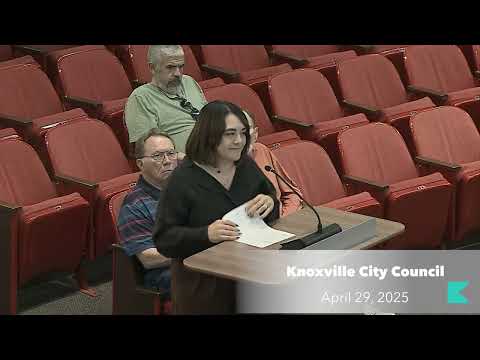
Proponents framed the vote as a modest, necessary step to increase housing supply. "Approving the one year plan without the duplex location requirements would be a great first step toward that," said Maria Mikhail, who spoke to the council representing the East Tennessee Realtors. Drew Harper, vice president of YES Knoxville, told the council, "This proposed one year plan is a modest but meaningful step towards solving a real problem."
Speakers who opposed the amendment said allowing duplexes inside neighborhood interiors would enable conversions or investor purchases that could reduce opportunities for single‑family ownership. "My concern is that you're gonna be taking property away that could become single family, owner owned houses," said Lee Hume, president of the West Hills Community Association.
Council discussion focused on design standards and whether the change should proceed only if conversion standards are in place. "The change that council took advantage of or adopted in the amendment last time was to make sure there's design standards for conversions," said Councilman Roberto, who described the standards as requirements such as windows, porches and entrances that keep new or converted duplexes oriented to the street. Director Brooks, speaking for the Planning Department, said the city had processed about 55 special‑use cases for duplexes over the past five years, roughly 10 to 11 per year.
Council members stressed different priorities in the debate: some urged immediate action to expand housing choices and property rights; others called for a more comprehensive, deliberate planning process that would address scale, affordability and neighborhood impacts. "We're actually giving property rights back to property owners," said Councilwoman Singh. Councilwoman Parker said she was "concerned about scale" and asked whether the dimensional standards used for missing‑middle zones could be applied citywide.
On roll call, the vote was four in favor and four opposed; Mayor Kincannon cast the tie‑breaking vote in favor and the ordinance passed on second reading. The ordinance text says the effective date is tied to the design standards amendment; council members and staff noted the planning commission would consider design standards on May 8. The council recorded no further amendments at second reading.
What happens next: the change removes the location filter in code that had limited duplexes to certain streets and edges of neighborhoods and makes conversions and new two‑family buildings more broadly eligible under existing zoning processes and setbacks. Director Brooks confirmed the same front, rear and side setback table (Table 4.42) applies to single‑family and two‑family dwellings in RN1 and RN2 districts. The planning commission will next take up the design standards staff and council referenced; implementation and any future regulatory changes would follow those standards.
Supporters and opponents asked staff and council to continue community engagement as the city applies design standards and processes to new applications.