Get Full Government Meeting Transcripts, Videos, & Alerts Forever!
Get email alerts on the Arts Grants topic
No spam. Unsubscribe anytime.
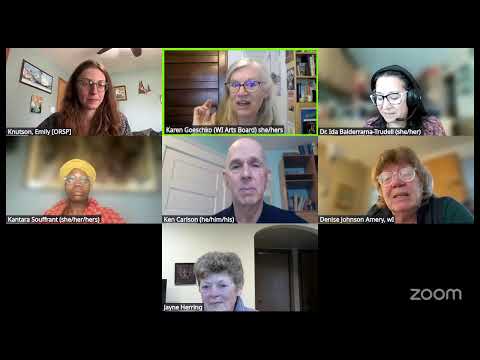
Wisconsin Arts Board review panel sets recommended funding floor after daylong grant evaluations
Summary
A Wisconsin Arts Board grant review panel spent the afternoon evaluating roughly 30 grant applications, identifying strengths and frequent concerns across proposals and agreeing on a recommended funding floor (average score 86) to send to the WAB board for final approval next Friday.
A Wisconsin Arts Board grant review panel spent the afternoon evaluating about 30 applications for arts project grants and agreed to send a slate of recommendations to the Board for final action next Friday, panelists and staff said. After discussion and scoring, the reviewers agreed on a recommended funding floor at an average score of 86 and instructed staff to present the ranked recommendations to the full Board for its vote.
The panelists said the group reviewed a wide range of projects: public concert series and collaborative radio programming in Milwaukee; museum workshops for Spanish‑speaking audiences in Manitowoc; youth and disability‑focused theater programs in Fort Atkinson; multiple public‑art mural proposals; community arts festivals; survivor‑focused fashion and healing projects; and several residencies and mentorship programs, including a statewide professional dance mentorship. Funding requests commonly amounted to $3,000–$6,000 for single projects; several larger, multi‑year initiatives sought more support.
Panelists said they most often praised proposals that directly compensated artists, articulated measurable evaluation plans, documented community partnerships and showed evidence the applicant had addressed comments from the first phase of review. "I liked that the money was going strictly to the artist fees," said Ida, panelist, during the Radio Milwaukee discussion. Several panelists highlighted projects that paired artist fees with clear outreach plans, including Radio Milwaukee’s collaborative concert series and Sun Prairie’s multi‑site mural initiative.
Repeated weaknesses across applications included missing or unclear letters of support, thin evaluation plans, lightly described outreach and recruitment strategies for target communities, and gaps in planning for logistics such as inclement weather or the timeline for artist recruitment. "I would have liked to see letters of support — that would have strengthened things for me," Ken, panelist, said during discussion of several museum and community projects.
Panelists also flagged safety and capacity issues for projects serving vulnerable people. The Serania Studios Arts Foundation proposal, which targets survivors of domestic violence and human trafficking, prompted multiple reviewers to ask for clearer evidence of trauma‑informed staffing and trained evaluators before the panel would comfortably recommend support. Several reviewers said such details should be explicit in applications that work with trauma‑exposed participants.
Accessibility was another recurring topic. Panelists discussed American Sign Language interpretation, sensory access and other accommodations as central to reaching underserved audiences rather than as a separate checklist. "Our interpreters are paid at $500 per interpreter per show," Ida, panelist, said while summarizing a local presenter’s practice and reminding reviewers that costs and lead time for interpreters are real budget items. Reviewers encouraged applicants to weave access planning into project narratives and partnerships, not just list it in a standalone section.
A few technical questions came up about proposed evaluation methods: one mural festival planned to use a commercial location‑analytics service (Placer.ai), which raised panelist questions about accuracy versus direct survey methods. Panelists also pressed applicants on timelines and budget assumptions — for example, whether international performers’ travel and visa costs were fully covered — and asked for details about artist biographies and community recruitment when those items were missing.
After rounds of discussion, the panel compared final scores and identified a natural break in rankings; members agreed to set a recommended funding floor at an average score of 86 and to forward the ranked recommendations and supporting notes to Board staff. "We will present your recommendations at the Board meeting next Friday," Jane, staff member, said. The Board will take the formal vote; staff expect to notify applicants the Monday and Tuesday after the Board meeting.
The panelists praised the variety of projects and said the day’s critiques were aimed at strengthening proposals, not penalizing them. Several reviewers suggested procedural changes for future cycles: require a clear letter of support or equivalent evidence of local partnership, ask applicants to call out how phase‑2 materials respond to phase‑1 comments, and embed accessibility planning in the main project narrative.
Panelists and staff said they will provide the Board with the ranked list, the panel’s notes and the suggested funding floor; final awards depend on the Board vote and the available appropriation.