Get Full Government Meeting Transcripts, Videos, & Alerts Forever!
Get email alerts on the Municipal Budget topic
No spam. Unsubscribe anytime.
Sierra Vista council reviews FY26 personnel, capital and maintenance priorities; members warn street repairs remain underfunded
Summary
City staff presented a draft fiscal year 2026 budget overview including personnel reclassifications, capital carryovers and grant-funded projects; council members raised concerns that proposed street-maintenance funding is insufficient and asked staff to return with balanced numbers before the tentative budget is released.
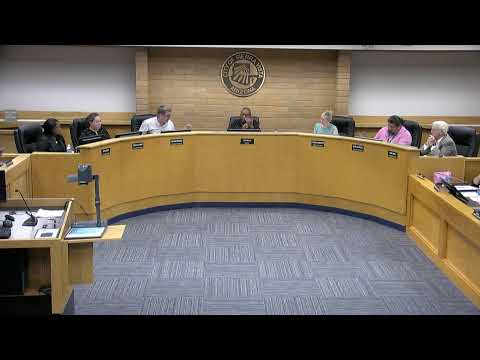
City staff presented a draft fiscal year 2026 budget overview at a Sierra Vista City Council working session that detailed personnel reclassifications and promotions, a list of capital carryovers and new project requests, and grant-funded items — while council members repeatedly flagged street-maintenance funding as inadequate.
Harrell, a city staff member presenting the strategic-plan status, said the council was ready to move forward with adoption of the updated strategic plan but noted only minor edits from the prior draft. Jen, the budget presenter, then reviewed initial FY26 projections for the general fund, operations and maintenance (O&M), personnel and capital lists, and cautioned that the numbers will change as departments finalize requests.
The nut of the session was the FY26 budget snapshot. Staff reported a current general-fund projection showing a gap of about $687,000 at this stage; citywide personnel and enterprise fund totals were presented as estimates and described as likely to change during the budgeting process. Jen said the city’s current total FY26 personnel estimate across funds is approximately $47,303,000 and noted general-fund personnel accounted for about $37,000,092 of that figure. Staff also said FY26 includes a 2% step increase for full- and part-time employees effective July 2025.
Council members and staff discussed several personnel reclassifications recommended by human resources. Examples presented included converting a community-service officer position to a supervisor, reclassifying a recreation coordinator to program supervisor (about a $14,000 annual differential), a payroll coordinator to HR analyst (about $10,000), and a refuse-worker promotion to a refuse technician (about $9,706 differential). Staff described these as promotional reclassifications rather than net new headcount.
On capital projects, staff walked through the general-fund capital list and enterprise requests. Notable items included replacement or upgrades for aging emergency generators and UPS systems at fire and police facilities; evidence-parking lot expansion for the police department with paving, fencing and cameras to reduce contamination risk; carryover fire apparatus (one expected delivery in February 2026) and a separate replacement request for a 2005 pumper; and a list of IT, facilities and park projects. Staff said fire-truck procurement typically takes about 18 months to two years.
Parks and recreation items drew extended discussion. Staff said preliminary estimates to reconstruct the Lynn Roberts splash pad are about $100,000 after earlier, higher cost uncertainty. Roadrunner Park phase 1 design and construction were discussed as having total-phase estimates substantially higher (the concept estimate during earlier phases was around $9 million for a full phase 1), with staff seeking to leverage a Land and Water Conservation Fund match to expand a current $1.75 million city placeholder into a roughly $3 million project. Councilmembers asked staff to prioritize which capital matches to hold for grants versus spending locally.
Members asked questions about other enterprise fund capital requests: transit carryovers and bus-stop ADA upgrades, paratransit scheduling software to replace an Excel-based manual booking system (the paratransit service handles roughly 50–75 trips per day), refuse equipment requests including new roll-off containers and a compost turner that is frequently down, and airport pavement rehabilitation proposals that reference a January 2022 ADOT pavement-management report (presented PCI estimates in the mid-60s).
A recurring theme was streets funding. Several council members warned that the proposed $1.5 million for annual street maintenance is “woefully short” of need. Staff outlined other sources augmenting street work — capital improvement funds, one-time HEERF carryovers and a pending grant application for Buffalo Soldier Trail reconstruction — but acknowledged the bulk of augmentation is targeted to large reconstruction projects rather than routine maintenance. Staff said HEERF carryover amounts include roughly $2.2 million for Fry/North Garden and about $1.8 million carryover for BST reconstruction, while MLK carryover estimates were reported near $223,000.
On community facilities, staff recommended a dedicated puppy room at the animal shelter (quotes around $200,000 were mentioned), and said the project was being recommended for the budget after prior promises to the council. Staff also presented a list of vehicle replacements and highlighted items that will be removed from inventory.
Council direction and next steps were procedural: staff will continue department-level meetings, refine O&M and personnel numbers, and provide a balanced general-fund presentation and a complete tentative budget book before Memorial Day weekend. No formal budget votes were taken at the working session.
Ending: The council is scheduled to review the balanced general-fund numbers at an upcoming meeting; staff said they expect to deliver the complete tentative budget book before Memorial Day weekend and will return with updated, balanced figures for council consideration.