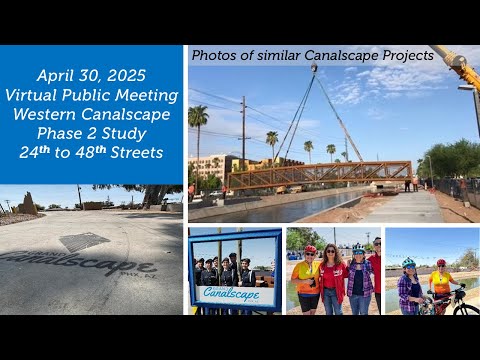
Phoenix seeks community input on Western CanalScape Phase 2 trail, bridge and lighting options
Loading...
Summary
City of Phoenix staff and Salt River Project presented conceptual designs for Western CanalScape Phase 2 between 20 Fourth Street and 40 Eighth Street and invited public feedback on path width, a new pedestrian bridge, amenities, lighting and funding; community members pressed for safety, emergency access and outreach details.
City of Phoenix project staff and Salt River Project officials described conceptual designs for the Western CanalScape Phase 2 corridor — between 20 Fourth Street and 40 Eighth Street — and asked residents for input on path width, bridge location, lighting and amenities in a virtual public meeting. The team said an online survey launched at the meeting and is open through May 18 to collect community preferences for features such as path width, bridge siting, seating, shade and public art.
The presentation stressed that the study is in the predesign, alternatives stage and that community input now can shape final concepts. "This meeting is for the community to help us determine the amenities that we are trying to figure out," said Andy Granger, Assistant Street Transportation Director. Brandy Rourke, City of Phoenix project manager, described the study as a continuation of Phase 1 work and said the project team will look for funding for design and construction after the study phase concludes.
Why it matters: staff said the canalscape provides a recreation route and connections to neighborhoods, jobs, schools and transit and supports the city's climate and active-transportation goals. The presentation said the canal improvements align with a city climate action target to develop recreational trails along the majority of canal banks by midcentury.
Key options presented include two canal-path widths — up to 10 feet or up to 12 feet — and two candidate locations for a single new pedestrian bridge. The project team described option A as offering a balance of seating and fitness stations and option B as offering roughly twice the seating with fewer fitness stations. "A 12 foot path ... will provide more comfort and room to share space with all canal users," the presentation said, noting the Grand CanalScape used a 10-foot path.
The team said proposed amenities being studied include concrete path surfacing, pedestrian lighting, seating, fitness/stretch stations, structural shade, bike racks, pet-waste stations and public art. Brandy Rourke said lighting and trash/pet stations "are part of the study phase right now to include those." Andy Granger said the planned lighting is LED and from a permanent power source and that solar lighting can be evaluated but may be less reliable and more maintenance-intensive.
Salt River Project (SRP) staff noted maintenance constraints along the canal. "SRP uses a 20 foot minimum usable bank width ... to maintain it," Brian Mutschler, Salt River Project Field Consulting Services, said; the presentation said SRP requires the 20-foot usable bank for operations and that lighting and other amenities would be located outside that 20-foot band so SRP can maintain access.
Funding and timeline: the team said SRP aesthetic funds traditionally pay the majority of canalscape costs and that the city typically contributes a smaller portion. The presentation estimated SRP has historically funded about 80% of similar projects and said the study should conclude by the end of the calendar year, with a second public meeting planned for fall 2025 and a completed project report anticipated by the end of 2025. Final design and construction would follow pending funding and bid results.
Connectivity and crossings: several residents pressed the team about safe crossings at busy streets and over I-10. The project team said they evaluated grade-separated crossings (bridges or underpasses) but found them cost-prohibitive and instead plan to install HAWK pedestrian signals at street crossings to improve safety. The team also noted that Tempe is planning a pedestrian bridge over I-10 as part of the Broadway Curve work and that Tempe is looking to connect its western canal improvements to that new bridge.
Safety, access and operations: residents raised concerns about homeless encampments, motorized vehicles, and emergency access. Andy Granger said concrete paths of 10 to 12 feet would allow access when emergency vehicles require it. Brian Mutschler said SRP patrols the canal area with contract security and that the north bank is reserved for SRP operations; he said SRP's north-side access roads are not intended for public recreational use. Questions about policing, homeless outreach and maintenance were referred to Phoenix CARES and city responders for follow-up.
Property impacts and easements: staff said the study is in its early stage and that no homes are anticipated to be displaced. "We don't anticipate taking any property from backyards as part of this project," Granger said, and the team said any necessary easements would be identified during final design and are expected to be minimal.
Resident concerns and follow-up: commenters asked about equestrian use, cooling pavement, glare into backyards from lighting, electric-bike rules and whether fencing adjacent to private property would be replaced. Project staff said equestrian signage and options would be followed up on, cooling-surface technologies could be evaluated, lighting would be pedestrian-scale LED directed at the path to limit intrusion, and that fencing improvements are typically the responsibility of adjacent property owners and not an anticipated construction scope item. Marielle Brown, Active Transportation Principal Planner, said Phoenix CAN connector projects are being vetted and staff will coordinate connections where feasible.
How to give input: the team encouraged residents to complete the online survey at phoenix.gov/streets/westerncanal2, use the project hotline, or submit comments through the project website. The meeting was recorded and will be posted on the project web page.
No formal actions were taken at the meeting; the session was for public engagement in the study phase and for staff to record preferences and questions for later consideration.