Get Full Government Meeting Transcripts, Videos, & Alerts Forever!
Get email alerts on the Urban Forest Policy topic
No spam. Unsubscribe anytime.
Atlanta officials, residents debate draft update to city's tree protection ordinance
Summary
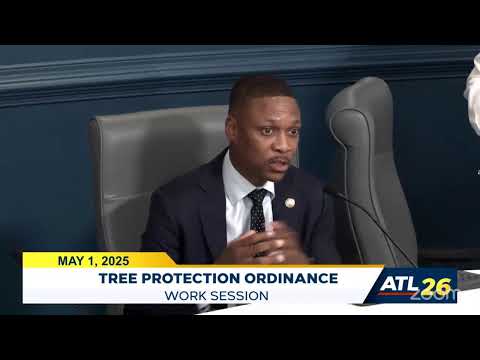
Commissioner Janae Prince of the Department of City Planning presented proposed changes to Ordinance 24-01691 and revisions to Chapter 158 at a City of Atlanta work session, asking the council and the public to review a draft meant to help the city reach a 50% tree canopy goal.
Commissioner Janae Prince of the Department of City Planning presented proposed changes to Ordinance 24-01691 and revisions to Chapter 158 of the City Code at a City of Atlanta work session, asking the council and the public to review a draft intended to help the city meet a 50% tree canopy goal. "We are here to discuss ordinance 24 dash o dash 16 91, which is an important and timely update to the city of Atlanta's tree protection ordinance," Prince said.
The proposal would expand preservation standards beyond single-family lots to commercial, multifamily and mixed-use properties; ban clear-cutting of lots; increase recompense (the fee paid when trees are removed) and fines for illegal tree removal; create incentives for stream-buffer restoration; add staffing for implementation; and establish a professional registration program for tree professionals. Prince told the council Atlanta's current canopy measures about 46.5% and that "we're not gonna hit the 50% canopy goal without having preservation on our commercial lots."
Why this matters: The ordinance aims to slow canopy loss linked to redevelopment and increase on-the-ground tree preservation and replanting at a time Atlanta is pursuing a stated citywide canopy target of 50%. Supporters said stricter preservation will protect public health, reduce urban heat island effects and improve stormwater management; builders and some housing advocates warned higher fees and tighter preservation could increase development costs and slow housing production.
Key elements presented by planning staff
- Scope and goals: The draft would extend preservation requirements to commercial and multifamily sites (staff said single-family lots today hold roughly 76% of the city's canopy while other parcels comprise about 24%). Priority trees (large native trees) would receive special protection and new planting standards would be used on a trees-per-acre basis rather than only on DBH inches per acre. David Zaporinik, identified as the city's arboricultural manager, led the technical walkthrough of preservation and planting tables.
- Planting and replacement: For non-fully forested commercial sites staff proposed a new baseline of 20 trees per acre for planting credits; for many plantings the city would credit developers 1.25 times for planted trees rather than accepting only monetary recompense.
- Fully forested sites and stream buffers: Staff said fully forested sites (defined in the presentation as sites with roughly 80% canopy or about 1,000 DBH inches per acre) are rare ("only 250 sites that are 5 acres or more" out of roughly 70,000 parcels) and would face higher preservation minima. The presentation also described restoring stream buffers and applying both state and city buffer protections (staff said the state requires a 25-foot buffer and the city's proposed buffer would add another 50 feet, totaling 75 feet).
- Recompense and enforcement: Planning staff proposed raising the per-tree recompense and ramping up fines because the existing formula (described in the presentation as $100 per tree plus $30 per inch) does not cover the city's higher costs to plant in constrained urban locations. Staff also proposed a Tree Trust Fund continuing at $200,000 per year (from a phase adopted in December 2022), and said administration of a low-income senior assistance program would be awarded to a 501(c)(3).
- Implementation capacity: Staff withdrew an earlier proposal for 20 new Tree Trust Fund positions and said the current proposal asks for 12.5 positions to implement the ordinance. They also described a professional registration program for arborists and related professionals; registration would be free and renewed yearly, and registrants would attest they read and would comply with the ordinance.
Public comment and stakeholder positions
Speakers at the session represented tree advocates, neighborhood groups, builders and housing nonprofits; 22 people were registered to speak. Longtime resident Carol Holiday said the ordinance is a public-health priority and urged proportional cost relief for truly affordable housing projects. "A cost break for affordable housing projects addressing a critical need makes sense, but the cost break should be proportional to the number of affordable housing units offered," Holiday said.
Affordable-housing advocates asked for broad recompense relief. Kristen Allen, policy co-chair for House ATL, summarized a March letter from the coalition and said House ATL supports a recompense increase but continues to request a 100% recompense waiver for affordable housing and retention of a maximum recompense to preserve predictability for lower-income developers.
Builders and developer representatives said the draft could raise costs and reduce housing supply. Kevin Norton, senior vice president of land development for Empire Communities, said, "If codes are too restrictive, they can slow or even stop development," and urged more project testing and design evaluation before adoption. Home builder Jim Sheeks told the council, "This ordinance does not balance tree preservation with housing," while also noting his company builds lower-cost for-sale housing in many parts of the city.
Tree advocates and conservation commissioners pressed for stronger protections. Chet Tisdale, a member of the Tree Conservation Commission and an environmental lawyer, praised the preservation standard in the draft and urged the council to "end clear cutting" and adopt the ordinance to halt rapid canopy loss.
Specific implementation questions raised in public comment
- Cost and timing for compliance: House ATL and other advocates requested predictable maximum recompense levels and a clear, administrable trigger for affordability waivers; some builders and nonprofit developers warned that higher recompense without a capped maximum would destabilize project budgets.
- Tree Trust Fund spending: Commenters asked for limits on using trust-fund money for staff salaries and for clarity that money should prioritize planting and preservation rather than administrative overhead.
- Appeals and transparency: Several speakers requested clearer appeal procedures for permits, and sought public notice or on-site posting so neighbors can verify legal tree removals.
- Stream buffer protection: Engineers and environmental speakers urged that stream buffers receive strong protections and that incentives not be the only mechanism for preserving streamside forest patches.
Council questions and next steps
Council members asked planning staff to ensure the TPO aligns with the zoning rewrite (zoning 2) and with existing buildable-area rules so homeowners and developers know what they can legally build. Council member Amos Overstreet asked how the draft would help low-income seniors; staff responded the proposal includes a $200,000 annual program to support hazardous-tree removal for qualifying seniors, administered through a nonprofit.
Staff said they will perform design testing to evaluate how the TPO interacts with current zoning and the zoning rewrite and expect to release a revised draft for review; no vote was taken at the work session. Planning staff and the council president said substitutes and further revisions will return to the Community Development/Human Services Committee for continued public hearings and comment.
Ending note: The meeting produced no formal council action; it was a staff presentation followed by extended public comment and council questions. Staff emphasized implementation challenges, including enforcement capacity, coordination with zoning code changes and the need for clear, administrable rules that balance tree preservation, stream protection and affordable housing goals.